Topic Background

Ajiu
Crypto Newbie
3h ago
🍽️ Hungry Addicts - The Ultimate Airdrop
$100 Million in $DUST is waiting for you!
Open food packs and claim your meal.
The more food you collect, the bigger the rewards.
6 Food NFTs to collect:
🌭 Export Dog | 🍿 Farm Corn | 🍣 Raw Liquid | 🍰 Liquid Slice | 🧼 Export Pill | 🥫 Struggle Meal
1 food = Small Portion
Collect all 6 food items = The Ultimate Feast
📸 Snapshot: April 13, 2026
How to participate:
🔁 Like, share, and reply
🌐 - Open food packs and claim your share
Don't miss out on over $100,000 in $DUST rewards before TGE begins!
Complete your meal and claim your $DUST feast! 💀


48

366

48



Silly Grandpa Talks Crypto
Crypto Newbie
19h ago
Magic (Treasure) Core Advantages:
1. Cross-Game Economic Hub: Arbitrum's leading GameFi ecosystem native token, a universal currency for 12+ blockchain games, connecting NFTs/trading/governance, forming a strong ecosystem barrier.
2. Deflationary + Scarcity Design: Total supply of approximately 350 million, halving issuance + transaction fee burning, long-term deflationary, anti-inflation.
3. Low Fees, High Speed, and Security: Based on Arbitrum, fast transactions, low fees, PoS + DAO governance, moderate to high decentralization.
4. GameFi + DeFi Integration: Staking rewards, NFT lending, on-chain governance, a win-win situation for players/developers/holders.
In short: Magic is Arbitrum's strongest GameFi ecosystem token, with a cross-game deflationary model + low fees and high speed, a rare and high-quality asset in the GameFi sector.
36
321
31

zhao
Crypto Newbie
1d ago
As the official partner of Olympus eSports,
LeviX has officially entered the global eSports arena.
🔥 The journey begins now.
The core asset of the LeviX ecosystem—HONO NFT—is now officially launched.
In its early stages, HONO NFT will remain non-transferable until the token is officially issued to ensure that the incentive mechanism is aligned with the long-term development of the ecosystem.
HONO's design is inspired by the Olympic flame,
aiming to become a super IP connecting Web2 eSports and Web3 finance.
This is more than just an NFT.
It's your gateway to the next generation of AI-driven eSports economy.
⚔️ The game has begun.
42
376
37


Annie Lian
Crypto Newbie
1d ago
Why Blockchain Games Are “Dead”: 12 Key Truths
Aligned with @calilyliu's views.
I will share my perspective based on my experience as a venture capitalist and former chairman of the Korea Esports Industry Association.
I have also discussed these points on my other platforms.
Posts👇
1/ Playability Must Come Before Profitability
Blockchain games fail because they prioritize tokens over gameplay. Players will reject clunky interfaces and pay-to-win mechanics disguised as innovation.
Games must be fun even without economic incentives, otherwise they are just Ponzi schemes in visual guise.
Sustainable Web3 games require an engaging cycle first. Blockchain should enhance ownership, not replace design. Fun is non-negotiable. Everything else is speculation disguised as entertainment.
2/ GameFi's Fatal Flaw: An Unsustainable Dual Economy
GameFi promised to provide games and DeFi, but ultimately delivered a hyperinflationary token-consuming mechanism. When revenue depends on new players rather than actual utility, collapse is inevitable.
Sustainable models require real value: functional NFTs, tokens pegged to governance or content, and revenue from actual gameplay experiences.
If rewards and spending are unbalanced, all "play games to earn money" becomes "praying to earn money."
3/ Web2's Dilemmas Cannot Be Transformed into Web3 Success
Studios that fail in traditional gaming often see blockchain as a rescue measure, not a transformation.
Web3 requires deeper community engagement, transparent token economic models, and iterative co-creation.
The idea that NFTs can solve poor design or low retention is unrealistic. Success requires rethinking distribution, ownership, and player autonomy from the outset, not adding wallets to an already collapsing cycle.
4/ Native Web3 AAA Games: Built-in Blockchain, Not Add-on
True Web3 AAA games must be built with a decentralized architecture from the start. Dynamic NFTs, on-chain logic, and player-owned economies all require fundamental design.
Studios that abruptly switch to blockchain during development often see it as a monetization strategy rather than a transformation tool. This creates friction: high gas fees can disrupt gameplay. Custodial wallets can erode ownership.
Only teams designed to address the limitations of Web3 can deliver a seamless, scalable experience.
5/ Sustainability is not optional, it's a matter of survival.
Short-term hype kills projects. Sustainable blockchain games require long-term token velocity management, diversified revenue streams, and community-aligned incentive mechanisms.
Develop post-airdrop user retention plans and the ability to handle bear markets. If your model only works in a bull market with unlimited liquidity, you're building a casino, not a game. Sustainability requires a sound economic strategy, not just viral marketing.
6/ Airdrops and Free Rewards: The Illusion of Engagement
Free tokens attract mercenaries, not players. Airdropped farmers immediately sell their rewards, causing token value to plummet and disrupting economic stability.
This creates a vicious cycle: the need for more rewards leads to further asset devaluation. Sustainable growth stems from organic community building and rewards tied to genuine contributions.
If user acquisition relies on free funding, you're building a liability, not a player base.
7/ Lack of Leadership Kills Technological Ambition
Many Web3 game projects fail because teams lack game expertise, blockchain knowledge, or both. Founders treat tokens as funding tools, leading to misaligned incentive mechanisms.
Even exceptional technology struggles without experienced producers, economists, and community leaders. Leadership must balance vision with execution, decentralization with decisive governance. Poor management renders innovation meaningless.
8/ Ecosystem Gap: Lack of Infrastructure Hinders Scalability
Blockchain games lack mature tools, distribution channels, and interoperability standards. Players face fragmented wallets, high gas fees, and poor user experiences.
Developers struggle with limited SDKs and cross-chain complexity. Mass adoption remains a distant prospect without robust infrastructure such as a scalable L2 security layer, unified identity authentication, and seamless fiat currency access. Building an ecosystem is no easy feat. But this is the cornerstone of sustainable growth.
9/ Overemphasis on Investment, Not Experience: Core Misalignment
When players focus on asset trading rather than the game itself, the gaming experience falls apart. Games designed around trading attract traders, not true players. This causes economic volatility, where fun takes a backseat, and ROI becomes the key.
True engagement stems from compelling stories, skill-based progression, and social interaction. Blockchain should enable deeper, more immersive experiences through ownership, not reduce games to financial dashboards.
10/ Regulatory Ambiguity: The Hidden Killer
Ambiguous securities classifications, conflicting jurisdictions, and compliance costs stifle innovation. Project teams hesitate to implement robust token economic models due to concerns about enforcement. Players face uncertainty regarding asset ownership and taxation.
Without a clear regulatory framework or proactive policy engagement, mainstream applications will stagnate. Sustainable Web3 games require legal foresight, not just technological superiority. Ignoring compliance is not rebellion, but recklessness.
11/ The Lack of Practicality in Token Economics: Empty Promises
Many projects issue tokens with unclear future uses, which ultimately fail to materialize. If tokens are used solely for speculation or lack effective governance, demand will vanish.
Sustainable models link tokens to real-world value: for example, as materials for production, entry qualifications, content rewards, or revenue sharing.
Practicality must be immediate, easily understood, and integrated into the core cycle. Otherwise...Tokens are like digital ribbons—colorful, but worthless.
12/ Community and Customers: Misinterpreting the Essence of Web3
Web3 promises player ownership, but many studios treat communities as marketing channels rather than co-creators. True decentralization means shared control over the roadmap, revenue, and governance.
Projects that listen to users, iterate based on feedback, and empower players build loyalty that withstands market cycles.
Those who extract value without giving anything in return will breed resentment. In Web3, your community is not your audience, but your stakeholders. Please respect this.
46
344
38



TheCryptoBasic
Crypto Newbie
03-21 10:20
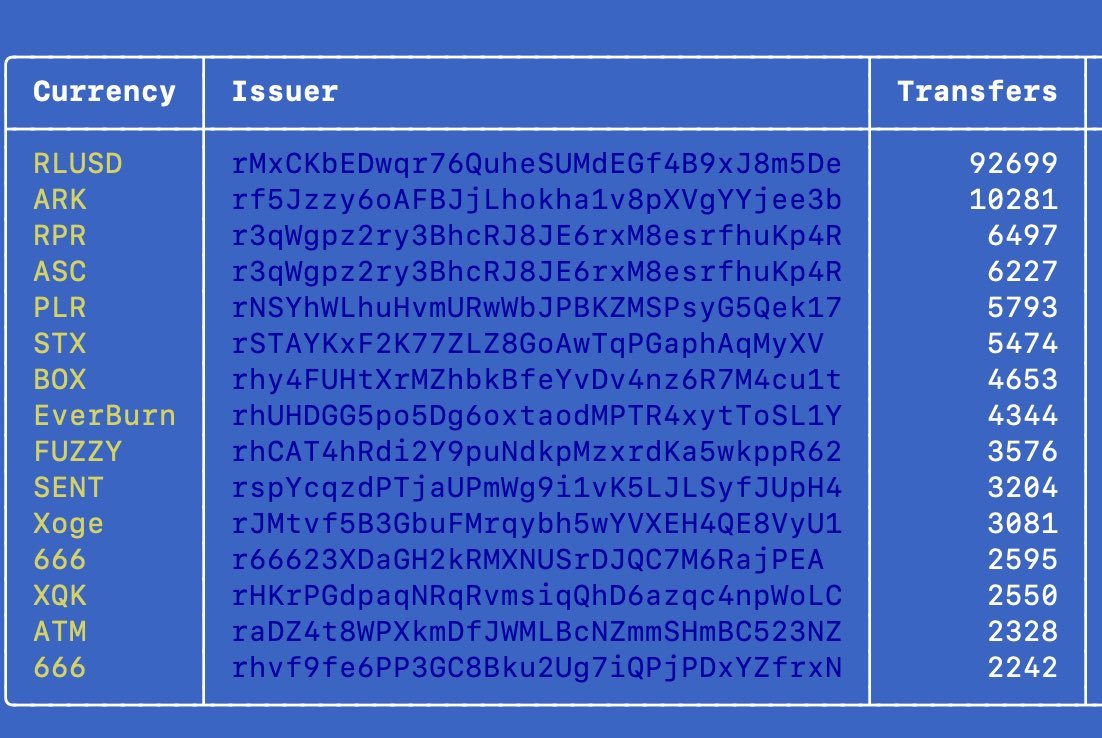
Vet highlighted that analysis of the past 5,000 XRP blocks showed that payment transactions accounted for 53% of over 1 million transactions.
OfferCreate transactions followed closely behind, accounting for 34.2% (371,895 transactions), driven by strong liquidity demand and high transaction activity.
Meanwhile, approximately 32% of liquidity-related transactions failed due to competition and timing issues.
Furthermore, network NFT activity surged, with NFTokenBurn transactions reaching 65,369 (6.0%), primarily due to the large-scale burning following the SBI EXCO 2025 NFT event.
Analysis confirmed that RLUSD saw 92,699 transactions, making it the most actively used token by a significant margin.
43
328
33

DANNY-OF-WEB3 🧸✨
Crypto Newbie
03-21 01:55
Here are four compelling reasons why you should follow @pacifica_fi.
Feel free to use this information.
1/4} A 🧵
What is Pacifica? Pacifica is a Solana-based decentralized perpetual futures exchange (perp DEX) dedicated to providing speed and user experience comparable to centralized exchanges (CEXs) in the DeFi space.
1) Total Funding? Pacifica is entirely self-funded, with no venture capital investment, and has maintained organic growth since January 2025.
2) The Team Behind Pacifica?
Pacifica's core team brings together expertise from the world's leading cryptocurrency exchanges and protocols (Binance, FTX, Coinbase, NFTperp), top financial institutions (Jane Street, Fidelity), and AI pioneers (OpenAI, DeepMind, ByteDance), and boasts academic backgrounds from MIT, Stanford, NUS, and other top universities.
Sources?
3) Why Should You Follow Pacifica? > Ranked #7 in 24-hour trading volume.
> Trading volume exceeded $21 billion in four weeks.
> Open interest reached $100 million.
> Daily trading volume hit a record high: $1.7 billion.
> Strong and experienced team.
> Top 5 Penp DEX, leading on the Solan platform.
Source?
4) How to open a position?
> Visit
> Connect your Phantom wallet.
> Deposit USDC and start trading.
> I've generated nearly $1 million in trading volume and am working towards more. I've also earned some points for generating trading volume.
> Pacifica points are designed to recognize those who contribute to Pacifica's success.
> Every Thursday, Pacifica users receive 500,000 points.
Honestly, you're still young to sign up and start trading/generating trading volume. Please like and share this so more people can see it.
>Previous post.
1)
2)
34
345
24