


数字货币空投的基本概念、参与方式和获得潜在收益的机会,撸毛党集中营在这里🙌
Topic Background

DANNY-OF-WEB3 🧸✨
Crypto Newbie
3h ago
If you're looking for something to click on.
Then you should definitely check out @ConcreteXYZ, this is my next recommended project.
How to locate it?
> Visit
> Use code → fa931ae1
> Connect your wallet.
> Connect all available social media accounts.
> Complete tasks.
> Earn points (coins), the more coins you have, the more airdrops you get.
> Check in daily for extra rewards.
> Click to link accounts and connect your social media accounts.
Good luck!
> Previous post.


48

460

34


ChainSeeking You 🔥
Binance
18h ago
I've created an AI skill using Nansen data to automatically publish content on Binance Square.
Binance Square offers a plethora of "social mining," "trading rewards," and "project airdrops."
All you need to do is automatically publish "high-quality content."
Then you'll see users flock to follow you.
⬇️ New AI Skill—Fully Automated Nansen On-Chain Research Report Publishing Open Claw Skill.
With just a few simple configuration steps, it automatically crawls smart money trends and hot sectors on Nansen daily, writes highly-rated research reports, and publishes them to Binance Square with a single click.
npx skills add 0xcii/nansen-binance-publisher
Claw hub:
@nansen_ai @binance
24
486
21

andrew chen
Crypto Newbie
19h ago
Web 1.0 introduced new channels:
- Email, search, link sharing, etc.
Web 2.0 also introduced new channels:
- News feeds, creators, viral marketing, etc.
Mobile:
- App stores, SMS invitations, vertical videos, mobile ads
So what about artificial intelligence? I've always complained that AI hasn't brought about much substantial change. But we're now seeing a huge growth channel opening up: products built as APIs/CLIs can be instantly integrated into new projects by tools like Codex/Claude.
Perhaps a "native AI hotel app" doesn't refer to a mobile booking app with an AI chat panel, but rather a CLI that helps you book hotels, which AI agents can integrate into custom answers, projects, or code. Simply adding an AI chat panel is a weak form of this generation of AI. Perhaps the real innovation lies in being agent-first, not human-first.
Once you start looking at AI this way, many existing products suddenly seem poorly designed. They were designed as destinations, but agents don't need destinations; they need functionality. Composable, callable, and reliable functionality. Therefore, the way we interact in the future will no longer be "go to Expedia" or "open the app," but rather: agents will build workflows on the fly. It will invoke flight search tools, hotel booking tools, weather models, and even charts of your personal preferences. These aren't complete products in the traditional sense; they're more like endpoints with features and states.
This completely revolutionizes the distribution model. In the past, you won by capturing market share, such as through search engine optimization, app store rankings, and homepage traffic. But in the agent's world, you win by becoming the default callable primitive. This primitive will repeatedly appear in the agent's generated plans because it's effective, has a clean interface, and structured output. The distribution model has shifted from the "top of the funnel" to the "top of the call stack."
Even more surprisingly, this could actually drastically reduce product size. The best products might resemble well-designed, concise, and efficient command-line interfaces (CLIs) with clear default settings, rather than bloated user interfaces. This is almost like an early version of the Stripe API, but applicable to all situations. Imagine what it would look like if every vertical had a "strip-level" basic element that agents could prioritize for use? There's also a peculiar brand reversal here. In the past, humans chose brands; now, intelligent agents will choose brands. Therefore, brands become machine-readable to some extent. Reliability, latency, error rate, pattern clarity. You can almost imagine "agent SEO," where ranking factors are the success rate of thousands of agent runs, or how easily your tool integrates into the thought chain execution loop.
This also foreshadows a new kind of moat. It's not just about data or network effects, but deep integration with the agent ecosystem. If tools like Claude, Codex, or OpenClaw find your tool to be the safest way to accomplish X, it will be embedded in prompts, templates, and possibly even fine-tuned. You will become the default option. And historically, default options have been extremely sticky.
Another perspective argues that most current "AI features" are merely locally optimal solutions. Chat panels, co-pilots, assistants—they are just transitional. The true final state may be closer to an invisible infrastructure coordinated by intelligent agents. The user interface is merely a debugging layer, allowing humans to peek into the operation of intelligent agents.
Therefore, the new growth channels for artificial intelligence can perhaps be summarized as follows:
- Callability
- Composability
- Reliable operation at scale in agent loops
- Embeddability in agent templates and workflows
- Becoming the default primitive for specific domains
If this is indeed the case, then the key question for any new product will no longer be "What is the user interface?" or "What is the killer feature?", but rather "What are the most basic functionalities?"
41
368
22

Token Terminal 📊
链上数据
19h ago
@gradypb of Sequoia Capital stated that record system software companies are relatively unaffected by artificial intelligence, but companies building interaction systems on top of these systems face challenges:
“The first wave of migration from on-premises to the cloud was primarily focused on record systems—such as Workday, Salesforce, and ServiceNow.”
“The second layer on top of that is the interaction system. A record system may have a core database, but many different workflow applications run on top of it.”
“I think with the arrival of the AI software wave, we will see a third layer emerge.”
“This layer handles the actual work. It deploys various agents. These agents may or may not need the underlying workflows, but they definitely need access to everything within the record system.”
Therefore, I think these record system companies are relatively safe. They may not take on many new workloads, as these workloads may flow to AI-native companies. But overall, I think they are quite safe.
I think some workflow-based companies in the middle are in a difficult position because they are neither record systems nor the deployed agent capabilities. So, they must find a way to become some kind of agent tool to handle whatever tasks need to be completed.
35
394
31
ChainSeeking You 🔥
Binance
21h ago
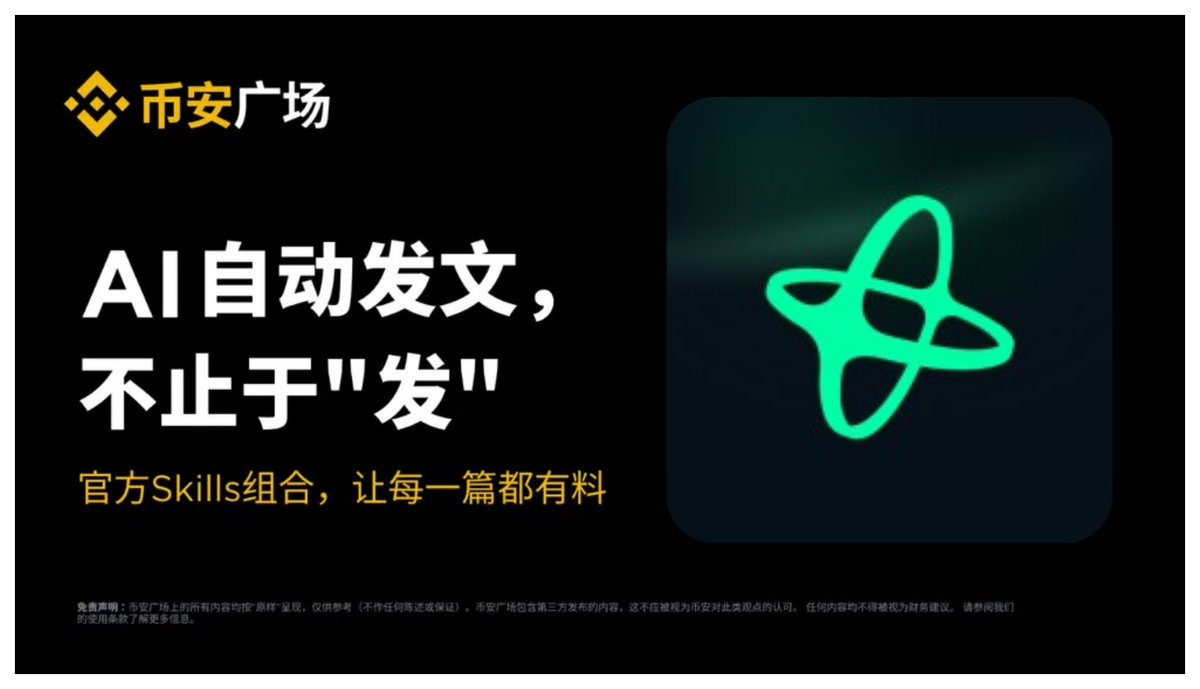
I've created an AI skill using Nansen data to automatically publish content on Binance Square.
Binance Square offers a plethora of "social mining," "trading rewards," and "project airdrops."
You simply need to automatically publish "high-quality content."
Then you'll see users flock to follow you.
⬇️ New AI Skill—Fully Automated Nansen On-Chain Research Report Publishing Open Claw Skill.
With just a few simple configuration steps, it automatically scrapes smart money trends and hot sectors on Nansen daily, writes highly-rated research reports, and publishes them to Binance Square with a single click.
npx skills add 0xcii/nansen-binance-publisher
Claw hub:
@nansen_ai @binance
skills:
46
459
20

zhao
Crypto Newbie
22h ago
🪂 NOCtura Airdrop Event is Now Live! 🪂
A $3,400,000 reward pool is now available - accumulate points and claim your rewards!
How to Participate: Connect your Solana wallet →
Go to the pre-sale page
Open your user control panel
Click "Points"
Earn Points Quickly:
• Daily Check-in → +2 points (7 consecutive days = +20 | 30 consecutive days = +100 | 90 consecutive days = +500)
• Social Tasks: Verify your Twitter/X account +50 points • Join a Telegram group +50 points • Join a Discord server +50 points
• Follow @NOC_tura_ for extra points: Likes +15 points, Retweets +15 points, Quotes +25 points
• Purchase NOC → Earn 3 points for every $1 spent
• Invite Friends → Earn 1 point for every $1 a friend you invite spends Don't miss out! First come, first served!
Start Stocking Up Now →
Who will be number one? Tag your friends!
#Airdrop #SolanaGem #Pre-sale #Privacy #SolanaBuilders #Giveaway #NOCtura
39
422
31

OKX Chinese
OKX
1d ago
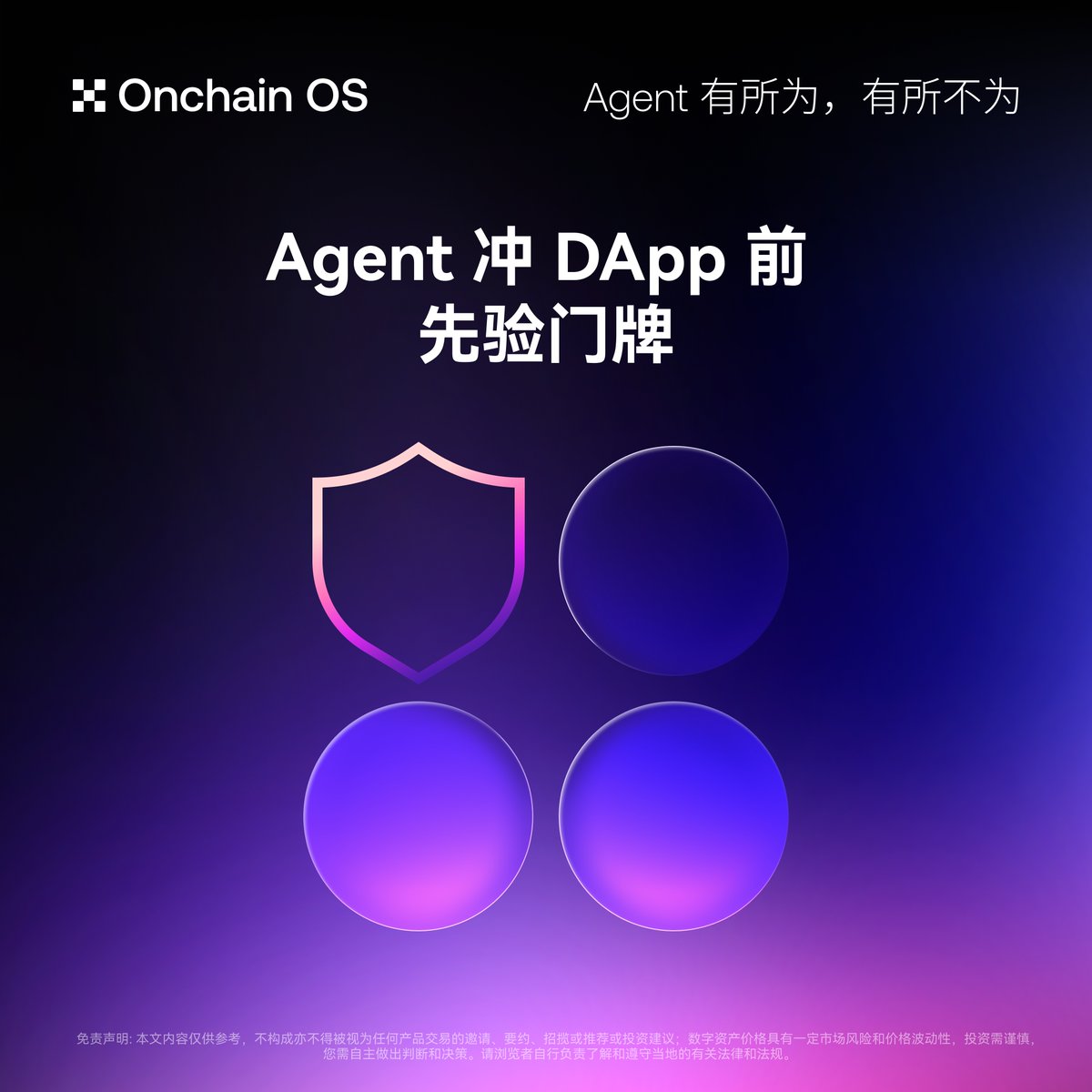
The agent automatically connects you to DApps for interaction, but fake domains differ by only one letter ⚠️
Onchain OS Security Skill automatically blocks 👇
◼️ Before the agent accesses the DApp, it compares the domains against the phishing domain database in real time.
◼️ Full coverage of phishing sites and new domains with zero latency.
◼️ Access is not allowed, so there's no question of theft.
The agent knows what to do and what not to do 🦞
45
400
34

David
Crypto Newbie
1d ago
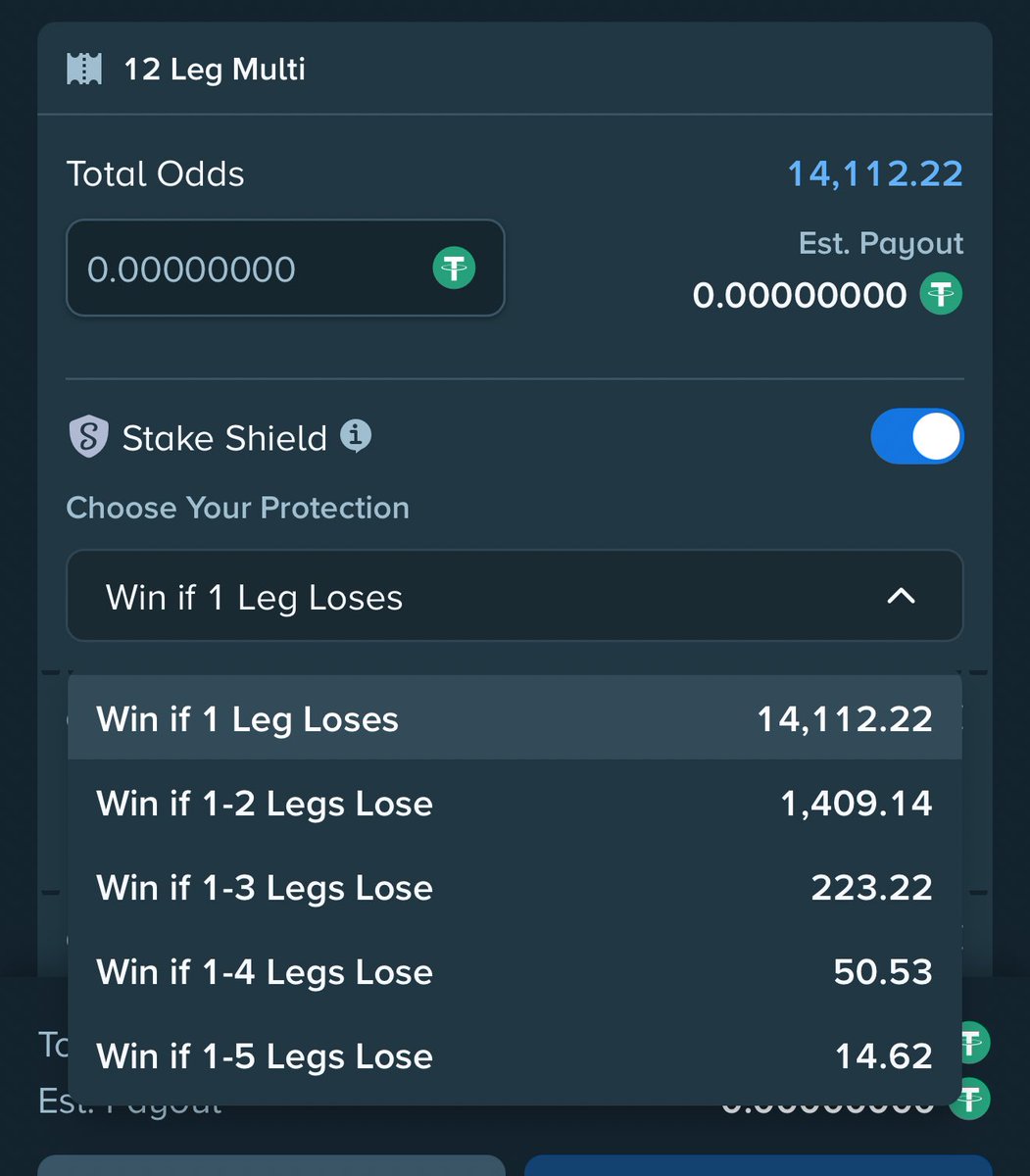
12/12
4/4
4/4
4/4
For higher winning potential, please use the betting limit protection feature 🛡️ (Flexible Betting) 🔥
Register an account using the following methods
Use the welcome code "banks" to receive weekly airdrops and rewards
Get the iOS app via the link
Bet responsibly 🔞🔞
33
398
26

BNB Chain
Binance
1d ago
AI agents can generate outputs and respond to prompts.
But can they reliably transact? Can they get the work done? Are they trustworthy in moments of value crisis?
This is the current gap: not a lack of capability, but a lack of infrastructure.
Each team in this space is tackling different challenges.
@virtuals_io → Agent-to-agent transactions
@I3_Cubed → Model access and monetization
@honeycombchain → Agent identity and interaction
@flapdotsh → Verifiable AI decision-making
Different angles, but the same direction.
Take @virtuals_io as an example.
They are building a business layer where agents can hire each other, locking funds in a third-party escrow account, only paying out after the work is verified.
It sounds simple, but it solves a real problem. Agents can respond, just not yet accountable.
@I3_Cubed is working on building a model marketplace.
Instead of relying on one or two large models, they've focused on building a marketplace comprised of numerous smaller models.
These models are more accessible, pay-per-use, and can be combined into workflows based on tasks.
This transforms models from tools into assets.
@honeycombchain brings agents closer to users.
Agents on their platform aren't anonymous; they possess identities, reputations, and wallets. They can publish content, interact, trade, and even be bought and sold.
This fundamentally changes your perception of agents.
@flapdotsh addresses the trust issue.
If AI makes decisions involving the flow of funds, those decisions cannot be made unknowingly.
Therefore, they've built an AI oracle that records its output on-chain with proof, making it visible and verifiable.
Overall, you'll find that all of this ultimately points in the same direction:
One layer handles transactions.
One layer handles execution.
One layer handles interaction.
One layer handles trust.
Individuals are useful individually; combined, they form a larger whole. The problem isn't that intelligent agents can't do things.
It's that they can't yet operate reliably within the system.
Generating output is not the same as completing work and proving its value, nor receiving compensation for it.
This is the underlying architecture currently being built.
The frequent appearance of the BNB chain has its reasons.
Agents don't just perform one operation.
They continuously perform tiny operations, over and over again, but this only works if transaction fees remain low and throughput remains high. Otherwise, the user experience collapses.
What's interesting is how all of this is connected.
The agent economy isn't built on a single product. It only truly comes together when these components begin to work together.
When agents can discover, execute, and transact.
30
420
43

Solana
Crypto Newbie
1d ago
P-Token has just launched on the testnet and may be the most underrated upgrade to Solana this year.
For non-technical readers:
All token operations on Solana, including swaps, transfers, and minting, run through a core program called SPL Token.
P-Token replaces it with a version that reduces computational costs by up to 98%.
What this means for you:
▫️ Token transfers reduced from approximately 4,645 CU to approximately 76 CU
▫️ Approximately 12% of the network's block space freed up
▫️ Reduced priority fees for swaps, DeFi transaction flows, and any interaction involving large amounts of tokens
With the mainnet expected to launch around April, Solana is rapidly evolving before our eyes.
39
353
31