Topic Background

Flower
Crypto Newbie
1h ago
I liquidated a large portion of my stocks, leaving only a core position in CRCL. With the ongoing conflict and the risk of black swan events, it's wise to avoid trouble. Liquidating my holdings is a safer strategy; I'll wait for a chance to recover losses.
As for cryptocurrencies, I liquidated them a long time ago. I've been focusing on stocks recently; I'll deal with cryptocurrencies later in the second half of the year.


40

486

33


DeFi miner 🔶 BNB
Binance
1h ago
I recently came across a supposedly most stable investment strategy: Harry Brown's "Perpetual Portfolio," which divides funds into four equal parts:
25% Stocks: Capture economic growth (e.g., S&P 500 or Asia-Pacific broad market)
25% Gold: Heal against inflation and geopolitical instability (the recent safe-haven star)
25% Long-Term Bonds: Protect against deflation and economic recession
25% Cash/Short-Term Bonds: Cope with liquidity crises and maintain purchasing power
Every year, sell the stocks that have risen the most and buy the stocks that have fallen the most, returning to the 25/25/25/25 ratio.
It's said that with this portfolio, there have only been four instances of losses due to extreme circumstances over several decades, with a long-term annualized return of over 8% 🤔🤔🤔
While this is significantly lower than the 30% monthly return claimed by the previous "investment genius,"
it still seems quite reliable. When I have money, I plan to use this strategy for retirement 😌
43
389
22



[email protected]
Crypto Newbie
3h ago
There were no major macroeconomic data releases this week. The only significant macroeconomic event is the approaching one-month anniversary of the US-Israel attacks on Iran, raising questions about how the tensions will develop.
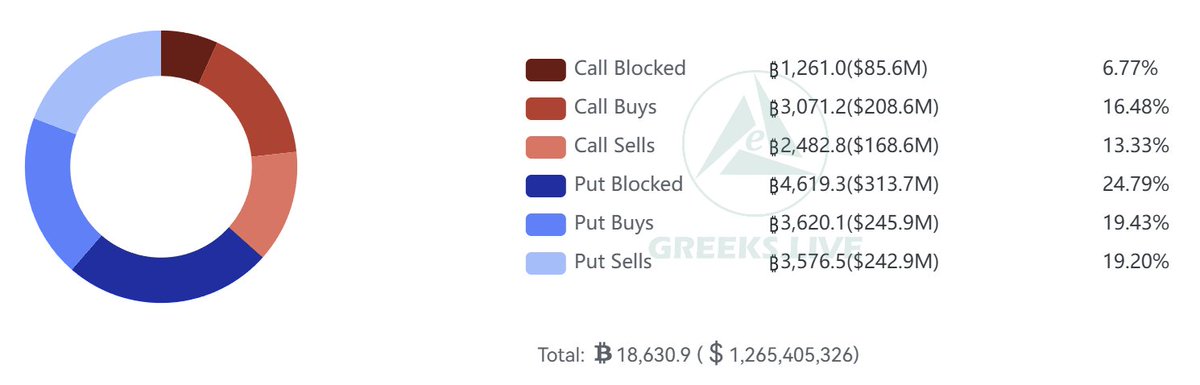
US stocks have performed poorly this week, with major stocks and indices experiencing significant declines. Cryptocurrency was also affected and dragged down, effectively breaking below $70,000. Implied volatility for options across all major maturities is rising, while skew has declined across the board, indicating market concerns about a potential escalation of the crisis.
Put options accounted for nearly 70% of trading volume, a high percentage typically seen only during periods of market panic and widespread concern among large investors about downside risk.
48
356
39

benmo.eth
Crypto Newbie
4h ago
Coinbase has also launched US stock trading, further blurring the lines between old and new in crypto finance. While Robinhood continues to dominate the crypto market, Coinbase is now turning the tables and encroaching on the stock market. This US stock listing, initially appearing in the Asian derivatives market, is accompanied by an unprecedented trading event from Coinbase: [details omitted]. Simultaneously, USDC margin trading offers a 3.5% APY.
![Coinbase has also launched US stock trading, further blurring the lines between old and new in crypto finance. While Robinhood continues to dominate the crypto market, Coinbase is now turning the tables and encroaching on the stock market. This US stock listing, initially appearing in the Asian derivatives market, is accompanied by an unprecedented trading event from Coinbase: [details omitted]. Simultaneously, USDC margin trading offers a 3.5% APY.](http://img.528btc.com.cn/pro/2026-03-23/img/17742440564746c14b6a9bx5c75a3a947h4xb42hb23cj.jpg)
30
449
20


BATTLE
Crypto Newbie
8h ago
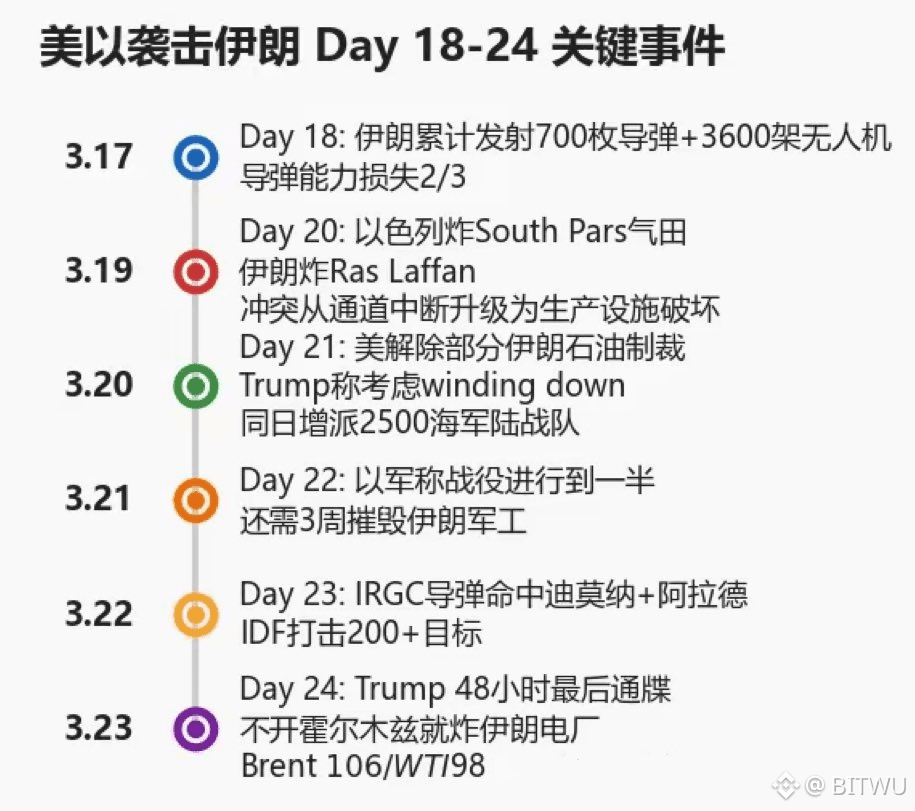
Trump issued a 48-hour ultimatum, clearly a ploy to appeal to voters in the midterm elections; $100 worth of oil equals political suicide.
Meanwhile, Iran is becoming increasingly defiant. They've realized the US government has no credibility, and ceasefire agreements are utterly useless; they've attacked again in less than a year.
Therefore, Iran is determined this time. Forget negotiations; they want the US to pay the price—first, end the petrodollar!
Iran is attempting to drive up energy prices to precisely target the $60 trillion US stock market, which is heavily shorting oil, thereby severely damaging US wealth and credit.
Currently, stocks account for nearly 40% of US household net worth, far higher than the 10% during the 1990 energy shock.
If the stock market continues to slump, consumer spending could be 1.5-1.8 percentage points lower than currently projected, equivalent to a reduction of over 1% in real GDP.
So, is Trump really willing to risk a stock market crash by bombing power plants?
Stop it, Trump! Tacos aren't shameful! If the fighting continues, Putin next door will recover.
48
397
34

Bluechip
Crypto Newbie
8h ago
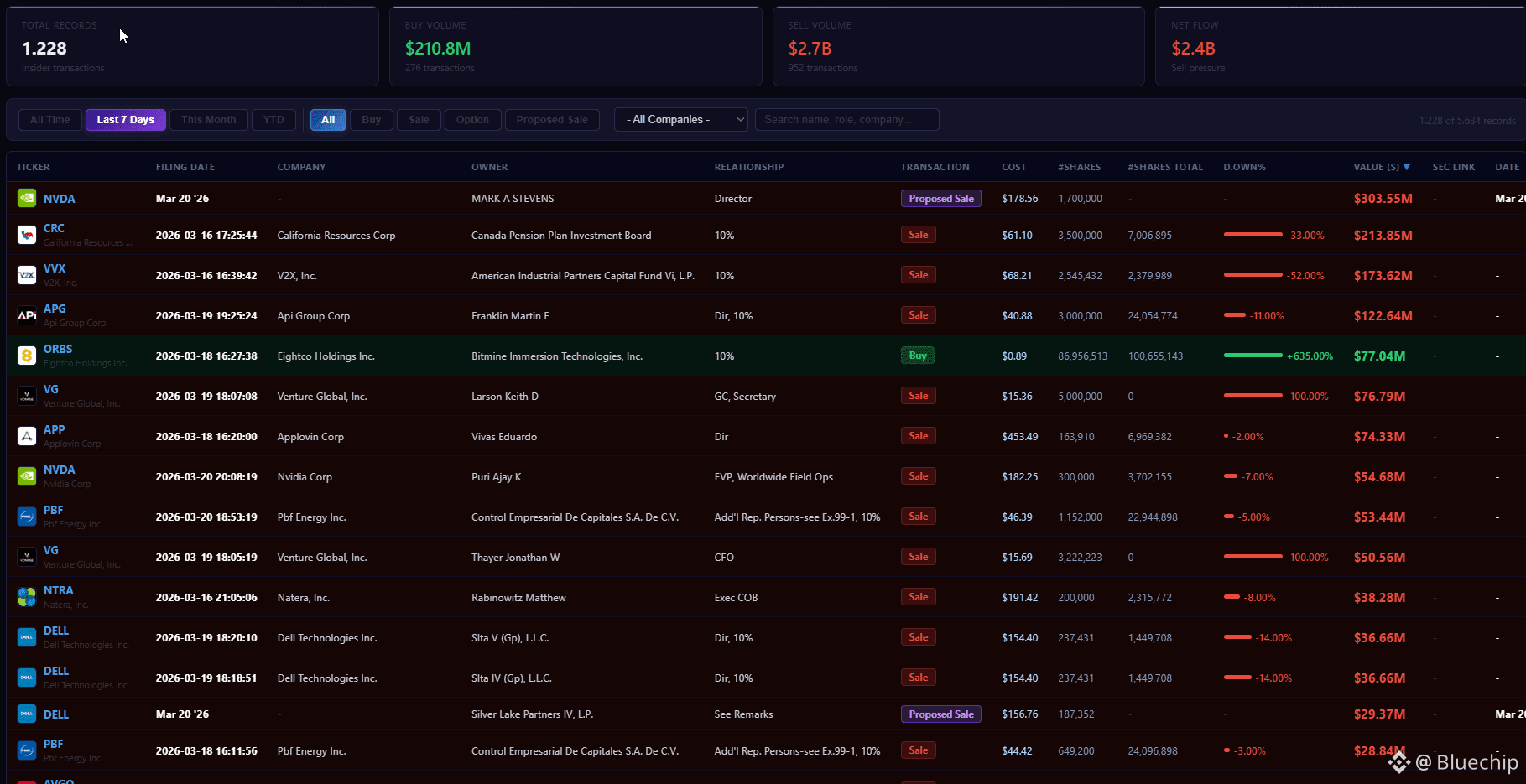
Insider selling has reached its highest level since 2021.
Thousands of sell orders have flooded the market in just the past few days.
Executives, founders, and insiders are selling shares on a massive scale.
This isn't market noise; it's position sizing.
This also helps explain the S&P 500's weak performance in March.
According to filings with the U.S. Securities and Exchange Commission (SEC) in the first 20 days of March:
• Total insider trades: 4,372
• Buy volume: $2.3 billion, totaling 1,020 trades
• Sell volume: $21.4 billion, totaling 3,352 trades
• Net cash flow: $19.1 billion, facing selling pressure
This is highly unusual.
When those closest to a company start actively selling shares, it usually means one thing:
They've seen information the market hasn't fully digested.
Now, here's the interesting part that most people overlook:
Almost every time we see this behavior, the luxury goods market follows suit. Yachts. Watches. Private assets.
Liquidity doesn't disappear; it just rotates.
Savvy investors will withdraw from public markets,
and reallocate their funds to hard assets, private assets, and luxury goods.
This is how the world truly works.
23
351
41

Crypto-Ecoinstein
Crypto Newbie
8h ago
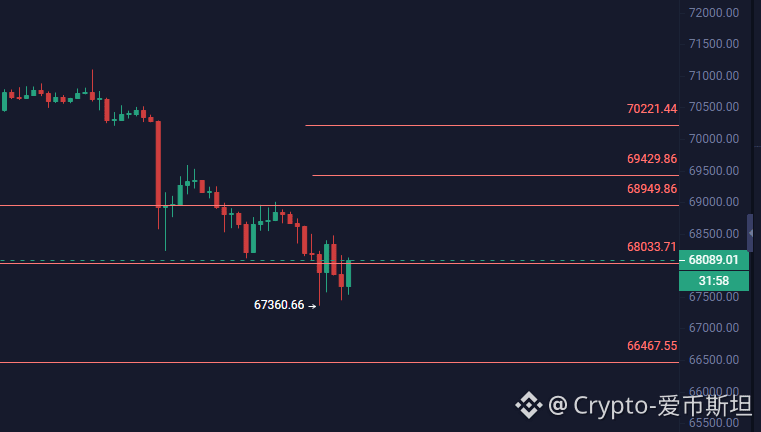
South Korean stocks triggered a circuit breaker, the Nikkei index fell 4%, and I observed Bitcoin's trend; it fell 700 points, but remained relatively stable overall, indicating that the influence of the Asian trading session is weakening.
The main reason for the stock market declines in Japan and South Korea is that these two countries are heavily reliant on resources, a serious issue. With oil prices fluctuating so drastically, they naturally couldn't withstand it.
If Bitcoin rebounds, the resistance levels are 689, 693, and 702, while the support level is at 664.
$BTC
@CZ @richardteng @heyi
{spot}(BTCUSDT)
33
404
38