Here's my opinion: the current upward cycle in precious metals is over. Silver's cycle has ended, and gold's will likely continue for another six months before it ends.
Logic: A good way to observe cycles in any market is to identify the leading and second-leading stocks in a given sector and observe the changes in their exchange rate pairs. The exchange rate pair of the second-leading stock/leading stock is a measure of the cycle.
Early to Mid-Bull: Leading stocks rise.
Mid-Bull: Second-leading stocks begin to catch up.
Tail-Bull: The exchange rate pair of the second-leading and leading stocks begins to surge dramatically.
Tail-Bull: The second-leading stock reaches its peak first, the exchange rate pair tops out and begins to collapse, while the leading stock stagnates or continues to rise for a period.
The above applies to ETH, SOL, and BTC. I've seen this cycle more than once. In fact, the sector rotation in on-chain memes and A-shares follows the same logic. When you see the exchange rate pair of the second-largest/first-largest stock start to collapse, the cycle of that sector is not far from ending.
You can observe this closely:
Chart 1 below
Blue: Silver
Orange: Gold
Candlestick Chart: Silver/Gold Exchange Rate Pair
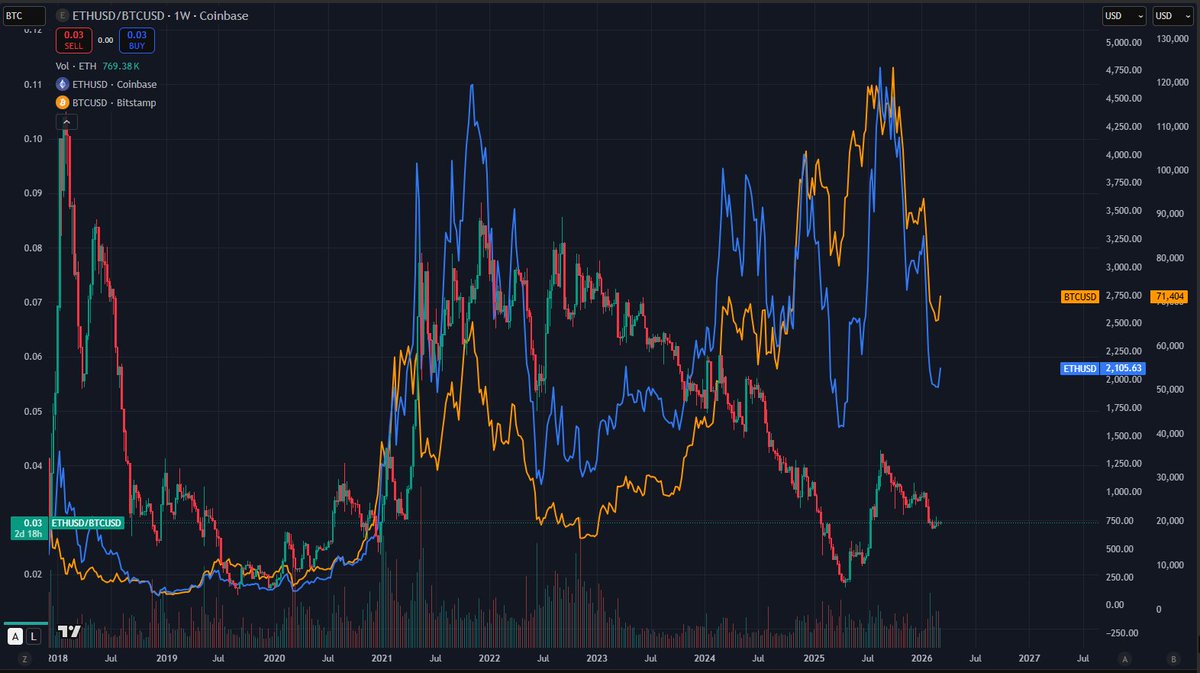
Chart 2 below
Blue: Ethereum
Orange: Bitcoin
Candlestick Chart: ETH/BTC Exchange Rate Pair
The logic behind this phenomenon is not difficult to understand:
* **Leading Stock:** The stock with the strongest narrative, the purest logic, the most compelling story, and the strongest willingness to attract institutional investment. Everyone in the market assumes that "to play this theme, you must have a leading stock," and the leading stock also has a higher institutional presence.
*Second-Large Stock:** It has a related narrative, but its logical purity, storytelling, market capitalization, turnover rate, and institutional preference are all weaker than the leading stock.
The natural order of capital entry is: buy the most certain and most expensive one (the leading stock) first, then buy the cheaper and more cost-effective one (the second-largest stock).
When sector sentiment peaks and profit-taking begins, those who exit first are often the "least profitable, riskiest, and most vulnerable" – they typically hold the second-tier leading stock (meaning higher retail participation in the second-tier).
The result is: The propagation path of sector speculation is: Leading stock → Second-tier leading stock → Third-tier leading stock → Minor stocks catching up.
The peak is the reverse: Minor stocks die first → Third-tier leading stock collapses → Second-tier leading stock collapses → Leading stock corrects.
(Ugh, why can't I move images when editing posts now? Too lazy to write an article, just bear with it 😅)