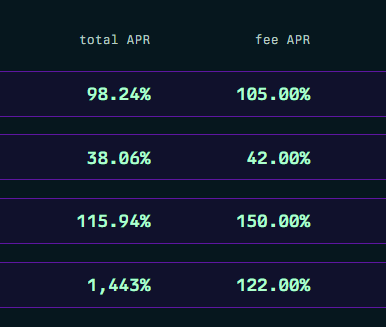
In the arena, try different approaches.
To be honest, these positions are relatively small, but they all follow a common theory that I'm happy to share.
Trading volume is largely a result of arbitrage.
Let me explain:
► The mark price only changes when a swap transaction occurs.
► The index price is a weighted average of prices from different sources (usually major exchanges).
This means that if no one is swapping on a decentralized exchange (DEX), the index price may deviate from the mark price. This creates arbitrage opportunities.
For example:
Suppose $exampleCoin has poor on-chain liquidity, but its off-chain price is highly volatile, and you don't mind taking that risk.
So, you set a fee tier as high as 1% and a fairly wide fee range, and then… you… wait. It's like fishing, but your earnings are higher, and it smells more like you're in your office than by a beautiful lake.
As expected, the highly volatile $exampleCoin surged 5% on centralized exchanges (CEXs), prompting CEX/DEX market makers to direct trading volume to your on-chain liquidity provider (LP) account, which charges around 1% in fees.
For every $10,000 in trading volume that flows through your liquidity, you earn $100, while they reap the arbitrage profits.
A win-win situation (unless you exceed expectations or the asset becomes something you don't want to deal with).
Furthermore, since all these DEXs (at least the ones worth investing liquidity in) are connected to aggregators, and all these aggregators are connected to meta-aggregators, there's no need to actively seek out these arbitrage opportunities; trading is automatically directed.
Therefore, you need to pay attention to the following:
1) An asset whose volatility means the index price should frequently deviate from the benchmark price, and the deviation should be sufficient for your liquidity to drive trading volume.
(For example, if you choose a 1% fee tier, you need to expect the difference between the benchmark price and the index price to occur frequently and exceed 1%).
2) Low or almost no on-chain liquidity.
3) An asset for which you are willing to take a certain level of risk exposure.
In short, good luck!