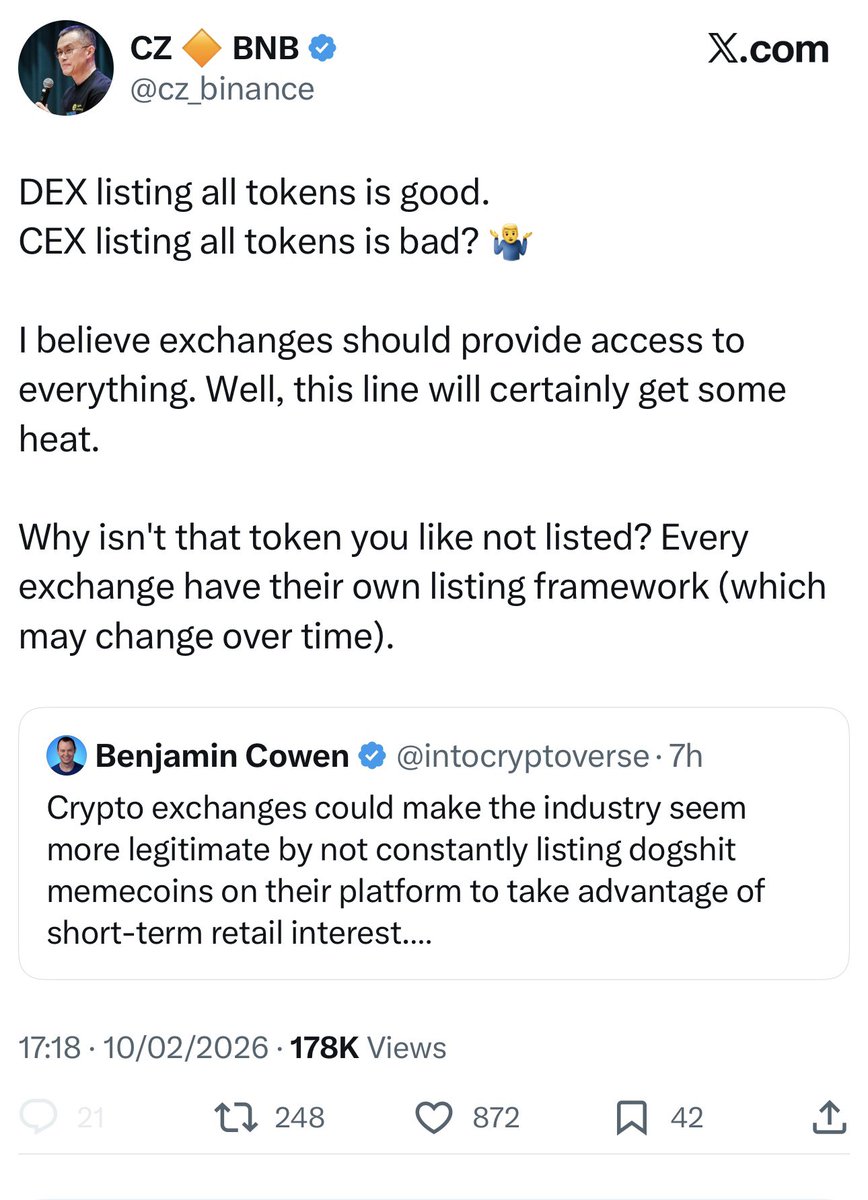
At first glance, this seems reasonable—but it's actually a false equating.
Decentralized exchanges (DEXs) and centralized exchanges (CEXs) play distinctly different roles.
Open, permissionless access belongs to DEXs; responsibility, standards, and accountability belong to CEXs.
DEXs are purely self-custodial tools. The service provider is not an intermediary and does not control user funds. Users interacting with DEXs understand—or should understand—that they are using a tool and are fully responsible for their actions. As SEC Chairman Paul Atkins stated:
“Self-custodial ownership of personal property is a fundamental American value that should not disappear just because people log onto the internet.”
In contrast, CEXs act as banks, holding user funds in custody. Therefore, they have explicit obligations regarding anti-money laundering (AML), sanctions compliance, fraud prevention, and consumer protection. CEXs are not neutral conduits. They carry trust and bear operational responsibility, and therefore have an obligation to protect users, not just list all transactions.
Conflating decentralized exchanges (DEXs) with centralized exchanges (CEXs) is not open and transparent.
It's an attempt to evade responsibility.
This fundamental distinction reflects a long-standing value difference between OKX and Binance.