Walrus Protocol: The Cornerstone of Web3 Data Autonomy
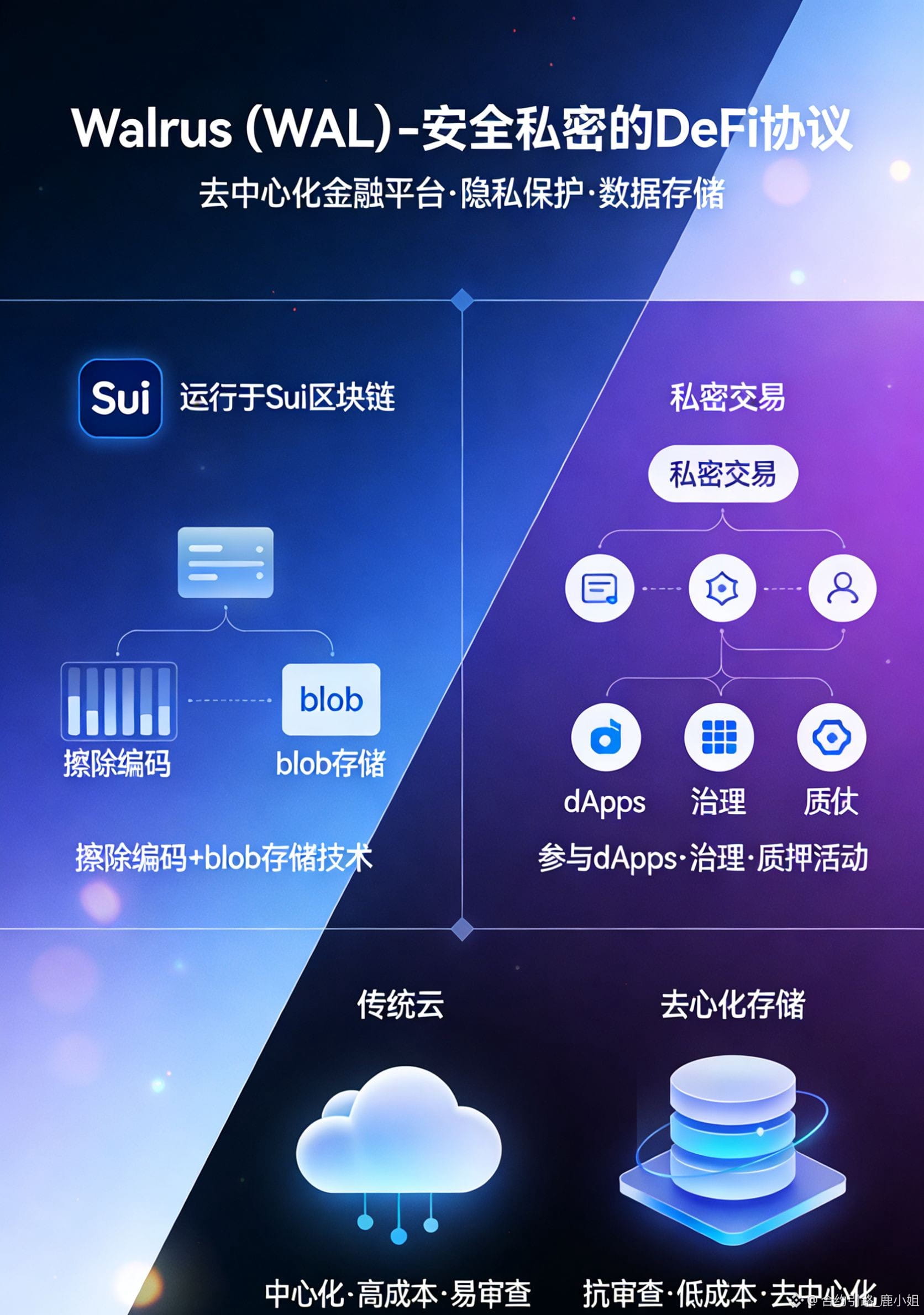
In the current booming development of Web3 applications, a core contradiction is becoming increasingly prominent: on-chain applications embody the concept of decentralization, but the data they rely on for operation is mostly stored on centralized servers. This architecture not only brings single points of failure, data breaches, and censorship risks, but also makes it difficult to fulfill the promise of "user-owned data." The Walrus protocol is an innovative infrastructure designed to resolve this fundamental contradiction. Going beyond simple file storage, it is built on the high-performance Sui blockchain and aims to become an integrated privacy data layer for Web3. By integrating decentralized storage, privacy protection, and smart contract interaction, it provides a truly user-controlled data environment for next-generation applications.
The core advantage of the Walrus protocol lies in its unique technical architecture and economic design. Technically, it uses erasure coding to intelligently segment files into encrypted fragments and distribute them across a global node network, ensuring extremely high data reliability and censorship resistance, while at a cost far lower than traditional cloud services. Economically, its native token, WAL, is the core driver of the ecosystem, used to pay storage fees, incentivize node services (nodes must stake WAL), and facilitate community governance voting. This design creates a decentralized, sustainable, and incentive-compatible closed loop, deeply binding the interests of users, maintainers, and governance, thus ensuring the network's long-term development.
With these characteristics, the Walrus protocol is supporting a wide range of real-world applications. It stores sensitive transaction records for privacy-sensitive DeFi platforms, manages asset state files for dynamic NFTs and full-chain games, provides content storage for decentralized social and media platforms, and even offers compliant data management solutions for enterprises that comply with regulations such as GDPR. In short, by deeply integrating core privacy, efficient storage, and user sovereignty, the Walrus protocol not only addresses the current pain points of centralized dependence but also defines the cornerstone of a future trusted data economy, making it a key force driving Web3 from financial experimentation to mainstream application.
@WalrusProtocol
#Walrus
$WAL