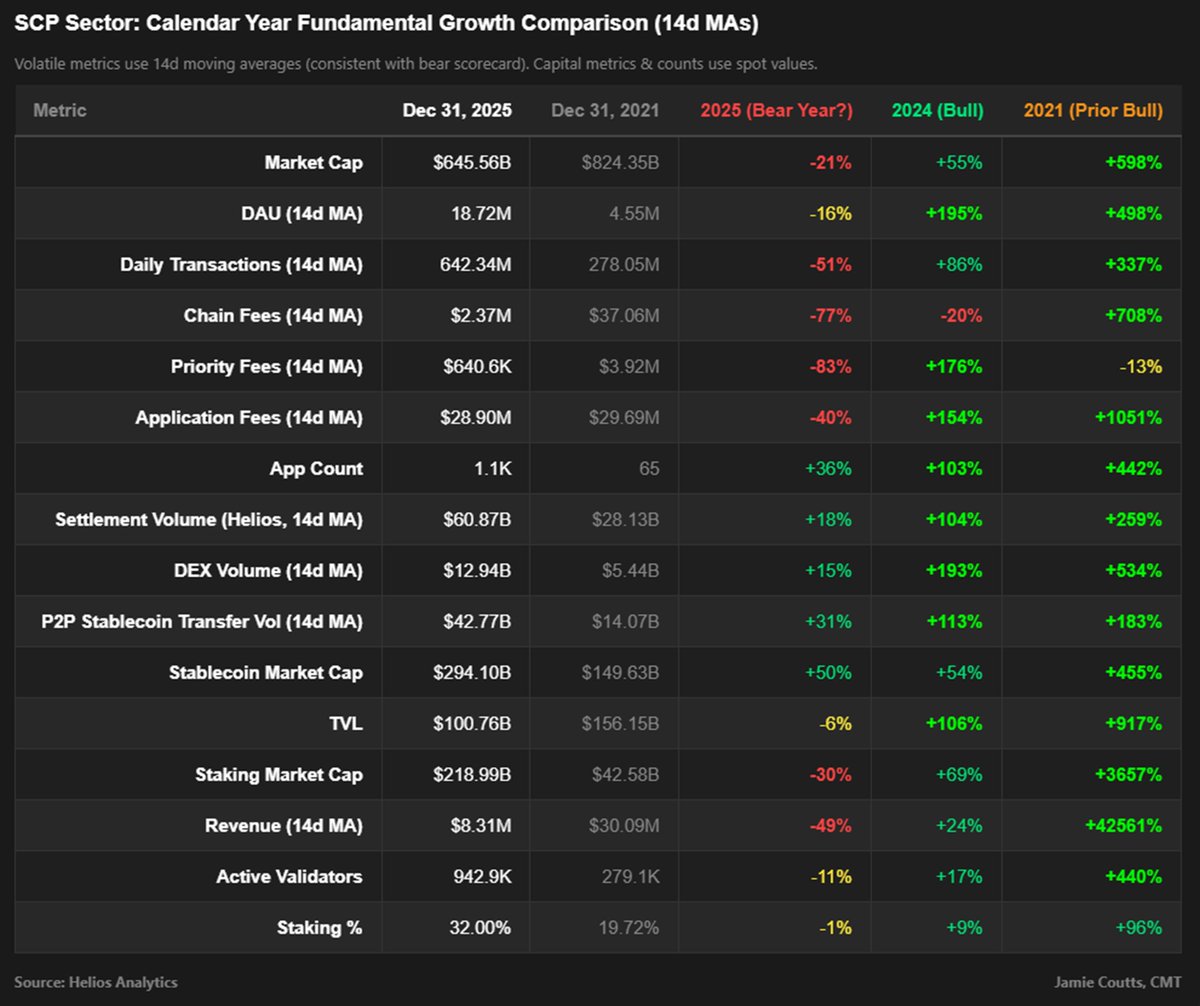
A 2025 cryptocurrency market overview reveals a two-speed economic landscape.
Utility continues to grow during market downturns: stablecoins grew by 50%, settlement by 18%, P2P transaction volume by 31%, and applications by 36%.
Speculative collapse: chain fees fell by 77%, transaction volume by 51%, revenue by 49%, and daily active users by 16%.
While this isn't the first time this has happened (a similar situation occurred in 2022), the development of utility and speculation diverges dramatically during economic downturns. Utility continues to grow, while fringe speculators turn to the field of artificial intelligence.
The problem is: blockchain pricing is still based on speculative throughput. This revenue stream is its primary source of income, but it has now plummeted.
The solution lies in putting more assets on-chain: tokenized stocks, fixed-income assets, and risk-weighted assets (RWA). The Clarity Act is a bridge, but its passage in 2026 remains uncertain.
AI-powered agents will be another major driver, but current trading volumes are not yet sufficient to convince capital markets.
The window for catalyst convergence is expected to be mid-2026. If the Clarity plan is approved and AI-powered agent trading volumes increase, then the rationale for a revaluation will be very strong. If neither of these conditions is met, the two-speed economic landscape will persist: stablecoins and tokenization will continue to grow, but at a slower pace, and valuations will continue to decline. Keep a close eye on both aspects.