Over the past two years, a significant change has been underway: the speed at which public blockchain transparent ledgers are being linked to real-world identities has far exceeded industry expectations. On-chain analytics tools and compliance services have matured rapidly, with capabilities such as Travel Rule, on-chain risk control, address profiling, and entity association being deployed at scale, making it increasingly easy for on-chain behavior to be mapped to individuals, businesses, and institutions in the real world. Simultaneously, stablecoin cross-border settlements, RWA asset on-chaining, and institutional trials of on-chain clearing have elevated "who can see what, and under what conditions" from technical details to core issues within the compliance framework. Coupled with multiple trust crises and real-world security incidents triggered by transaction traceability, a previously overlooked fact is becoming clear: in the on-chain world, visibility itself is becoming a risk exposure. These changes all point to one fact: privacy is no longer a question of "whether it's needed," but rather "how to redesign the visibility structure while ensuring compliance and verifiability."
At a deeper level, privacy is an individual's self-protection mechanism: it allows individuals to make decisions without having to subject every action to the immediate evaluation of others, institutions, or automated systems. Because when all actions are implicitly public, decision-making logic inevitably tilts towards "external visibility," forcing individuals and organizations to continuously optimize "how others interpret my behavior," thereby weakening the stability and autonomy of long-term goals.
This structural pressure is significantly amplified in scenarios such as on-chain finance, DAO governance, and enterprise-level on-chain decision-making. When fund flows, voting behavior, and strategy adjustments are all continuously trackable and analyzable, transparency itself can, in turn, alter participants' behavioral patterns, thus affecting the overall efficiency of the system and the outcome of the game.
It is worth noting that the Web3 industry has not always prioritized privacy. On the contrary, for a considerable period, privacy was underestimated: before the maturity of technologies like ZK-SNARK, strong privacy under decentralized conditions was almost impossible to achieve, and the industry narrative naturally gave way to more "deliverable" goals, such as scalability, decentralization, governance, and composability. However, this avoidance strategy began to fail in 2024–2025. On the one hand, AI is pushing the capabilities of "centralized data collection + high-intensity analysis" to unprecedented heights, even extending to user behavior patterns that haven't been actively disclosed. On the other hand, cryptography itself is evolving; zero-knowledge proofs, homomorphic encryption, and multi-party computation are becoming engineering feasible, making "programmable privacy" a real-world option and unlocking the value of data.
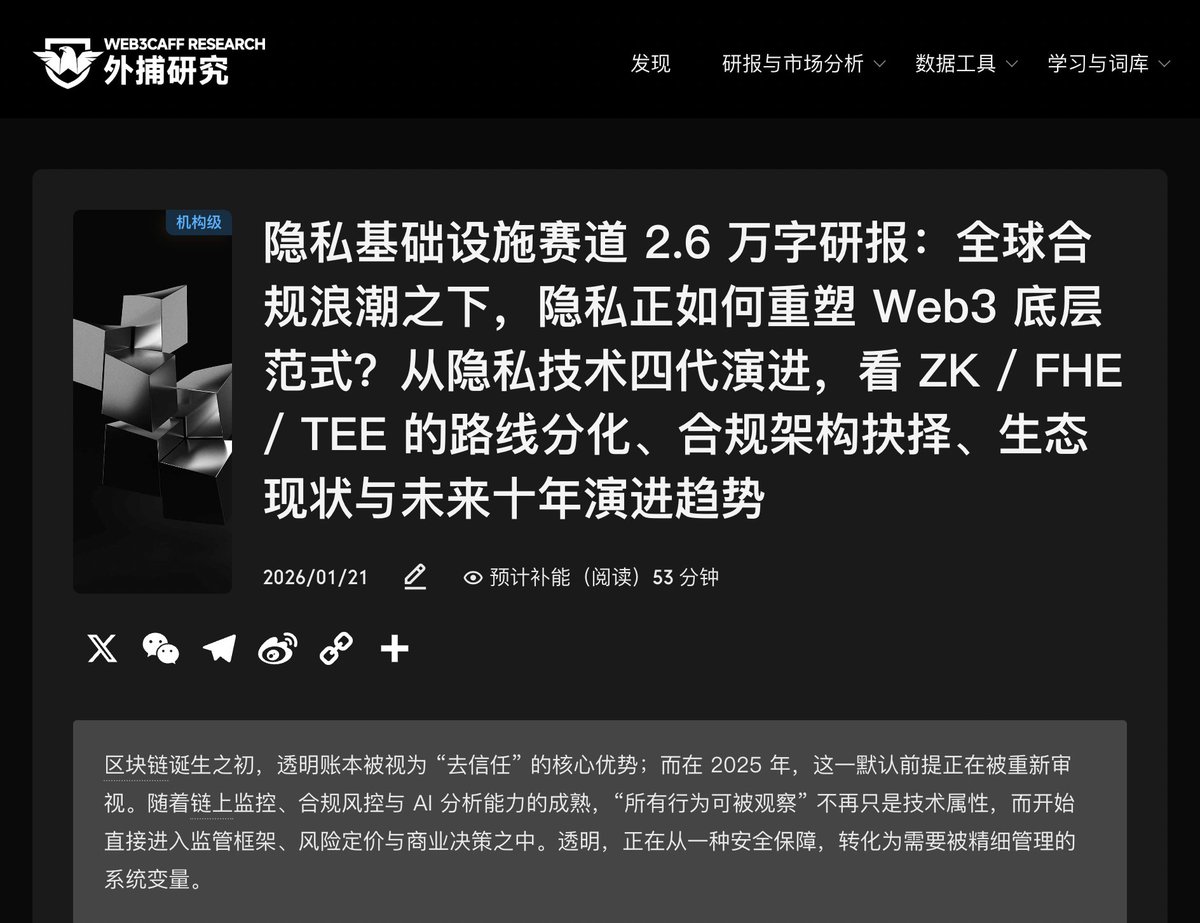
The above content is excerpted from Web3Caff Research's "Privacy Infrastructure Track 26,000-Word Research Report: Under the Global Compliance Wave, How Is Privacy Reshaping the Web3 Underlying Paradigm? From the Four Generations of Privacy Technology Evolution, to the Divergence of ZK/FHE/TEE Routes, Compliance Architecture Choices, Ecosystem Status, and Future Evolution Trends in the Next Decade"
Click to view the full version 👇