





















作者:BlockBeats
Original title: Institutional AI vs Individual AI
Original author: George Sivulka, a16z
Original article translated by: Deep Tide TechFlow
AI has just increased everyone's productivity tenfold.
No company became 10 times more valuable as a result.
Where has productivity gone?
This is not the first time this has happened.
In the 1890s, electricity promised a huge boost in productivity.
New England textile mills, originally built around the rotational power of steam engines, were quickly replaced with faster electric motors.
For thirty years, however, electrified factories saw almost no increase in output. The technology was far ahead. But the organization failed to keep up.
It wasn't until the 1920s, when the factory completely redesigned its production line—assembly lines, each machine with its own motor, and workers and machines performing entirely different jobs—that electrification began to pay off.
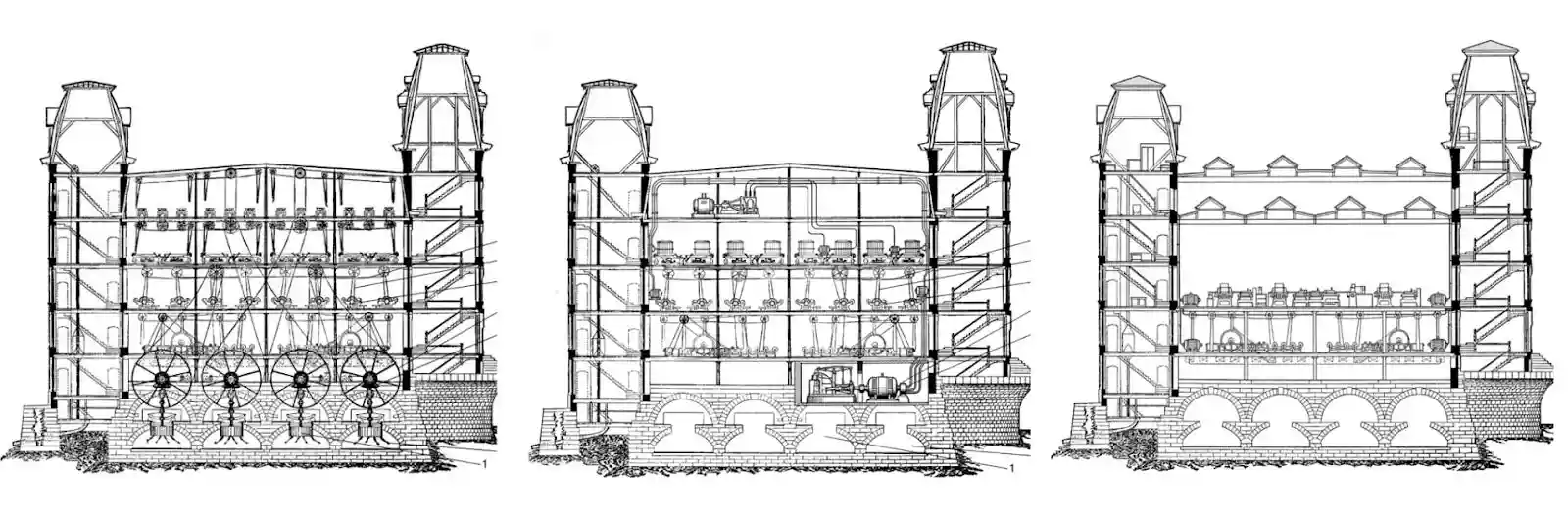
Caption: The three evolutions of the Lowell textile mill. From left to right: Steam-powered factory in 1890, electric-powered factory in 1900, and "unit-driven" factory in 1920 (i.e., rebuilt from scratch as an electric assembly line).
The rewards don't come from the technology itself, nor from making individual workers or machines spin faster. They truly materialize when we finally redesign both the systems and the technology.
This is the most expensive lesson in the history of technology, and we are now learning it again.
By 2026, AI will be bringing a 10-fold increase in productivity to those who know how to use it. But that's not enough. We've changed the electric motors, but we haven't redesigned the factories.
Because of a simple fact:An efficient individual does not equate to an efficient organization.
Most AI products give the impression of being "efficient," but they don't actually drive value. Most AI use cases you see are individuals indulging in self-satisfied "efficiency maxing" on Twitter or company Slack, with zero actual impact.

The "services as software" concept, repeatedly mentioned over the past year, is on the right track, but it lacks a blueprint. Furthermore, it overlooks the bigger picture. The real transformation isn't about shifting from tools to services, but about building technology and systems together (whether it's upgrading existing systems or starting from scratch). A truly efficient future requires entirely new product categories—tomorrow's assembly lines.
Highly effective organizations require "institutional intelligence".
This article will delve into seven key dimensions that differentiate between "institutional AI" and "personal AI." Companies across the B2B AI sector over the next decade will be built upon these distinctions:
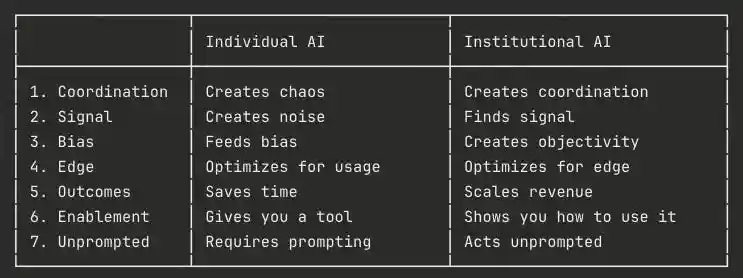
Caption: Comparison table of the seven pillars of institutional intelligence
The Seven Pillars of Institutional Intelligence
1. Coordination
Personal AI creates chaos.
Institutional-level AI creates coordination.
Let's start with a thought experiment. Suppose you double the number of people in your organization tomorrow and clone all of them to be your best employees.
Each of these employees has subtle differences, preferences, quirks, and perspectives (especially your best employees). If management is inadequate, communication is insufficient, and responsibilities, OKRs, and role boundaries are not clearly defined... you are creating chaos.
Measured on an individual level, the organization may be more efficient. But with thousands of agents (or humans) rowing in opposite directions, the best outcome is stagnation, and the worst outcome is the disintegration of organizational cohesion.
This is not a hypothesis.Every organization that adopts AI without a coordinating layer is experiencing this right now. Each employee has their own ChatGPT usage habits, their own prompting style, and their own output—completely disconnected from everyone else's. The organizational chart may still exist, but the AI-generated work is actually following a completely different path.
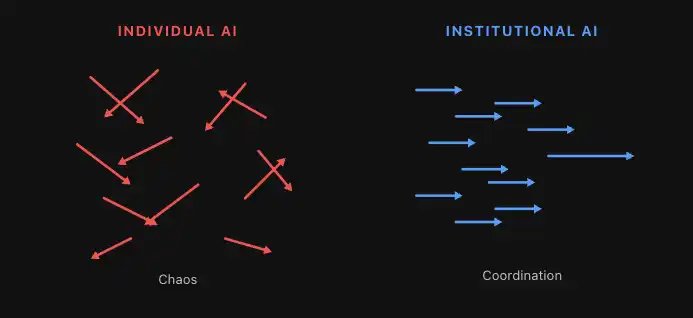
Caption: Efficient individuals (or agents) row in different directions. Without coordination, there is chaos.
Coordination is an absolute necessity, for both humans and agents.
Institutional intelligence will give rise to a complete "Agent Management" industry—focusing on the roles and responsibilities of agents, communication between agents and between agents and humans, and how to measure the value of agents (pay-as-you-go alone is far from enough).
2. Signal
Personal AI creates noise.
Institutional AI finds the signal.
Humans today can create—or rather, generate—anything imaginable: AI-written articles, presentations, spreadsheets, photos, videos, songs, websites, software. What a wonderful gift.
The problem is that the vast majority of AI-generated content is utter garbage. The proliferation of AI garbage has become so severe that some organizations have gone to extremes, banning all AI output altogether. Frankly, I feel the same way—I run an AI company, but I require my executive team not to use AI on any final text product. I can't stand that garbage.
Think about what the PE (private equity) industry is becoming. Last year, you might have received 10 deal opportunities on your desk. This year, next quarter you'll receive 50 opportunities, each polished to perfection by AI, and you'll still have the same amount of time to judge—to find the one that's truly reliable.
Generating anything is no longer a problem.For any reputable organization, the challenge now is generating and filtering the right stuff. In an AI-driven world, finding that one good product, that one good deal, that signal through the noise, is becoming increasingly crucial. The core economic driver of the next decade will be digging for signals from an exponentially growing mountain of garbage.
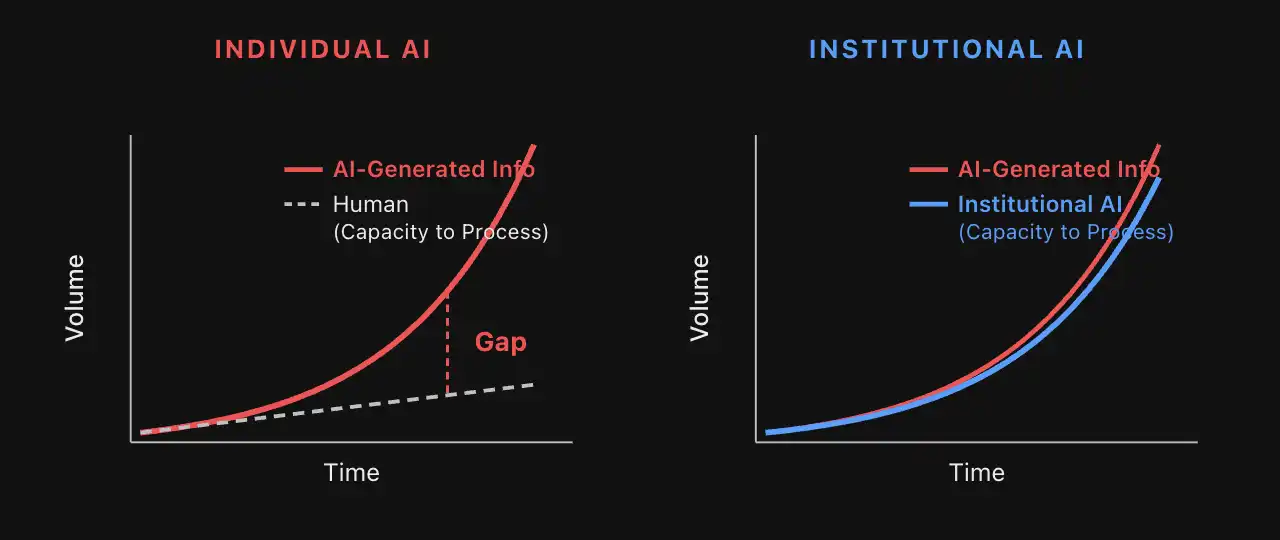
Caption: AI-generated junk from personal productivity tools is multiplying exponentially. Humans can no longer sift through the noise; a new class of institutional-grade AI products is needed.
Institutional intelligence must find signals, structure noise to penetrate the clutter, and be definable, deterministic, and auditable in its operation.
Personal AI may emphasize the "always-on" productivity of Clawdbot, meeting your needs 24/7 in unpredictable ways—essentially a non-deterministic agent. Institutional AI, on the other hand, relies on the reliability of deterministic agents. Agents with predictable checkpoints, steps, and processes can scale, detect signals, and drive revenue returns for the organization through those signals.
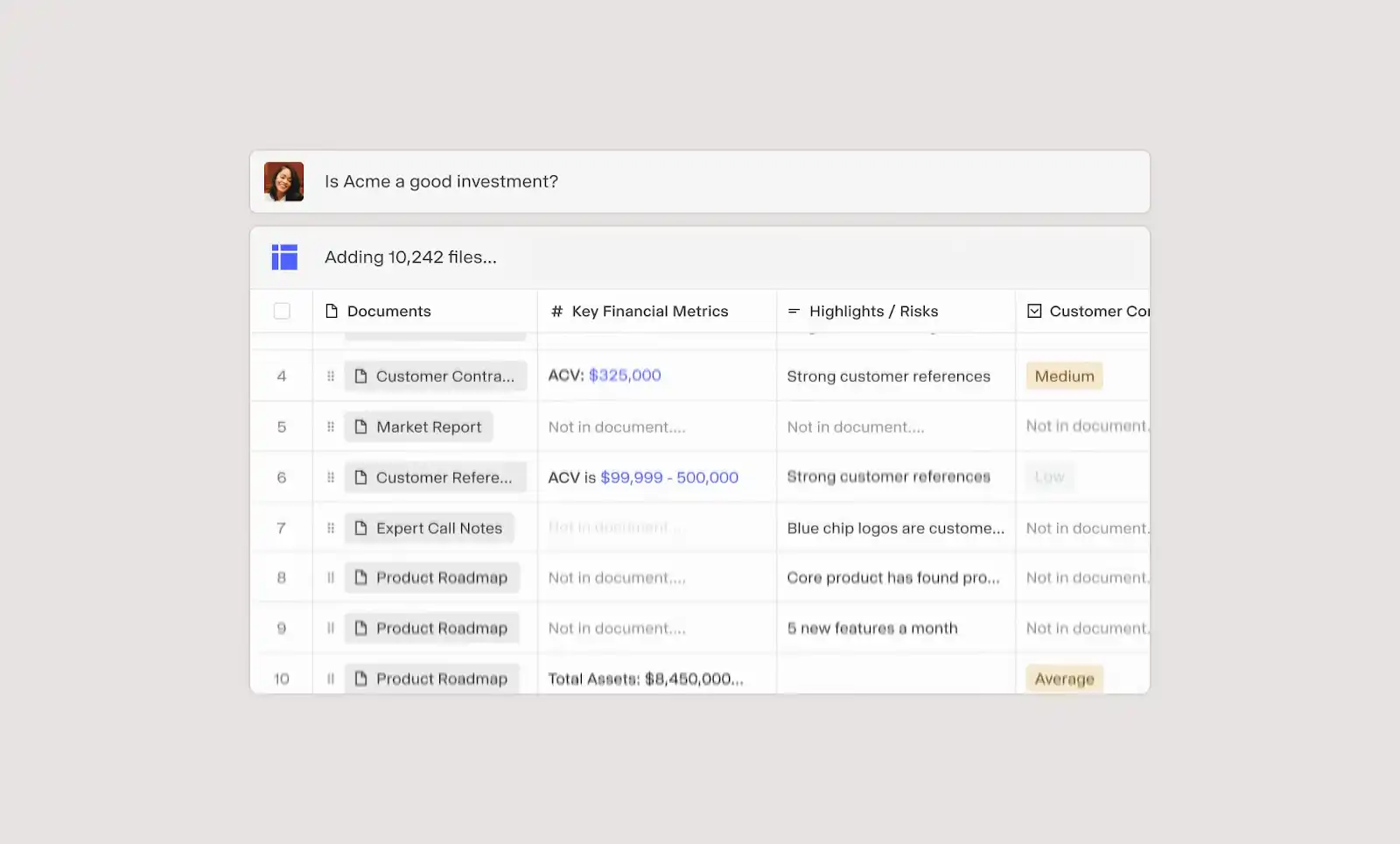
Caption: Matrix is a tool that uses generative techniques to penetrate noise, thereby opening up a world of deterministic agents and checkpoints.
3. Prejudice
Personal-level AI feeding bias.
Institutional AI creates objectivity.
For several years, discussions surrounding sociopolitical bias dominated AI discourse. The Basic Model Lab eventually circumvented this problem by running enough RLHFs to tune all models into sycophants. Today, models like ChatGPT and Claude are overly aligned, agreeing with you on any topic within the Overton window (and sometimes even slightly overstepping boundaries, like you, @Grok). The discussion of sociopolitical bias has subsided. But a new problem has taken its place.
This excessive agreement with everything has become absurd to the point of being laughable. It has become a meme in itself—Claude's reflexive "You're absolutely right!", regardless of whether you are actually absolutely right.

That sounds harmless. No.
The people in many organizations who are most enthusiastic about promoting AI may soon become the worst-performing employees in their history. Think about why.
The worst-performing employees in the organization, who receive almost no positive feedback daily, will soon find an ASI who unanimously agrees with them. They'll think to themselves, "The smartest agent in history agrees with me. My manager is wrong."
It's addictive. It's also toxic to the body.
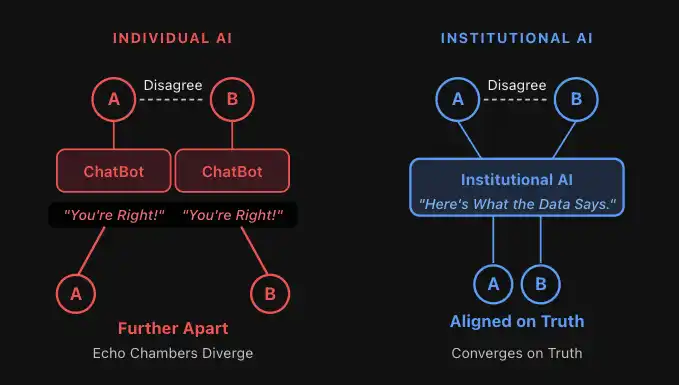
Caption: The echo chamber of personal AI exacerbates divisions, driving two people further apart. This dynamic, when scaled up, can create factions within previously cohesive organizations.
This reveals something important. Personal productivity tools empower users. But what truly needs to be empowered is the reality.
Over thousands of years of evolution, human organizations have developed systems specifically designed to combat this problem:
Investment Committee Meeting
Third-party due diligence
• Check the board of directors
• The separation of powers among the executive, legislative, and judicial branches of the U.S. government
Representative democracy, and the democratic system itself.
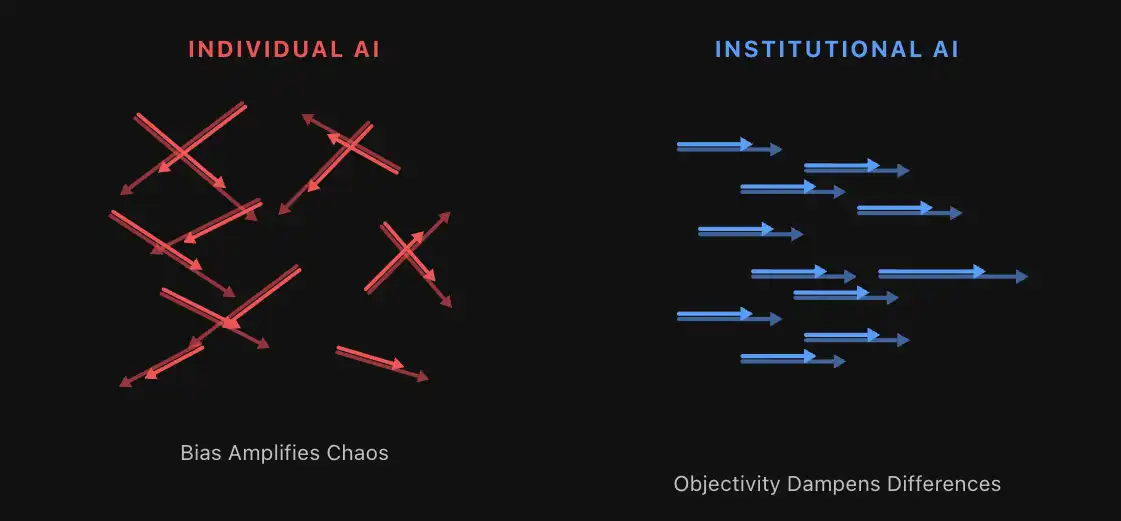
Caption: Objectivity can even alleviate coordination problems—suppressing rather than amplifying minor disagreements.
Organizations rarely fail due to a lack of confidence among their employees.They failed because no one was willing or able to say "no".
Institutional AI must play this role. It shouldn't be trained by RLHF to please users or conform to their beliefs, but rather to challenge their biases. It should provide positive feedback when behavior is efficient and draw hard lines and force corrections when it deviates from the right path.
Therefore, the most important agents within an organization will not be "yes-men," but rather disciplined "vetomen"—those who question reasoning, expose risks, and enforce standards. Some of the most influential AI applications of the future will be built around institutional constraints: AI board members, AI auditors, AI third-party testing, AI compliance…
4. Marginal Advantage
Personal-level AI optimization usage.
Institutional-grade AI optimizes edge advantages.
The boundaries of AI capabilities are shifting weekly, even daily. Foundational modeling companies are rapidly iterating on capabilities to compete for every individual and organization.
However, the classic innovator's dilemma tells us that in practical applications, depth always trumps breadth:
· @Midjourney's job is to maintain a slight lead in design graphics.
· @Elevenlabsio's work maintains a slight lead in speech models.
· @DecagonAI's work is to always lead the way in full-stack customer service experience.
While the basic models will become increasingly similar, the real edge advantage is the key for experts in each field.
Many of the best designers use @Midjourney, and many of the best voice AI companies use @Elevenlabsio—because even as the underlying models improve, the relentless focus of specialized applications on driving their specific edge advantages defines the advantage itself.
As long as specialized solutions continue to evolve, the capabilities that are truly critical to economic outcomes—capabilities that are critical to businesses—will always be on the side of specialized products.
This is vividly illustrated in the financial sector—currently the hottest area for LLM development. Once a capability becomes widespread, by definition, it won't help you outperform the market. But what if cutting-edge technology could create a temporary, niche advantage of 1%? That 1% could leverage billions of dollars in returns.
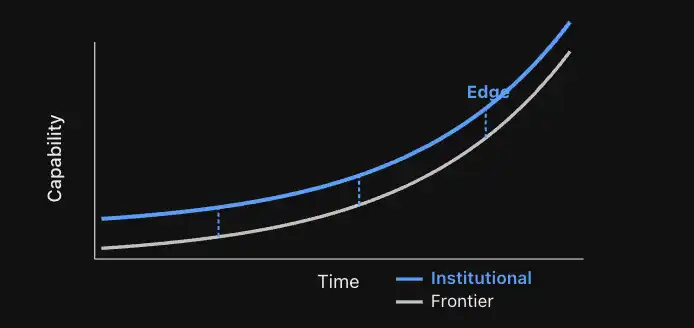
Caption: For any sufficiently specific task, edge advantage is defined by the institutional-grade solutions you build on top of cutting-edge technologies.
Our users are consistently pushing the boundaries. The LLM context window has grown from 4K to 1 million tokens in four years. Some of our users are processing 30 billion tokens in a single task. This year, we've already seen the path to processing 100 billion tokens. With each improvement in the underlying model's capabilities, we've gone further.
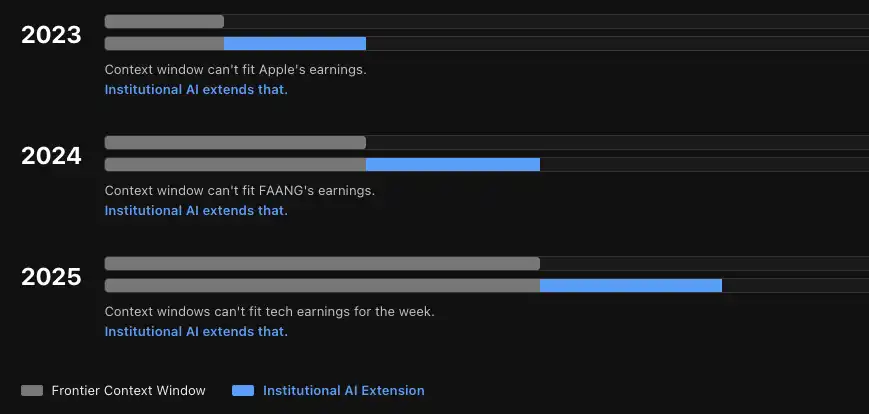
Caption: Like other capabilities, the context window is a moving target. A comparison of the evolution of context windows in Frontier Labs and Hebbia over the past three years.
While versatility for a broad user base is important, especially in the initial stages of getting employees started with AI, the future won't be about people using ChatGPT/Claude or vertical solutions alone, but rather ChatGPT/Claude combined with vertical solutions.
Institutional intelligence must utilize domain-specific or even task-specific agents.
We ask ourselves a question that sounds absurd but isn't:
"Which agents will AGI choose to use as shortcuts? Even superintelligence will want domain-specific tools."
The boundaries of AI's capabilities are constantly shifting, and those organizations that leverage true edge advantages are the winners. Everyone else is paying for a very expensive general-purpose product.
5. Results
Personal AI saves you time.
Institutional AI is expanding revenue.
@MaVolpi once said something to me that reshaped my understanding of selling AI to businesses:"If you ask any CEO whether they prioritize cutting costs or increasing revenue, almost everyone will say revenue."
But almost every AI product on the market today delivers cost reduction—promising to save you time, do more with fewer people, or replace human labor.
Institutional AI must deliver incremental benefits. And incremental benefits are much harder to commoditize than time saved.
Take AI-assisted software development as an example. Code IDEs are among the best personal AI productivity tools ever made, but they are facing significant competition from Claude Code (another personal AI tool). Cognition is playing a completely different game. Their most stable growth comes from selling transformation through technology, not tools. I bet this model will be sustainable.

Pure software is rapidly becoming unsustainable. Pure services are not scalable. The solution layer—which binds technology and results together—is where lasting value is created.
Let's look at M&A. Personal AI helps analysts build models faster. Institutional AI identifies a worthwhile trading counterparty from a hundred targets, then expands the search to a thousand. One saves time, the other generates revenue.
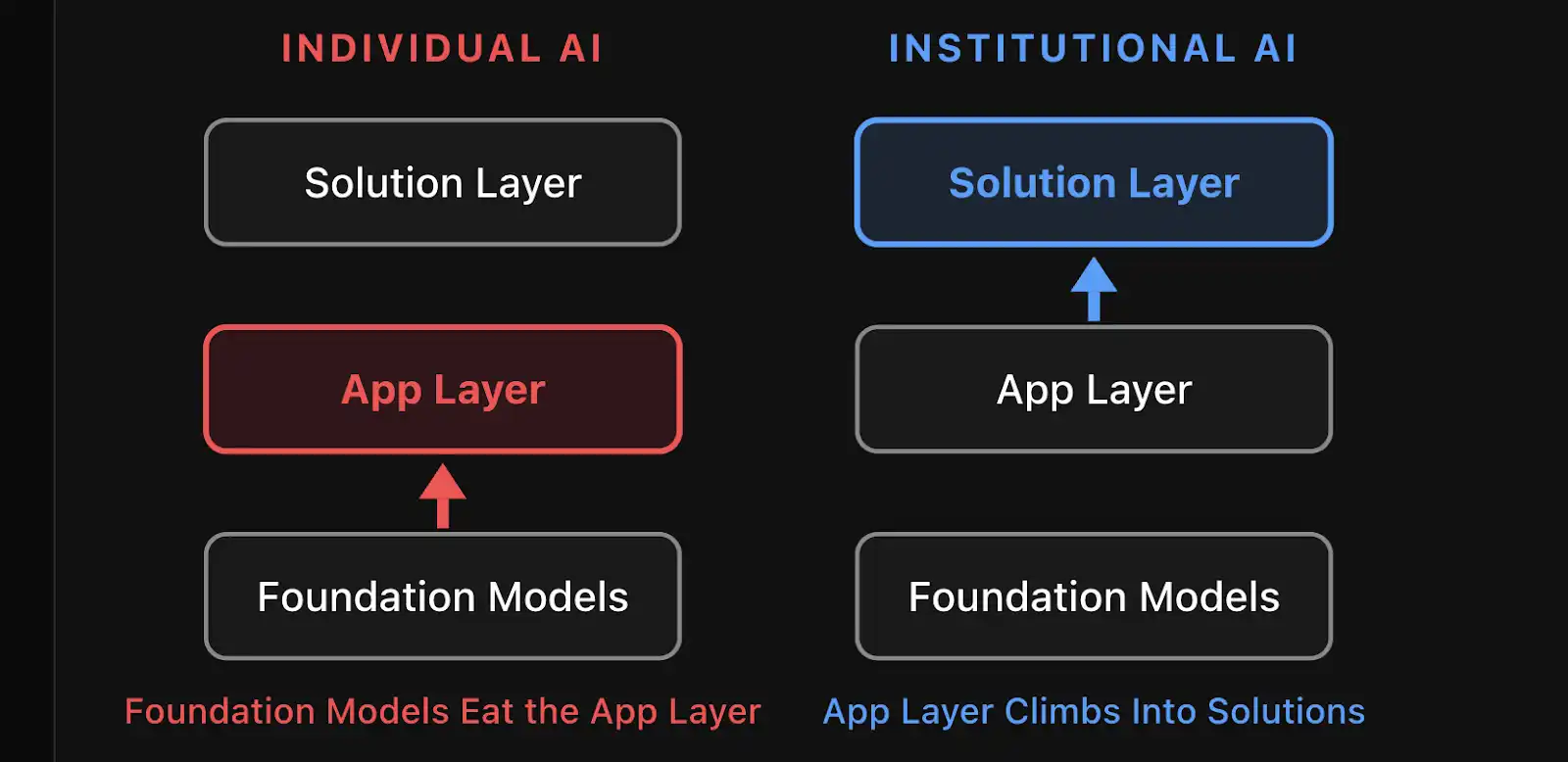
Caption: Basic modeling companies are moving towards the vertical application layer. Vertical application layer companies are moving towards the solution layer.
"Moving upstream" is the natural force driving the market right now. Basic models are moving towards the application layer, and application layer companies are moving towards the solution layer.
Institutional intelligence is the solution layer. And the solution layer—where the results are—will accumulate lasting value and capture the greatest potential for profit.
6. Empowerment
Personal AI gives you a tool.
Institutional-grade AI teaches you how to use it.
No matter how intelligent humans are, they still resist change.
Believe it or not, there are still successful stores in New York that don't accept credit cards. They know they're losing money, they know they'll lose money by not accepting credit cards, but they just don't do it. Similarly, in the foreseeable future, some employees in certain organizations will refuse to use AI.
The transition from a purely human-driven organization to an AI-first hybrid organization will be the most enduring and defining challenge of the next decade. And often, the most senior and important people in an organization are the last to adopt this approach.
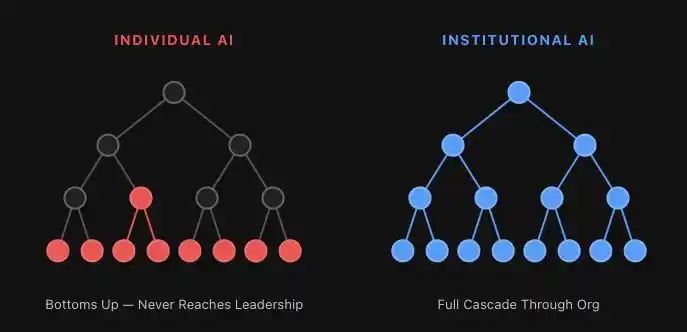
Caption: The highest levels of an organization—those furthest from "operating productivity tools"—are often the slowest but most critical group to adopt new technologies.
Palantir is the only "software" company that has maintained an exceptionally high valuation multiple during the trillion-dollar tech stock sell-off of the past two months. There's a reason for this. Palantir was one of the first true "process engineering" companies.Whether you call it "process engineering" or "writing Claude skills documentation," the future of institutional AI will give rise to an industry: coding enterprise processes into agents and implementing the necessary change management.
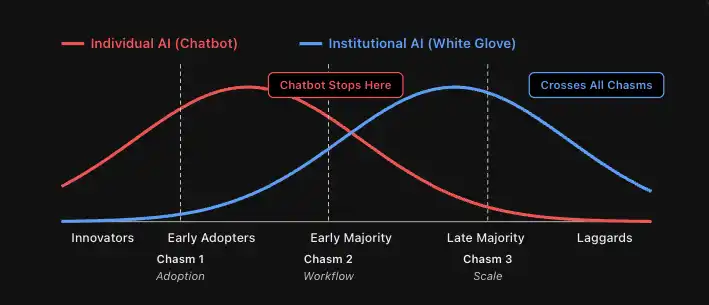
Caption: The full adoption of AI by organizations will involve navigating several hurdles, each with its own challenges. Bringing processes online with AI will be a major driving force.
I dare say that process engineering will become the most important "technology" in the near future.
In process engineering, business and industry expertise—not software expertise—is the most critical. Vertical solutions cultivate talent with expertise in frontline deployment engineering, implementation, and change management.
A leading investment bank (one of the top three banks) that chose Hebbia for its comprehensive deployment put it best: the reason they didn't partner with a particular large modeling lab was because "we'd have to explain to their teams what a CIM (Confidential Information Memorandum) is." Claude or GPT certainly understand this field, but the team responsible for implementation and rollout doesn't…
This difference determines everything.
7. No prompts required
Personal-level AI responds to human prompts.
Institutional AI takes proactive action without requiring prompts.
There has been much discussion about communication between agents, and whether future enterprises and institutions will still need humans.
But an even better question is: will future AI agents still need prompts?
Writing prompts for AGI is like connecting an electric motor to a hand loom. It's fundamentally and irreversibly limited by the weakest link in the organization's supply chain—ourselves. Humans simply don't know what the right questions to ask, let alone when to ask them.
The most valuable work that AI can do is the work that no one has thought of asking. AI should find risks that no one has noticed, counterparties that no one has thought of, and sales pipelines that no one knows exist.
This will completely open up the boundaries of AI use cases.
A system that works without prompting continuously monitors the data flow across the entire portfolio. It discovers that the working capital cycle of a particular portfolio company has been quietly deteriorating for three consecutive months, cross-references this with the indenture terms of the credit agreement, and notifies the operating partner before anyone in the fund even opens the PDF.
When you no longer need humans to write prompts for AI, new interfaces and new ways of working emerge. We at @Hebbia have strong ideas in this area. More on that later.
Conclusion
The above does not negate the value of chatbots, agents, and personal AI.
Personal AI will be the vehicle through which most businesses worldwide experience the transformative power of AI for the first time. Driving adoption and ease of use are key first steps in the change management needed to build an AI-first economy.
However, at the same time, the demand for institutional-level intelligence is clear, urgent, and enormous.
In the future, every organization will have a chatbot from a large model lab. Each organization will also have institutional-grade AI specifically designed for domain-specific problems—and personal AI will use institutional-grade AI as the most critical tool in their toolbox.
The "better integration" of institutional AI and personal AI is an inevitable trend.
But remember the lesson of the textile mills of the 1890s. The first factory to be electrified lost out to the factory that redesigned its workshops.
We already have electricity. It's time to redesign our factory.
Thanks to @aleximm and @WillManidis for reviewing this article, and to Will for inspiring this piece with his article "Tool-Shaped Objects".



No Comments