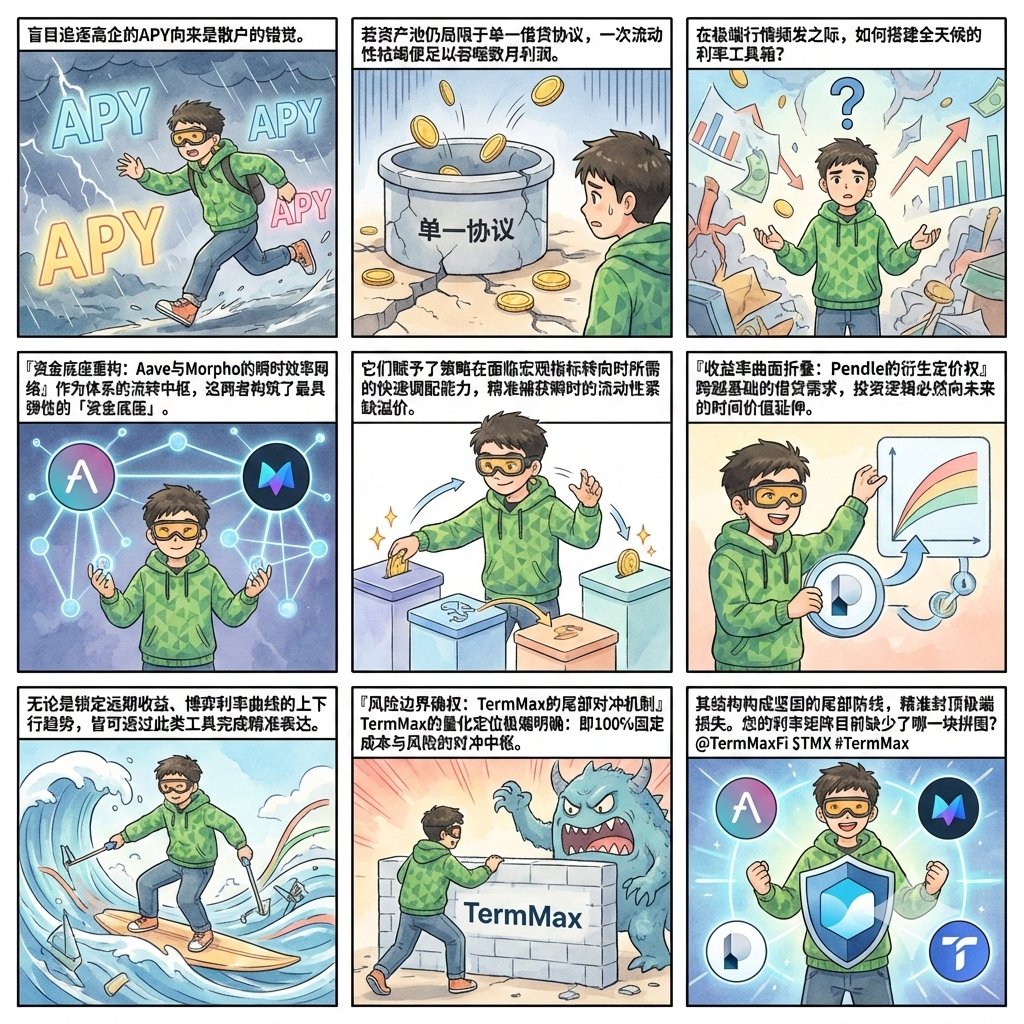
In reality, users are "obsessed" with triple-digit floating APYs, while top institutions are building high-probability "defense matrices."
A single point of liquidity depletion can wipe out six months' profits, making a complete "all-weather interest rate toolbox" the only solution.
TermMax's entry into the market (@TermMaxFi) completely completes this puzzle. Its essence is a 100% certainty-locking mechanism for tail risk, not a speculative tool for following the crowd.
____🛡️____🛡️____🛡️____🛡️____🛡️____🛡️____
『Efficiency Network Mapping: The Instantaneous Scheduling Foundation of Aave and Morpho』
These two protocols constitute the most flexible funding foundation within the @TermMaxFi system. The mechanism of the floating lending model lies in reflecting the supply and demand tension of the market in real time, supporting the flexible scheduling of daily funds.
When capital migrates frequently between different protocols, this network can accurately capture the instantaneous liquidity shortage premium.
At critical junctures facing shifts in macroeconomic indicators, these technologies grant the entire portfolio absolute efficiency in rapidly allocating and reallocating capital weights.
____🛡️____🛡️____🛡️____🛡️____🛡️____🛡️____
『Time Value Folding: Pendle's Derivative Pricing Power』
Beyond basic lending needs, institutional logic inevitably extends to future time premiums. Pendle's structured breakdown of returns effectively establishes derivative pricing power based on interest rate expectations.
Whether aiming to lock in long-term fixed income, bet on a one-way trend in the yield curve, or remove potential volatility risks from the balance sheet, this allows for precise expression of viewpoints.
@TermMaxFi elevates the static interest-earning model to dynamic quantitative management of the entire yield curve.
____🛡️____🛡️____🛡️____🛡️____🛡️____
『Risk Boundary Confirmation: TermMax's Tail Hedging Fortress』
The survival of a trading system depends on its depth of protection in extreme scenarios. As the final component of a complete toolbox, TermMax transforms all unknown variables into fixed parameters.
During the position building phase, its fixed structure completely cuts off the transmission path of interest rate spikes and liquidation anxiety; if high volatility occurs, this zero-tolerance design will build a solid tail defense line, strictly capping the worst-case loss.
@TermMaxFi $TMX #TermMax
____🛡️____🛡️____🛡️____🛡️____🛡️____🛡️____