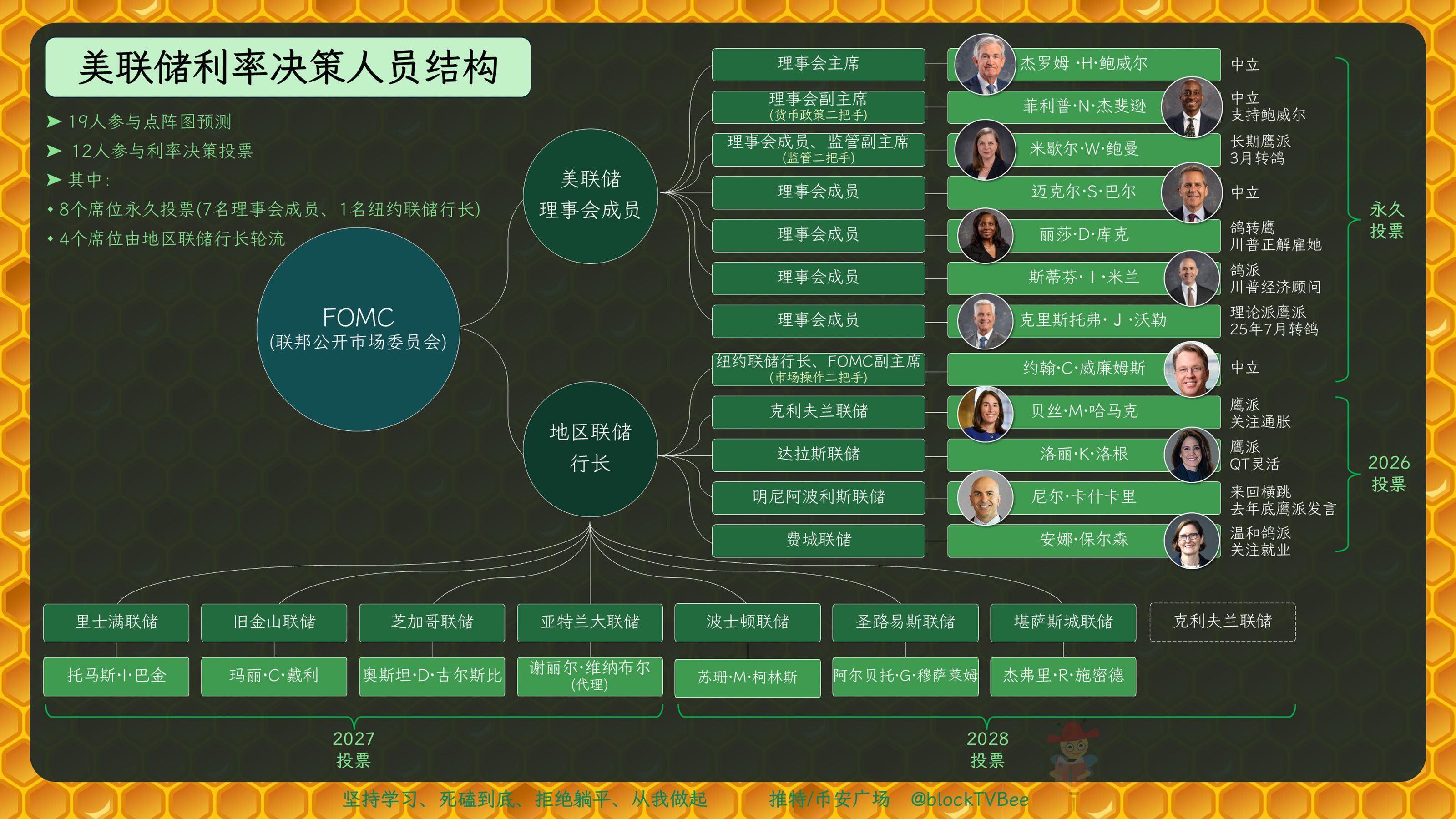
Why can't the dot plot represent 100% of interest rate forecasts?
A Visual Guide to the Fed's Interest Rate Decision-Making Personnel
First, the Fed's monetary policy is not decided by the Chairman alone.
Second, decisions regarding core monetary policy, such as whether to cut or raise interest rates, maintain the status quo, reduce or expand the balance sheet, or maintain the status quo, and open market operations, are often decided by voting.
Third, the Fed's quarterly summary of economic projections, including the dot plot of interest rate projections, involves all 19 seats on the FOMC (Federal Open Market Committee).
Third, not all FOMC members participate in the voting on core monetary policy; only 12 seats are used.
Fourth, the Fed Board of Governors consists of 7 seats, plus the president of the New York Fed; these 8 seats have permanent voting rights on core monetary policy.
Fifth, the remaining 4 voting seats are rotated annually by the presidents of the other 11 states' Fed branches.
Therefore, the dot plot cannot represent 100% of the Fed's interest rate forecasts.
The March dot plot included seven officials predicting no rate cuts. There's an extreme possibility that all seven might be non-voting officials in 2026.
Of course, the probability of this is practically zero. This is just an example to illustrate that the dot plot doesn't represent the Fed's interest rate forecasts 100%.
My view is that both Fed officials' statements and the dot plot itself influence market expectations. When the Fed lacks a clear direction, officials generally exhibit a balanced approach, lacking a clear direction. This year, the distribution of 4 doves, 4 hawks, and 4 neutrals out of 12 voting officials is quite even. The March dot plot showed seven predictions of zero and one rate cut in 2026, likely following the same logic.
Furthermore, the 12 actual voters are not entirely the same as the 19 who participated in the dot plot predictions. Therefore, the information conveyed by the dot plot may differ from actual interest rate policy.
Especially after Warsh took office, there could be even greater uncertainty. Q3 may be a transitional phase, during which officials will likely conduct research and discussions based on economic data.
However, there is still a chance for an interest rate cut in Q4, as the US employment problem may be more serious than the inflation problem, especially after high interest rates continue into Q4.