Why did safe-haven assets like gold and "digital gold" BTC plummet today amid war panic?
Today's market data presents an extremely unusual combination:
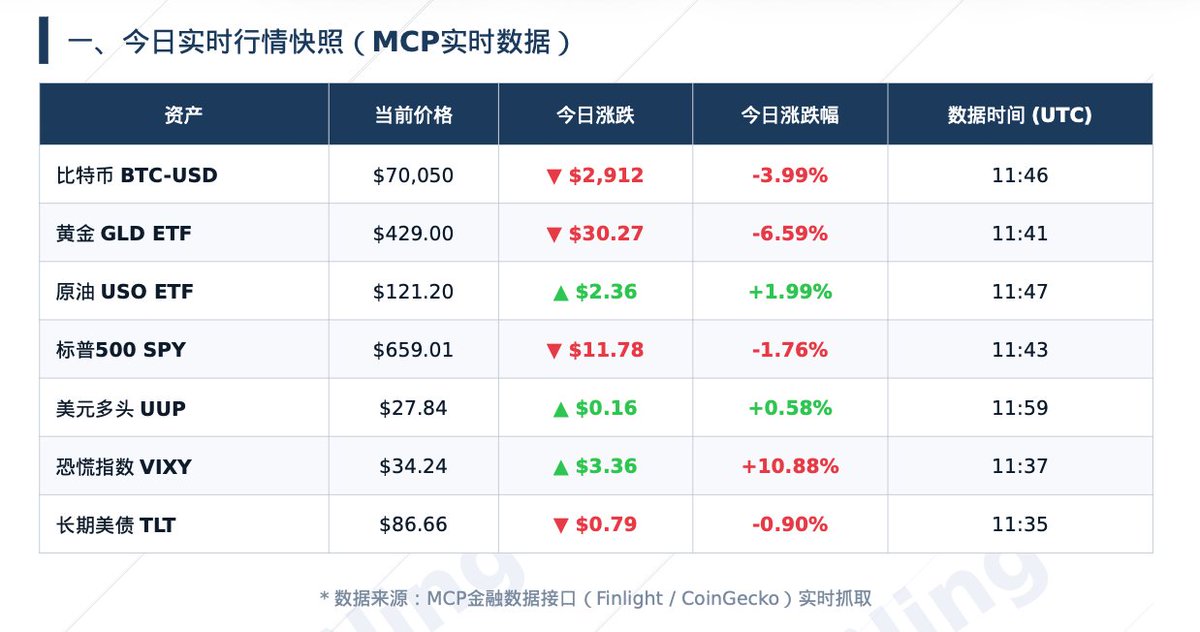
- The VIXY fear index surged +10.88% → Investors are extremely panicked, with risk aversion at its peak.
- Gold, however, plummeted -6.59%, and Bitcoin fell -3.99% → Both traditional safe-haven assets failed.
- Crude oil continued to rise +1.99% → The energy crisis remains unresolved.
- Long-term US Treasury bonds (TLT) also fell -0.90% → Even bonds are no longer considered a safe haven.
- The US dollar (UUP) rose +0.58% → The only "safe-haven" flow is cash (US dollars).
Today's market is a textbook example of "dash to cash" – investors are buying neither gold, nor Bitcoin, nor bonds; they are only buying US dollars.
The root cause is the "$100 Oil Paradox."
This war has created an extremely rare macroeconomic predicament.
Traditional logic: War panic → Capital flight to gold/Bitcoin ❌
The actual logic chain in this case: War → Hormuz blockade → Oil prices $110+ → Renewed inflation → Fed unable to cut interest rates → Increased opportunity cost of holding non-interest-bearing gold → Capital flight to US dollar cash → Gold/BTC crash ✅
In other words, the secondary effects of the war (energy inflation → monetary policy lock-in) are overwhelming its primary effects (panic buying → safe-haven buying).
The uniqueness of this war lies in the fact that it created an energy inflation crisis rather than a systemic financial crisis.
When market fear stems from inflation rather than credit collapse, the US dollar becomes the only true safe haven, while gold, Bitcoin, and even US Treasury bonds are under pressure.
This is a modern replay of the 1970s oil crisis.