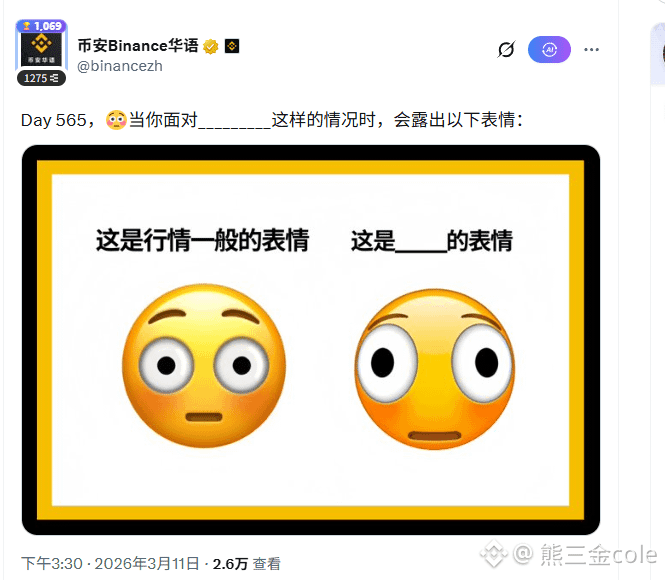
Binance posted an interesting image today, asking what situations would trigger the terrified expression on the right.
Actually, 90% of retail investors in the crypto market don't die in the "normal" fluctuations on the left, but rather in the extreme moment of "wide-eyed panic" on the right. 🤯
The expression on the left represents daily market monitoring: BTC fluctuates 1-2%, emotions are stable, and you can even casually do some grid trading. This is your "rational comfort zone."
What does the expression on the right represent?
It represents "a sudden 20% price drop," or "watching someone else's Dogecoin double in 10 minutes."
To put it bluntly, as long as you're human, you absolutely can't escape the emotional breakdown moments on the right.
You experience FOMO, you need sleep, and you might recklessly use leverage out of panic. To combat these human weaknesses, many people start to believe in various so-called AI trading bots.
However, most retail investors, in their pursuit of automation, fall into a huge trap, treating AI merely as a "tool" without giving it a proper "identity."
This is the fundamental reason why I've been deeply engrossed in #robo lately. If the previous wave of AI+Crypto hype was about "computing power sharing," then FabricFND is playing at a much deeper level: building a true robot economy network.
The core of the @FabricFND protocol is to assign independent on-chain financial identities to robots through the aGDP framework.
This means that AI assistants can directly purchase API computing power on-chain, complete arbitrage settlements on DEXs, and even hire another AI.
The entire payment, identity verification, and capital allocation process is a closed loop on-chain. AI transforms from a "tool" into an independent "economic entity."
I don't like reading lengthy white papers; I only look at the value flow.
In the Fabric system, #robo doesn't act as a token for air pollution control, but rather as a necessary settlement mechanism. With global labor shortages, the future trend of companies hiring "robot fleets" to work collaboratively is inevitable.
And to drive this massive fleet, $ROBO is an indispensable consumable. The logic is simple: the busier the network > the more real-world tasks are matched > the greater the robo consumption > the deflationary flywheel kicks in.
#robo $ROBO @FabricFND