🔥 War, tariffs, ETF losses... Stablecoin market capitalization rises instead of falls?
In the past month, the macro environment has essentially left no room for the crypto market to survive.
The US and Israel's actions against Iran caused oil prices to surge, triggering a surge in global risk aversion, putting pressure on US stocks, and causing cryptocurrencies to follow suit. BTC repeatedly tested the bottom between 65,000 and 72,000, with the Fear & Greed Index consistently hovering around "extreme fear."
However, a set of data on the blockchain is worth noting: even as BTC fell, the total market capitalization of stablecoins continued to rise. Money didn't leave; it simply moved from BTC and altcoins to stablecoin accounts.
This is a very interesting trend: more and more people are starting to treat "stablecoin investment" as a basic strategy in a bear market. Currently, stablecoin flexible deposit yields on CeFi platforms generally fluctuate between 4% and 7%. Taking 50,000 USDT as an example, at an annualized return of 6%, one would receive approximately 250 USDT per month, or 750 USDT per quarter—not particularly attractive, but certain.
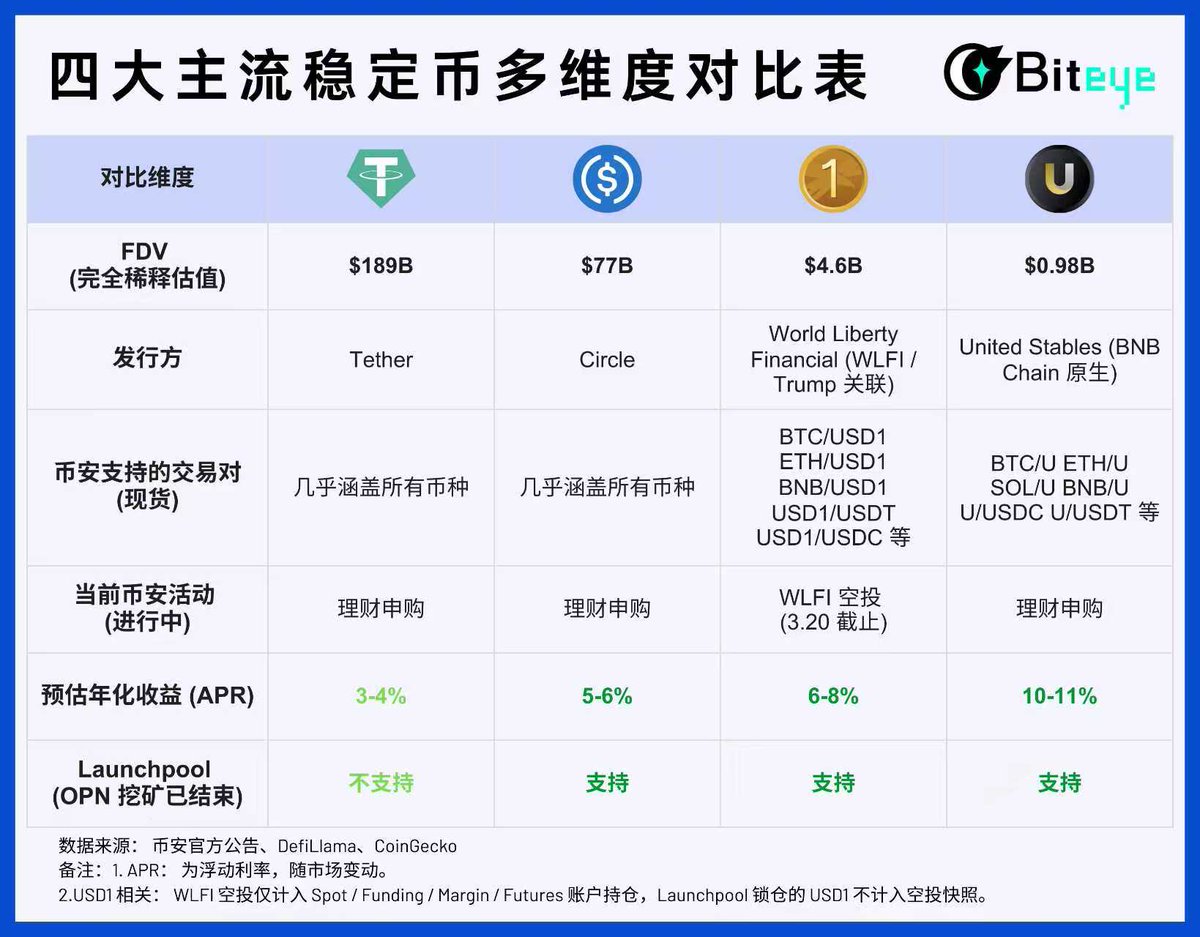
Biteye has compiled a multi-dimensional comparison of the four major stablecoins 👇
💡Biteye's View: Geopolitical conflicts are still escalating, and macroeconomic uncertainties are unlikely to disappear in the short term. However, Arthur Hayes's view has been repeatedly validated: after each geopolitical conflict, liquidity easing often follows. If this pattern holds true again this time, the real action now is not panic selling, but accumulating ammunition with certain returns, waiting for the starting gun of the next cycle.
We recommend including USD1 and USDU as part of a stablecoin portfolio, such as holding USDT, USDC, USD1, and USDU in a diversified manner. Use USDT/USDC to bet on stability, and USD1/U to bet on higher returns.
Biteye will continue to monitor good opportunities for profit during the bear market! 💪