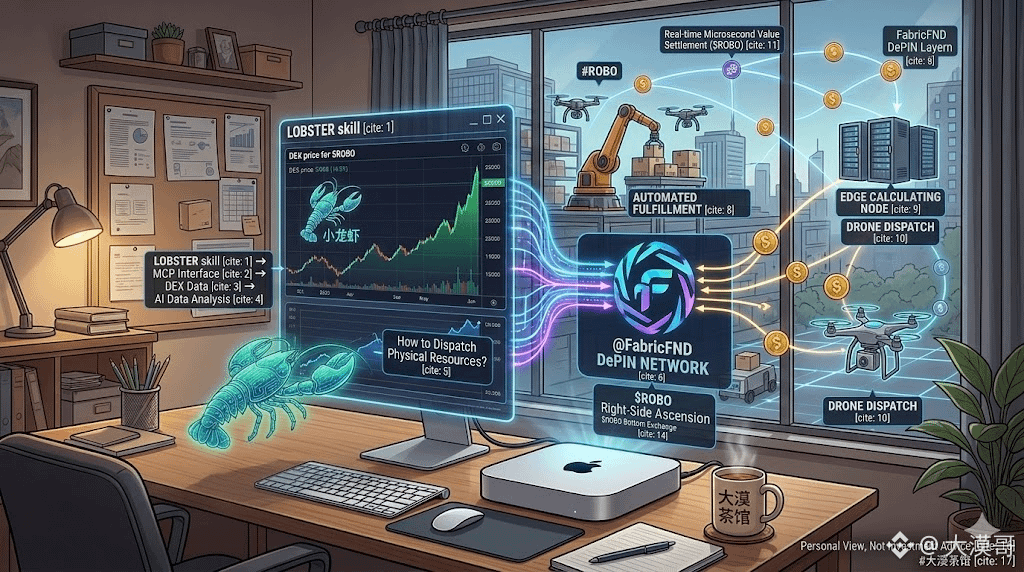
I just connected "Little Lobster" to the MCP interface of an on-chain DEX on my Mac Mini M4 to retrieve liquidity data in real time.
In the digital world, AI agents can now capture data and analyze metrics at millisecond speeds.
However, I've discovered a very real gap: when an agent calculates a trading opportunity, how does it allocate resources in the physical world?
For example, to cope with extreme market conditions, can it call upon stronger edge computing power across platforms, or coordinate with offline security and isolation equipment?
This is precisely the problem that @FabricFND is solving—providing AI agents with a decentralized execution layer that directly connects to physical hardware.
If MCP is the "universal interface" for AI to acquire data, then the Fabric protocol is the "standard language" for AI to command physical hardware.
In this highly automated network, all cross-platform collaboration relies on $ROBO's high-frequency, microsecond-level value settlement.
This closed loop of "agent + physical infrastructure" has far greater explosive potential than a simple large-scale cloud model.
Currently, $ROBO has seen sufficient turnover at the bottom, and its upward channel on the right side is very stable.
In the face of a clear trend, following the trend is the best choice.
Personal opinion, not investment advice. #ROBO #DesertTeahouse