TermMax "90x" - A Misconception? Correct These 3 Points First, or You'll Misunderstand the Game. @TermMaxFi
Many people's first reaction to TermMax's "Multiplier/Early Bird/90x/YT/LP/PT Loop" is: Go for it!
But I think the most important thing is to correct these 3 common misconceptions first, otherwise it's easy to "misunderstand the game."
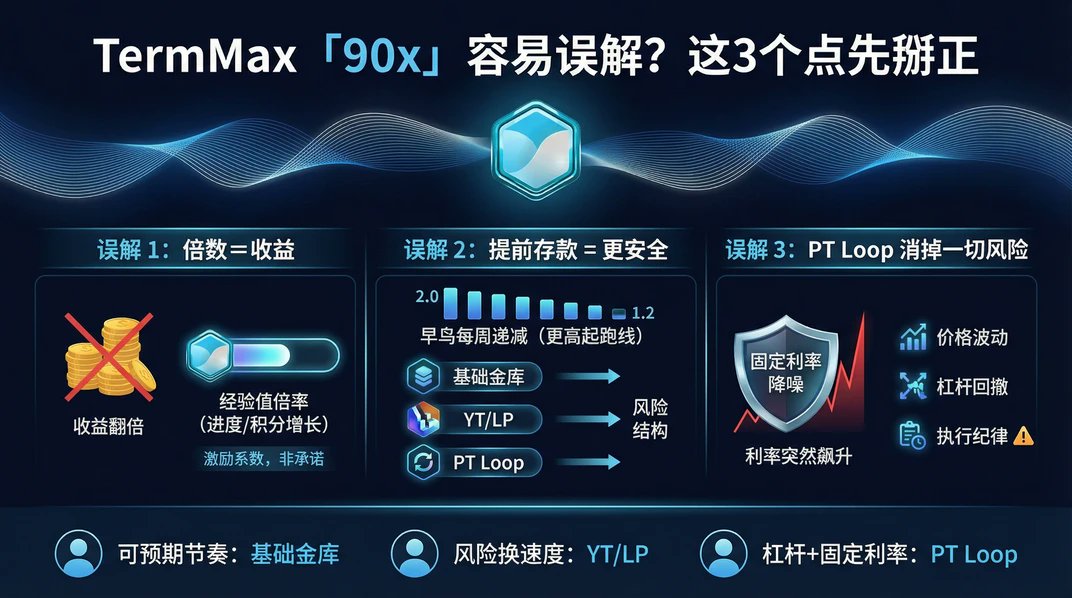
Misconception 1: Multiplier = Returns.
Early Bird × Duration refers to the experience value multiplier (progress/point growth), not a direct doubling of your asset returns.
Especially seeing the Pendle's 90x, it's more like an incentive coefficient for providing TMX asset liquidity (YT/LP), not a return guarantee.
Misconception 2: Early Deposit = Greater Security.
Early Bird does indeed decrease weekly (2.0→1.8→1.5→1.2), but entering early essentially locks in a higher starting line.
However, the risk structure is completely different depending on whether you choose the basic vault, YT/LP, or PT Loop. Early birds don't bear the risk for you.
Misconception 3: PT Loop eliminates all risk.
The highlight of PT Loop is using fixed-rate borrowing for cyclical amplification, eliminating the variable of sudden interest rate spikes.
But price volatility, leverage drawdown, liquidation distance, and execution discipline still exist.
In short: Fixed interest rates are noise reduction, not a shield.
After clearing up these misconceptions, it comes down to a simple question: What kind of player are you?
① Those who want a predictable pace:
The basic vault route is more suitable. Your advantage comes from the two layers of compound interest: early bird locking and duration rewards, not chasing maximum multiples.
② Those willing to trade risk for speed:
Only then look at Pendle's YT/LP. Higher multiples, but also higher requirements for volatility, liquidity, and strategy complexity.
③ For those who use leverage but dislike interest rate uncertainty:
PT Loop fixes financing costs before amplifying returns, but you need a clear plan for drawdowns and position discipline.
I actually think it has a clever design: no mandatory lock-up. You can exit at any time, but the longer you stay, the higher the leverage. The system prioritizes long-term investments, tolerates volatility, and adheres to the rules.