

















作者:Odaily 星球日报
Original article by Odaily (Planet Daily)@OdailyChina)
Author|Wenser@wenser 2010)

Time is running out for traditional betting companies; this may be the latest consensus in predicting the market landscape.
In the recently concluded Oscars, Kalshi and Polymarket's combined betting funds surpassed $100 million for the first time, a figure that remained in the less than ten million dollar range last year. Meanwhile, Kalshi partnered with Cash App to streamline user payment channels; Polymarket, after launching its AI Agent CLI application, now supports 24/7 transactions via Alchemy's AgentCard. In 2026, a pivotal year for predictions, the two giants of the prediction market are vying for new users from traditional betting companies, internet platforms, and even traditional media and finance. This time, they are primarily targeting real users on payment channels and tireless AI agents.
Prediction Market Giants' New Battleground: Payment Channels and AI Agent Users
Last week, Paradigm, a well-known investment firm, released its first public opinion poll of the year.The first survey report on prediction market platforms.
The survey results showMore than one-third (about 36%) of American voters have used prediction markets, or participated in betting, or browsed the market for information.
In terms of user demographics, prediction market users under 50 years old accounted for 66%, with those aged 18-34 accounting for 20% and those aged 35-49 accounting for 27%. Non-white voters used prediction markets slightly more than white voters, and men used prediction markets significantly more than women (46% vs. 31%).
Therefore, in the US market, prediction markets are no longer a "niche sector" but rather an "information source," "trading platform," and "information pool" that are closely related to every household.
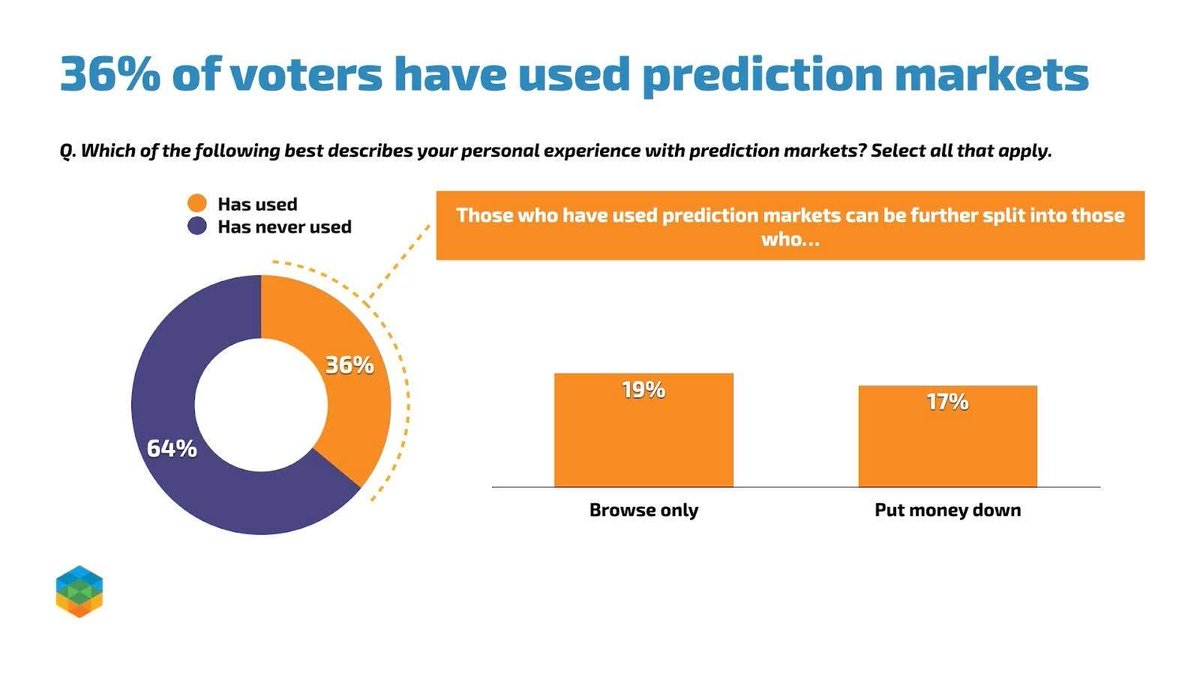
Of course, as the lead investor in Kalshi's previous $1 billion funding round, Paradigm's move is undoubtedly a "shout out for his bag" (promoting its own investment), which is perfectly understandable.But this survey also reflects a new problem—how do Kalshi and Polymarket, the two giants in the prediction market, penetrate the remaining 64% of American voters and even all American citizens?
The answer is naturally: either wage war against the old guard or seek new growth.
Kalshi's new approach to growth: Integrating payment channels and encouraging users to deposit funds.
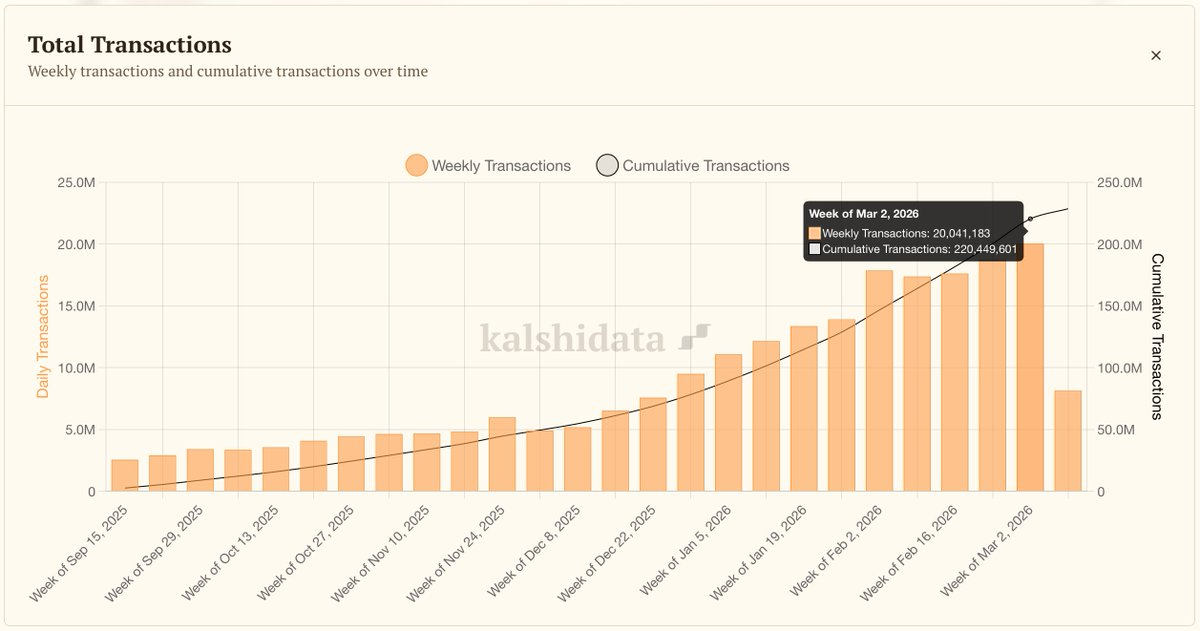
The number of transactions in Kalshi during the week of March 2 to March 8This marks the first time the platform has surpassed 20 million transactions in a single week, setting a new record for the platform's highest number of transactions in a single week since its inception.With transaction volume and number of transactions constantly breaking new records, if one wants to take it a step further, then leveraging the existing user base is undoubtedly a more effective strategy.
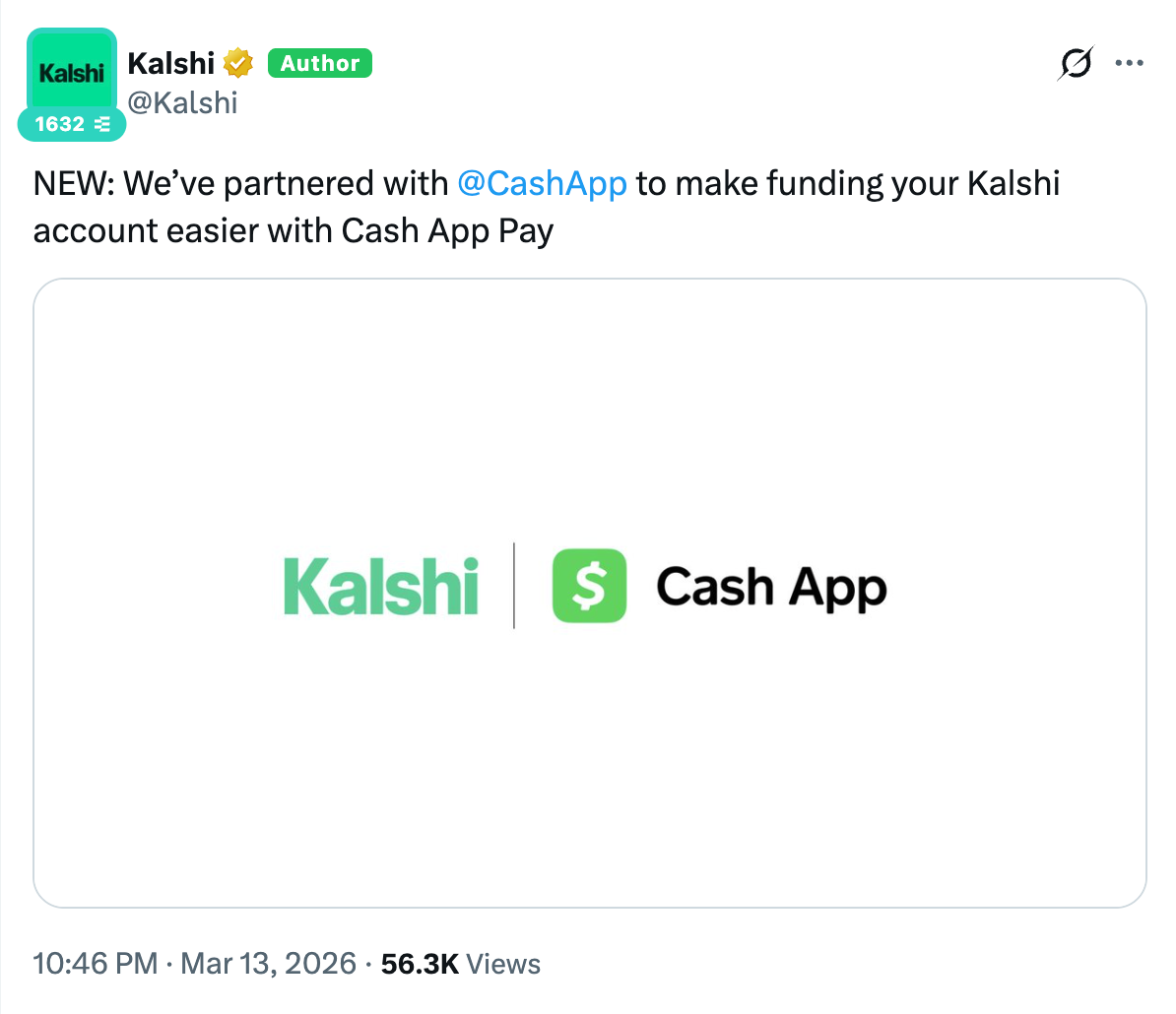
This might explain why Kalshi officially announced its partnership with Block's payment app, Cash App, last week. Kalshi's official statement was even more direct: "Make funding your Kalshi account easier with Cash App Pay." The message practically screams, "Start betting now with Cash App Pay!"
After all, even if only one percent of Cash App's 59 million monthly active users converts, it will bring Kalshi nearly 600,000 users, which is equivalent to the user base that Kalshi has painstakingly cultivated for two or three years.More importantly, these are all "incremental growth opportunities".
Polymarket's market expansion strategy: In addition to humans, AI agents are also target users.
On the other side of the prediction market, Polymarket, one of the duopoly players, is also performing admirably.
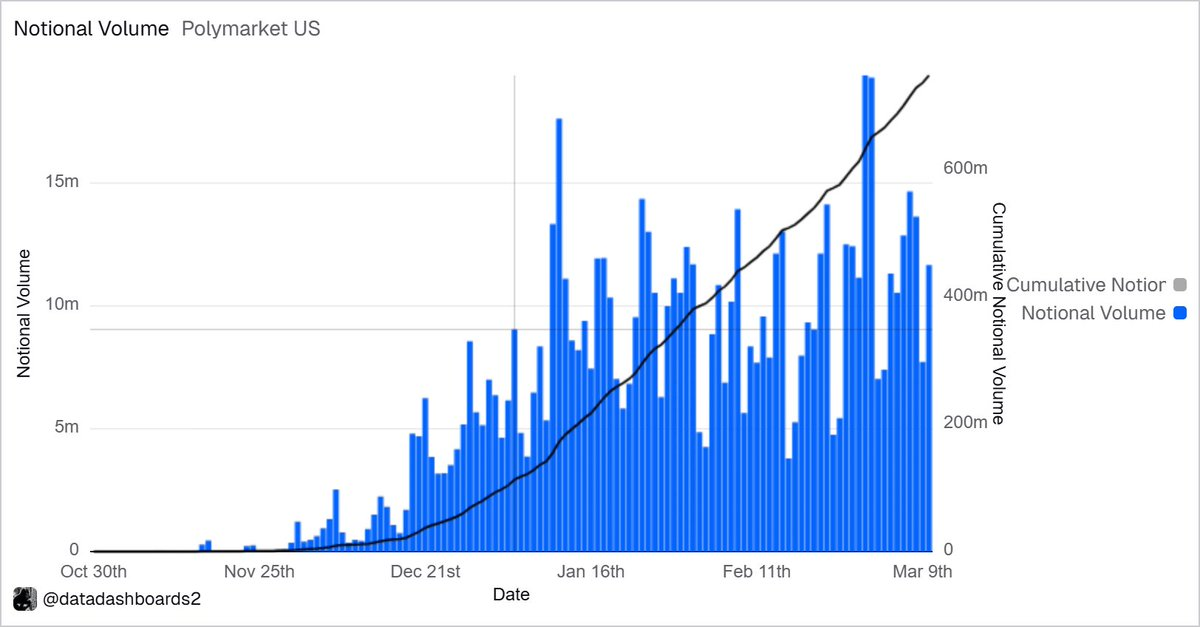
Since resuming operations in the United States last November, as of March 14,Polymarket US platform nominal trading volumeIt has surpassed $750 million, with over 5 million transactions. Previously, the platform's open interest reached as high as $2.6 million, but has recently fallen back to around $1 million.
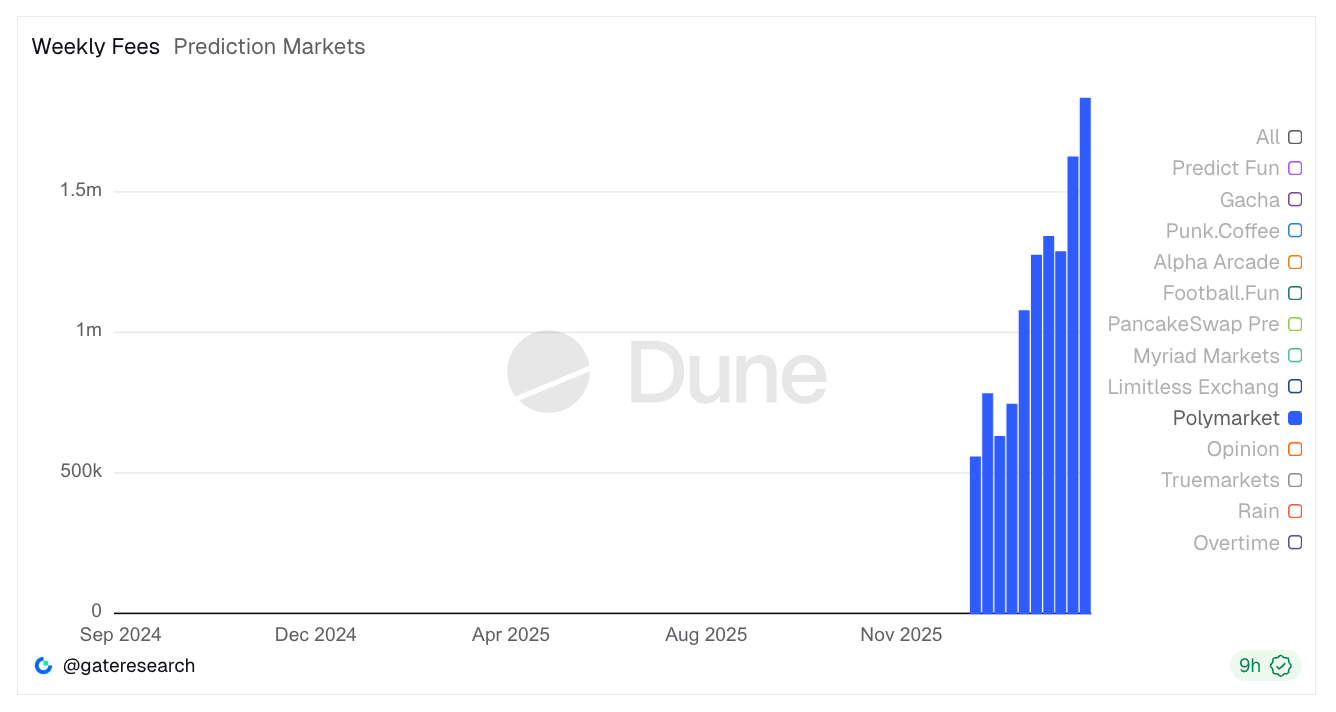
In addition, according toDune DataSince Polymarket began charging transaction fees on certain markets (including the NCAA and crypto diversification markets) on January 6, it has accumulated [amount missing] in fees.Over $11.2 million in transaction fees.In other words, Polymarket has fully demonstrated its ability to generate revenue.
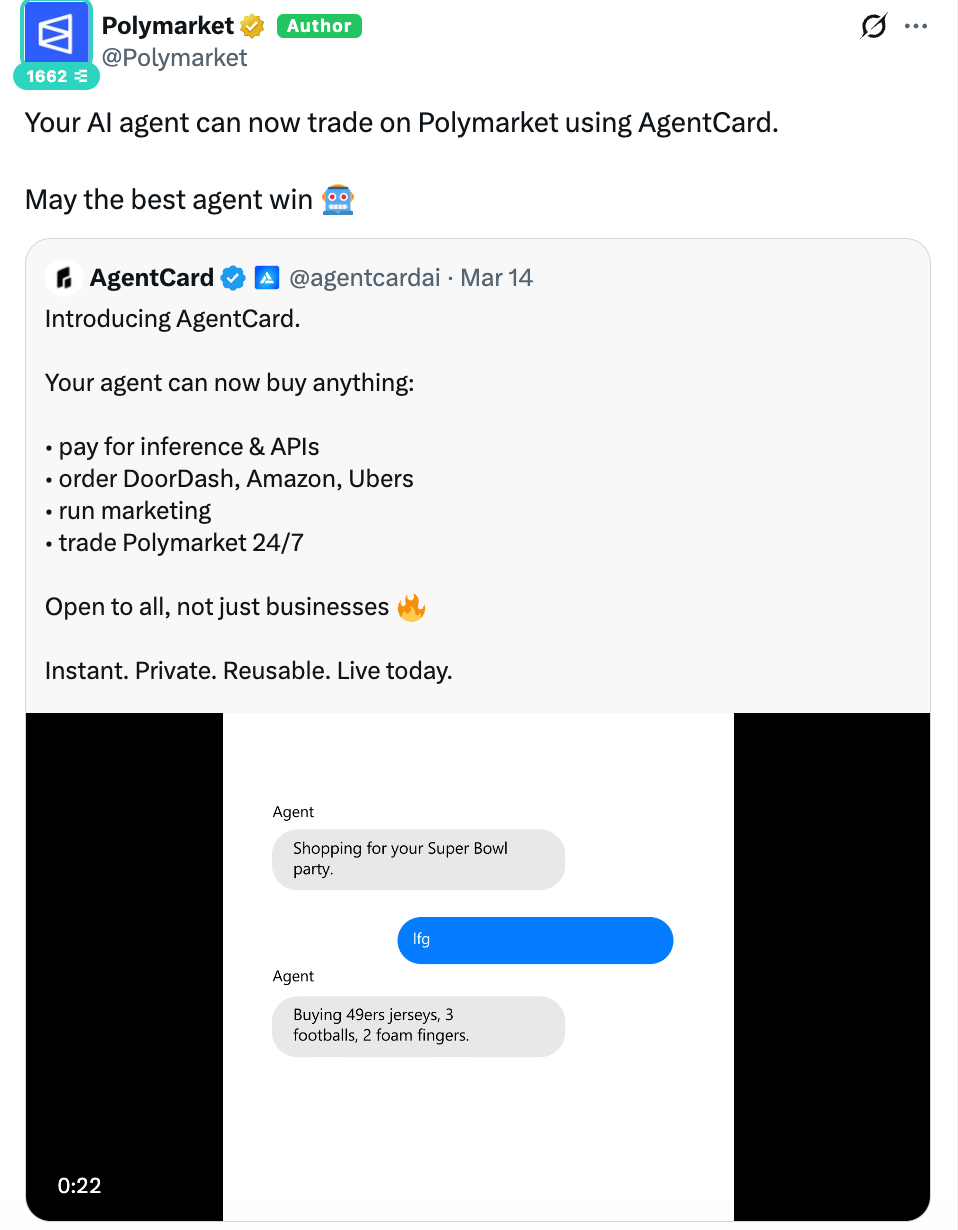
Therefore, the ambitious Polymarket is no longer satisfied with the existing market of human users, and has even begun to bet on supporting AI agents to trade 24/7.
Last weekend, the crypto payment platform Alchemy officially launched...AI-powered agent payment platform AgentCardIn addition to standard payment functions such as food delivery and AI app subscriptions, it also emphasizes..."Users' AI Agents can now trade on Polymarket 24/7"; this message was subsequently confirmed by Polymarket.
Against the backdrop of OpenClaw's "Lobster" payment boom and the widespread support for AI Agent payments from x402, ERC8004, and ERC8183, combined with Polymarket's previous...Polymarket CLI designed specifically for AI AgentsA prediction market platform that supports functions such as querying prediction market data, executing orders, managing positions, and interacting with on-chain contracts is gradually taking shape.
Like Circle, which has transformed from a "stablecoin issuer" into a "financial infrastructure builder for the AI era," Polymarket has already secured a key niche in the ecosystem as a "prediction market platform for AI agents."As Nvidia founder Jensen Huang said at last year's CES, the AI Agent industry will become a trillion-dollar sector, just like the robotics industry, and the 24/7 AI Agent may first shine in the prediction market.
Conclusion: The new war for predicting markets has begun.
Undoubtedly, a new war has quietly begun for prediction market platforms, which includes not only deeply engaging existing users, continuously incentivizing active users, and constantly converting new users; but also expanding the boundaries of betting events, communicating and engaging with regulatory authorities, and even future-oriented development towards "potential active users" such as AI agents.
Previously, Dingaling, the founder of Predict.fun, a prediction market platform in the BSC ecosystem, had planned to launch a product that combines prediction markets with DeFi, aiming to provide users with interest-bearing returns on their account funds. This could be considered an alternative "PayFi yield-generating product" and is quite anticipated.
Regardless of how the market unfolds, Kalshi and Polymarket have already begun leveraging new growth drivers in their pursuit of $20 billion or more in funding.