





















作者:区块律动
Original title: Polymarket v. Kalshi: A Complete Timeline of The Prediction Market Meme Wars
Original author: Hunter Ryerson, Pirate Wires
Compiled by: Peggy, BlockBeats
Editor's Note: From a free general store to a meme war of mutual mockery, the competition between Polymarket and Kalshi has long since transcended product and market share, becoming a meticulously craftd war for attention. This article traces the timeline of the rivalry between the two prediction market platforms over the years: regulatory maneuvering, user bans and reinstatements, the "competitive meme wars" on social media, and the marketing spectacle that ultimately spilled over into the real world. Behind the seemingly absurd and dramatic maneuvers lies a continuous rise in trading volume, valuation, and capital expectations.
The following is the original text:
February 12th, early morning, Manhattan. You wake up in a tiny, shoebox-sized apartment that costs $2,000 a month. You turn on the heat, drag yourself to the pantry, hoping to scrape together some breakfast. Then you remember: at 3 a.m. last night, you heated up and ate the last packet of instant ramen.
Just as you're hesitating about whether to continue contributing 20% of your income to DoorDash, a friend texts you, telling you about a new grocery store called "The Polymarket" that opened on Madison Street—and everything inside is free. So, naturally, you put on your pants, stroll over to Lower Manhattan, successfully squeeze into the store, and instantly enter "Black Friday shopping spree" mode, frantically buying everything in front of you, grabbing everything your debt-ridden hands can reach.
As you walk home with your bulging shopping bag, stuffed full of Sour Patch Kids gummies and vegetables you haven't seen in weeks, tucked under your arm, you pass a billboard advertising a promotion at an East Village market—sponsored by a company called "Kalshi"—giving away $50 worth of free groceries.
Am I dreaming? How could I be so lucky?
Congratulations, you've been caught up in the latest round of advertising frenzy in the prediction market.
That's right. Just this week, the wildly popular prediction market platform Polymarket announced its latest marketing gimmick: opening a "completely free grocery store" in New York City, open from February 12th to February 16th.
Its competitor, another prediction market, Kalshi, was not to be outdone, and launched its own "grocery-themed" marketing campaign: for one day only, it gave away $50 in general grocery subsidies to everyone at Westside Market on Third Avenue.
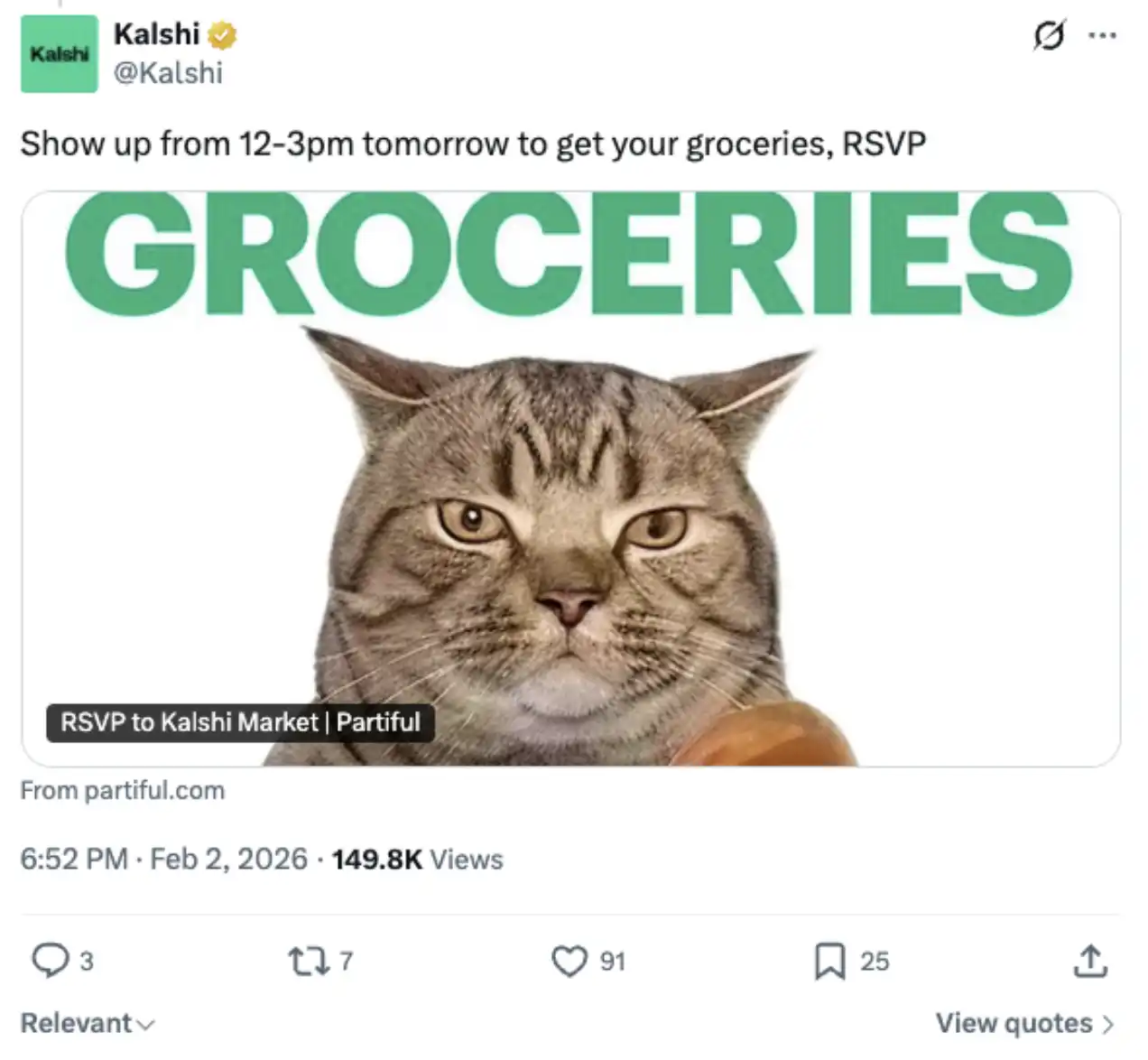
This back-and-forth imitation behavior prompted one X user to complain: "Kalshi and Polymarket can't even stand 24 hours a day, they have to copy everything from each other."
At first glance, it seems absurd that Polymarket and Kalshi would compete on marketing with "free bananas." But this is simply the latest episode in the long-standing feud between these two platforms. Keep in mind, their weekly transaction volume reaches billions of dollars. Their business model, simply put, is this: people can bet on the outcome of seemingly harmless events for extremely high returns, such as—whether the US military will arrest Venezuelan leader Nicolás Maduro while he's wearing casual pajamas. (That night, some unknown, but hopefully not Pete Hegseth, internet sleuth made a fortune.)
In short, these two prediction market platforms have always been competitors in the past five years, but the real fierce competition has only fully erupted in the last two years.
Polymarket, founded in 2020 by NYU dropout Shayne Coplan, is a cryptocurrency-based platform. Bettors need to deposit USDC, a stablecoin equivalent to the US dollar, on the Polygon blockchain to purchase shares of "yes" or "no" predictions.
In contrast, Kalshi initially operated almost entirely in US dollars, with transactions and fund deposits and withdrawals completed through traditional bank accounts. Since its launch in 2021, it has primarily focused on sports betting, which accounts for 90% of the platform's total transaction volume. Polymarket, on the other hand, leans more towards geopolitical and cultural events, such as wars, conflicts, and elections, and even pays American influencers to promote its political content.
From 2022 to 2025, Polymarket was under intense regulatory pressure from the U.S. Commodity Futures Trading Commission (CFTC) (and was fined $1.4 million), effectively handing over the U.S. market to Kalshi for several years. However, just a few months ago, Polymarket returned to the U.S. market, reigniting the fierce conflict between the two sides, with various frictions unfolding on the X platform and in the wider cyberspace.
For netizens who are "always online," the most entertaining part of this war is the so-called "competitive shitposting."
In the sports world, this strategy manifests as parodies of official sports announcement cards—the kind you often see on ESPN or FOX Sports accounts used to announce trades, drafts, or injuries. Both platforms use attention-grabbing, joking headlines to "report" sports news. For example, Polymarket's "DICK IS GROWING" alludes to Toronto Raptors player Gradey Dick's weight gain; and Kalshi's "LOVES RECEIVING BALLS" refers to San Francisco 49ers running back Christian McCaffrey, saying he "likes to catch"—you know, literally meaning "catching and passing the ball."

But as both sides fought for "meme-based attention," their tactics began to become increasingly underhanded.
In November 2024, evidence emerged that Kalshi attempted to pay influencers—such as former NFL wide receiver and current X platform activist Antonio Brown—to publish and spread negative comments about Polymarket (see: "Kalshi Pays Influencers to Attack Polymarket CEO After FBI Raid"). In one case, a journalist was reportedly paid $3,500 to write a smear article against Polymarket. (As an aside: If Solana were willing to pay that much to write a smear article, I could impeach Jackie Fielder by Monday.)
Kalshi reportedly manages influencers with a combined following of millions. Over the past few years, they have been attempting to gradually erode Polymarket's credibility.
Following this incident, the Trump administration relaxed regulations on prediction markets, allowing Polymarket to make a strong comeback in the US market. After months of preparation, the ban on US users was finally lifted in December, and Polymarket is now attempting to regain a majority share of the on-chain prediction market (currently, Kalshi still holds a dominant position after its integration with the Solana blockchain).
One way they found to "amplify their voice" was to do news on X. Over the past few months, Polymarket and Kalshi's brand accounts have clashed head-on on timelines, vying for the upper hand with short, powerful headlines and celebrity quotes—sometimes disregarding accuracy or any other principles. Recently, Polymarket mistakenly attributed a statement to Jeff Bezos and significantly exaggerated deportation data; while Kalshi spread false information about negotiations to acquire Greenland.
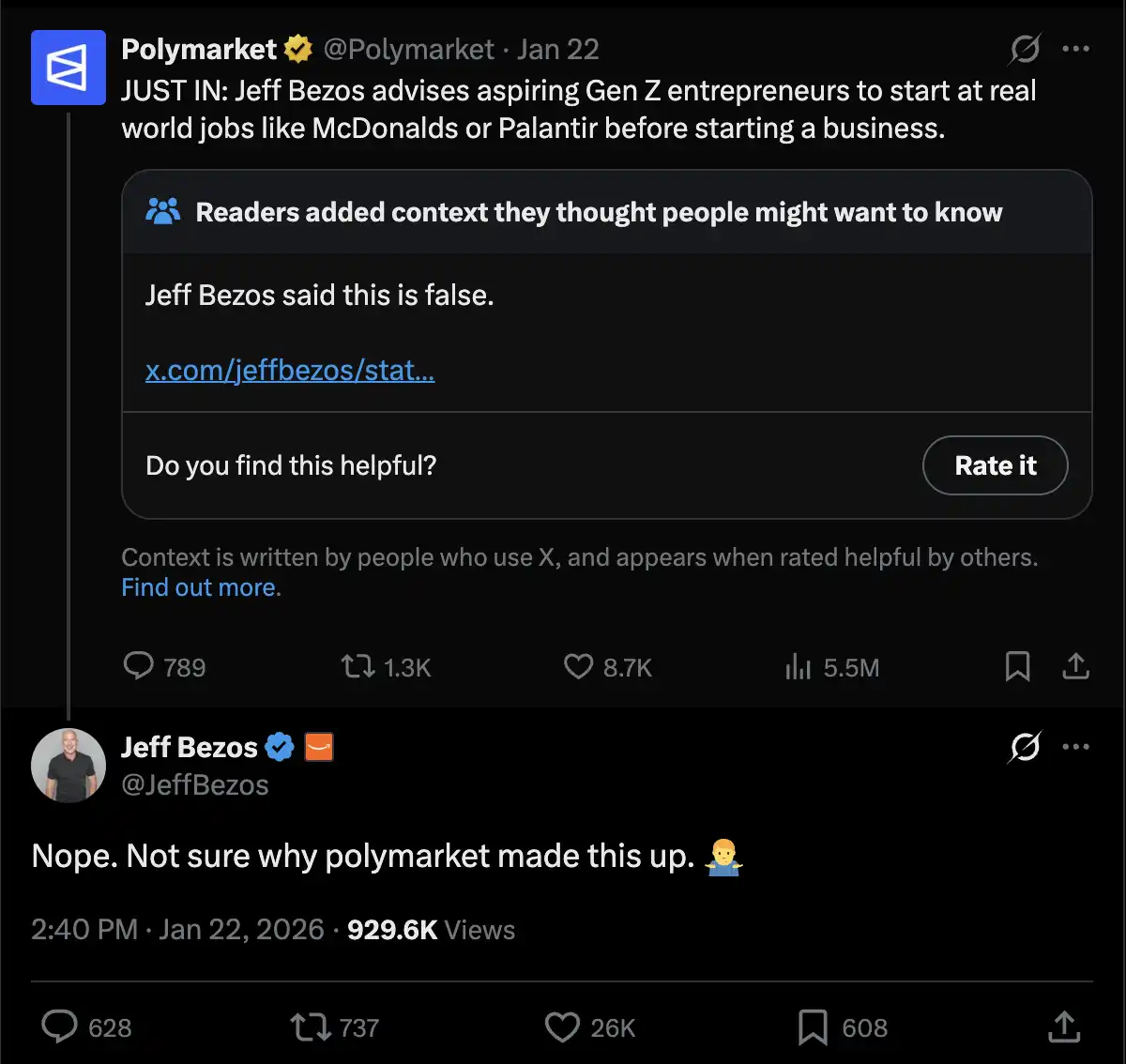
Ultimately, this feud has spilled over from the online world into the real world, and hopefully it will continue to have some positive "spillover effects" for ordinary Americans like you who are strapped for cash. But the real point is this: whether it's a marketing gimmick like "free groceries" or the mutual mockery and backstabbing on the X platform, both companies are extremely good at creating buzz and keeping people talking about them.
No matter how dubious their attempts to outdo each other may be, whether they appear sinister or strangely generous, we keep talking about it.
Perhaps this is exactly what they wanted. Kalshi and Polymarket are valued at $11 billion and $9 billion respectively, and they continue to climb at an astonishing rate. So, as long as the dramatic maneuvers in this frenzied war can attract a few hundred more bettors or bring in a few more investors, it's all worth it. It's a win-win situation for these two "duelers," if you're willing to believe it.



No Comments