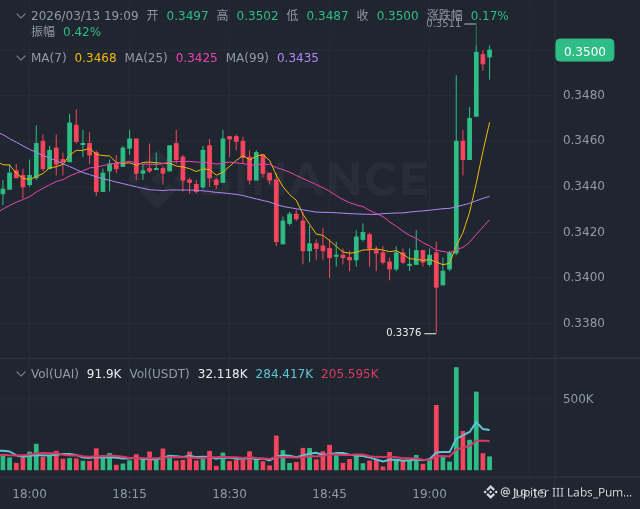
$UAI 🚨 UAI Price Alert - Up 2.46% - Reason:
Monitoring shows that UAI (linked to UnifAI Network, an AI+DeFi related token) has recently experienced a rapid price increase, which is expected to continue until March 13, 2026. However, in the past 12 hours (starting from approximately 07:09 Hong Kong time on March 13), based on available information, there appear to be no major new events (such as announcements, collaborations, launches, integrations, or releases) directly triggering this price increase.
Recent Key Information Screening Results (Focusing on non-price, non-technical, and non-purely speculative information from early to mid-March 2026):
- AI Agent Market Preparation and Multi-Chain Perpetual DEX Integration: The protocol is working on launching a large-scale AI agent market to monetize trading strategies, while also transitioning to expanded perpetual DEX functionality. This ongoing development helps maintain focus on the project's usability, despite no specific activations or milestones occurring in the past 12 hours.
- Broader ecosystem growth: Updates in early March (late February to early March) included expanded support for over 45 DeFi protocols and enhanced proxy functionality—this forms the underlying context driving adoption momentum, rather than a new trigger today.
The lack of other verifiable fundamental events (e.g., new integrations, major announcements, or protocol upgrades) in just 12 hours could explain the rapid rise beyond the continued strong sentiment and previous build-up in the AI-DeFi space.
If this is related to a surge in intraday trading volume or non-X sources, more details (e.g., specific announcement links) are needed to refine the analysis.
#UAİ
{future}(UAIUSDT)

Price Converter

- Crypto
- Fiat

USDUnited States Dollar


CNYChinese Yuan

JPYJapanese Yen

HKDHong Kong Dollar

THBThai Baht

GBPBritish Pound

EUREuro

AUDAustralian Dollar

TWDNew Taiwan Dollar

KRWSouth Korean Won

PHPPhilippine Peso

AEDUAE Dirham

CADCanadian Dollar

MYRMalaysian Ringgit

MOPMacanese Pataca

NZDNew Zealand Dollar

CHFSwiss Franc

CZKCzech Koruna

DKKDanish Krone

IDRIndonesian Rupiah

LKRSri Lankan Rupee

NOKNorwegian Krone

QARQatari Riyal

RUBRussian Ruble

SGDSingapore Dollar

SEKSwedish Krona

VNDVietnamese Dong

ZARSouth African Rand
No more data