I've recently become obsessed with badminton. For many years, I was stuck at the 3.0 level in the Chinese Badminton Association (BBA) rankings, and I was determined to move up to 4.0. I unexpectedly discovered that what was limiting me wasn't my racket control, but my footwork.
Fortunately, after a few lessons with my coach, I gradually found my footwork rhythm and was delighted to see an improvement in my return of the ball in singles. I recently saw a post on Xiaohongshu titled "The Four Fundamental Logics of Badminton," and it resonated with me deeply. It suddenly occurred to me that this concept has many similarities to Crypto investing.
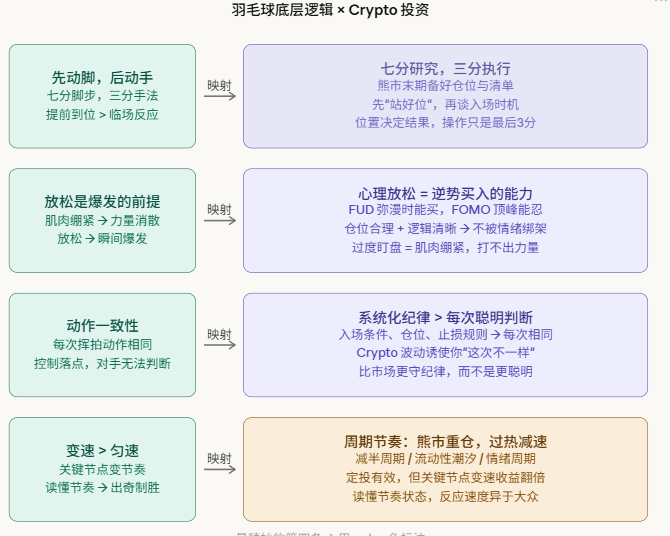
Fundamental Logic 1 - Move your feet first, then your hands (70% footwork, 30% technique)
Feet are like the right target + the right position; hands are more like candlestick charts + operations.
Fundamental Logic 2 - Relaxation is the prerequisite for explosive growth. Reasonable position sizing + a relaxed mindset; don't rush to go all-in; learn to wait, don't FOMO.
Fundamental Logic 3 - Consistency of movement + control of landing point
Do you have a trading system, or are you trading entirely based on intuition?
Fundamental Logic 4 - Energy and rhythm logic: Variable speed > Constant speed
The market spends most of its time in oscillation and downtime; there's no such thing as continuous profits. You need to seize the brief "explosive window" opportunity – move like a virgin, stay still like a rabbit.
I had Claude create a chart and am sharing it here for everyone's convenience. Finally, I'd like to reflect that while the techniques differ in all things, the fundamental principles are interconnected.

Price Converter

- Crypto
- Fiat

USDUnited States Dollar


CNYChinese Yuan

JPYJapanese Yen

HKDHong Kong Dollar

THBThai Baht

GBPBritish Pound

EUREuro

AUDAustralian Dollar

TWDNew Taiwan Dollar

KRWSouth Korean Won

PHPPhilippine Peso

AEDUAE Dirham

CADCanadian Dollar

MYRMalaysian Ringgit

MOPMacanese Pataca

NZDNew Zealand Dollar

CHFSwiss Franc

CZKCzech Koruna

DKKDanish Krone

IDRIndonesian Rupiah

LKRSri Lankan Rupee

NOKNorwegian Krone

QARQatari Riyal

RUBRussian Ruble

SGDSingapore Dollar

SEKSwedish Krona

VNDVietnamese Dong

ZARSouth African Rand
No more data