Why is it said that Injective has written the market structure into the deterministic instinct of on-chain finance?
Following up, I've been chatting with several DeFi developers lately, and the most common complaint is—on-chain trading should be more efficient, so why are we always stuck with old problems like order matching delays and inconsistent clearing rules? It wasn't until I delved into @Injective that I understood: what on-chain finance lacks isn't speed, but a structure that understands finance from the ground up.
{spot}(INJUSDT)
@Injective isn't a chain built for speed alone; it's more like an architect of a financial system. Traditional public chains let DEXs write their own order books, resulting in fragmented liquidity across different protocols and ridiculously high slippage. But Injective directly writes the order book as a chain-level module, like building a shared kitchen for all financial applications—whether you're doing perpetual contracts or spot trading, you use the same stove and refrigerator, sharing ingredients (liquidity) and having unified cooking (matching). A team previously used it to build a derivatives platform, and on the day of launch, order depth tripled, and slippage was halved. Isn't that much better than operating independently?
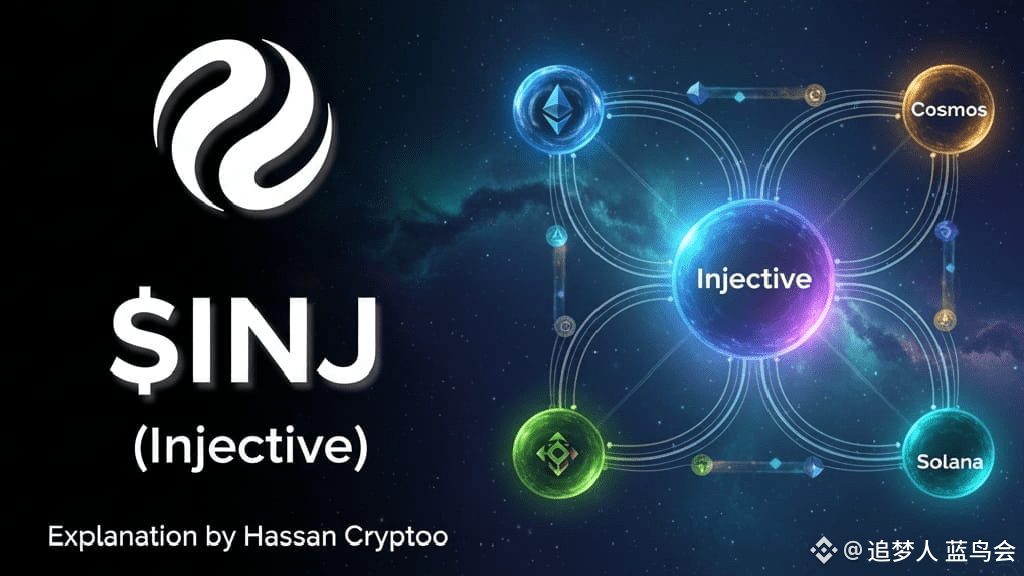
The multi-execution environment is also ingenious. Injective allows EVM and CosmWasm to collaborate within the same state machine. Developers can share order books and assets using tools written in Solidity and strategies written in Rust. A friend who works on quantitative strategies said that previously, cross-virtual machine data matching was always a step behind; now, with @Injective, strategy triggering and market data are synchronized instantly, doubling backtesting efficiency.
Cross-chain functionality is even more practical. It connected to the Cosmos ecosystem early on using IBC and built an Ethereum bridge, unifying assets from different chains into a directly tradable format. For example, if you want to hedge with ETH and BTC on Injective's DEX, you used to have to deal with cross-chain bridges; now you can place an order directly, and the assets arrive instantly—that's true cross-chain functionality.
The economic model is also interesting. INJ's burning mechanism doesn't rely on inflation to artificially inflate its value; instead, it pools protocol revenue into an asset pool, which users then bid on using INJ. The more active the ecosystem, the more is burned, making $INJ even scarcer. This isn't just token economics; it's clearly a self-value-adding machine for the network.
Honestly, the longer I study @Injective, the more it seems like a financial Lego baseboard—unpretentious, but every block fits perfectly. It doesn't chase trends or pad its ecosystem size; it focuses on mastering the hard nuts of market structure and execution certainty. How can such a chain not inspire anticipation for supporting more professional financial scenarios and becoming a new cornerstone of on-chain capital? I have high hopes for #Injective; it's not just there to fill a quota, it's here to define the next era.
Injective is truly different; the value of $INJ is hidden in every line of on-chain code. I believe that in the future, when people talk about professional on-chain finance, the first thing that comes to mind will be this chain that has "structure" etched into its DNA. @Injective Keep it up! I'm waiting to see how you reshape finance!
#Injective