I recently watched three Netflix Japanese dating reality shows in one go, which sparked an idea: to create a dating reality game that's different from traditional otome games, closer to a human observation/realistic hybrid. A couple of days ago, I posted on XHS saying "Love is an extension of a person's psychological structure," and it quickly went viral. The gist was that I discovered the filming techniques and guests of Japanese dating reality shows are very adept at exploring "Who am I, and why do I love this way?" This made me realize for the first time that dating reality shows, without malicious manipulation of competition and hormones, are actually the best human observation rooms.
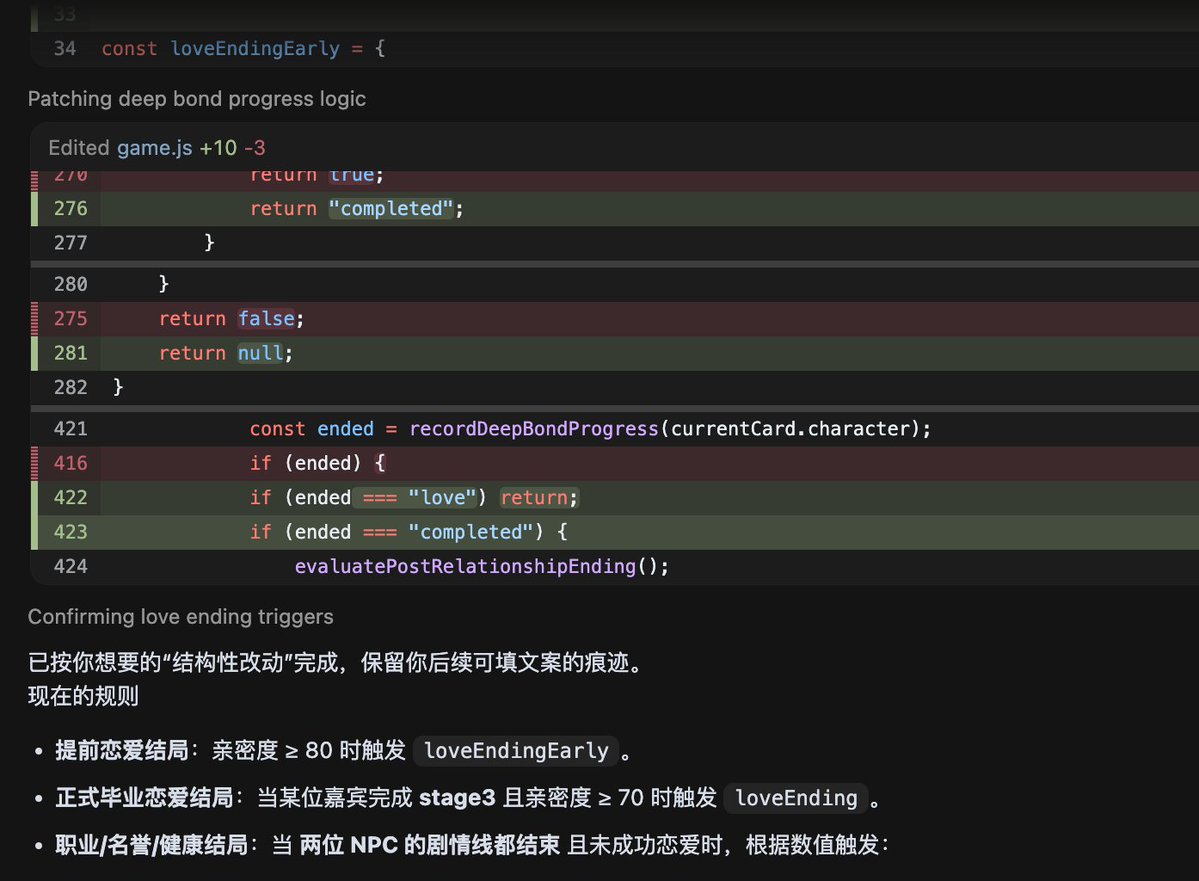
Today, while adjusting the game's numerical balance, I encountered a problem: when the main goal of the game is set to pursue numerical balance, once guest NPCs are introduced, the player's behavior unconsciously becomes pursuing and catering, and the numerical balance quickly collapses. So, I tried changing the original successful date subplot into an independent affection system, which made the endings more diverse, including career/reputation/self-growth/audience affection endings.
This change, surprisingly, brought me closer to the impact and inspiration I gained from Japanese romance reality shows: a romance reality show, in the end, can be about giving up everything else, simply gaining a deeper understanding of oneself and achieving personal growth.
Players must maintain their own numerical balance to gradually build rapport with NPCs, which is actually a real-world necessity. It was only when we reached this point in the design that the saying truly resonated: love is an extension of one's psychological structure came into play.
Before optimizing this numerical system, it might have just been a card-based murder mystery game, or a soulless romance reality gacha game; but through adjustments to the numerical structure, it increasingly resembled the authentic feelings I experienced with Japanese romance reality shows, more closely aligned with the rules of the real world, and sparked deeper reflection.
Games are truly magical; often, an experience, an emotion, a reflection is expressed through countless trials and the accumulation of numerical values. The reason I chose to make games is because the process of creation and reflection makes me feel like I'm living life earnestly again; and for players, perhaps they haven't seen such romance reality shows or had such experiences, but at least through this game, they can gain a genuine understanding that "love is an extension of one's psychological structure."
The value of games lies precisely in this: in a world where countless apps and the web are pursuing efficiency and the world is racing at breakneck speed, we can still preserve a moment of emotional catharsis and response. This gives me, who is polishing these numbers and codes, a greater sense of satisfaction.