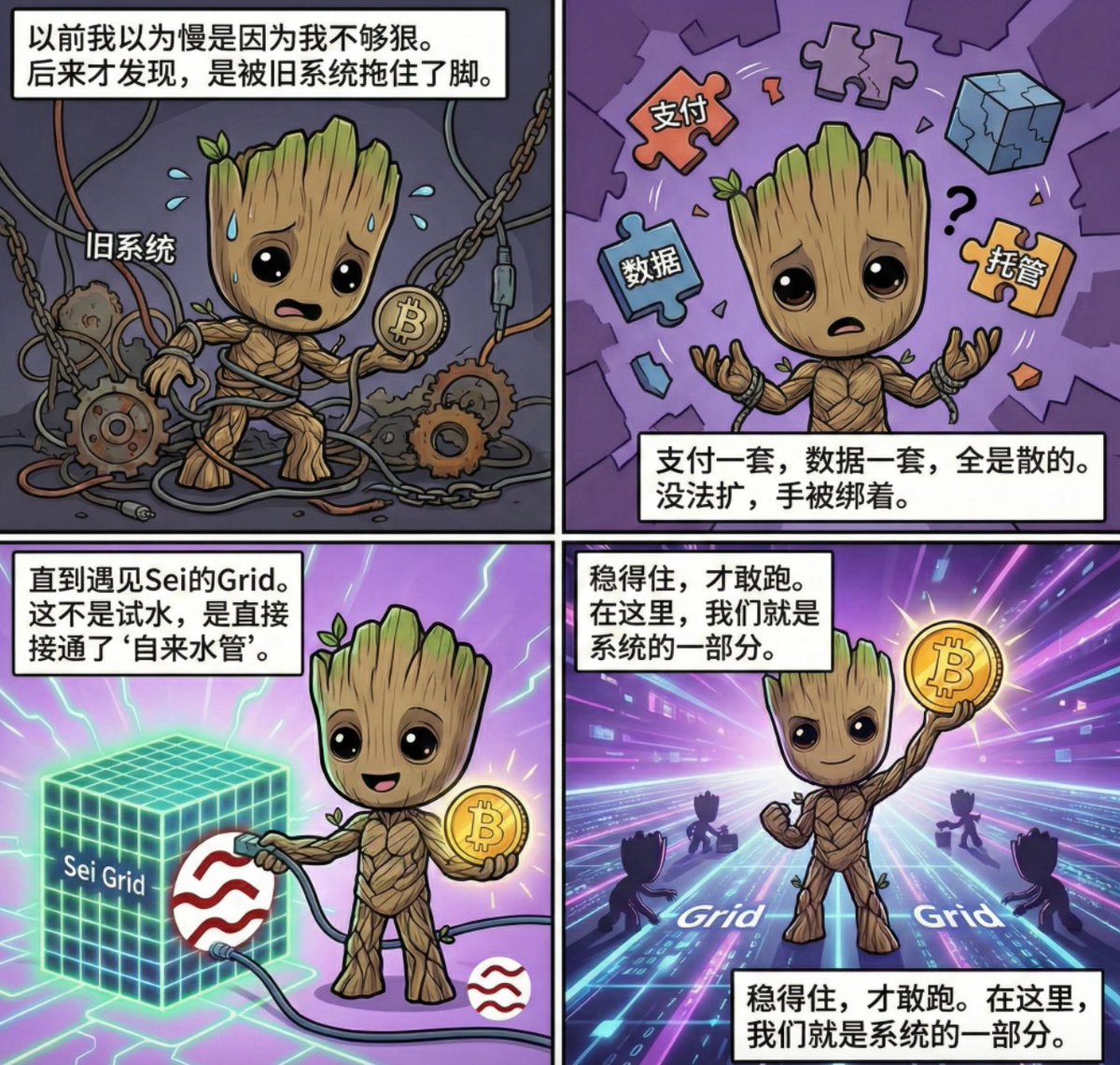
I used to think that,
the slowness was because people weren't ruthless enough.
But I later realized that wasn't it.
It's that those who actually get things done are being slowed down by the system.
Slow payment collection, slow settlement, slow market switching,
isn't a matter of ability; it's because the underlying system you're using simply can't run fast enough.
The biggest problem in the market right now can be summed up in one sentence:
Everything exists, but it's all fragmented.
One set of payment methods, one set of data, one set of hosting—
each time you take on a new location, it's like starting a new business all over again.
The result is: you want to expand your business, but your hands are tied.
@SeiNetwork's Market Infrastructure Grid isn't just giving you a "new tool,"
it directly weaves together everything you need for market operations into a network.
You're not here to "test the waters,"
you're directly connecting to an already running system.
【Three-Point Breakdown】
First point:
You're not here to test the waters, you're here to connect the pipes.
The water's already flowing; you just need to connect it.
Second point:
You're not consuming the system; you are part of the system yourself. Your arrival actually increases the value of the entire network.
Third point:
The more people use it, the better it is.
This is counterintuitive, but it's where the gap begins to widen.
【Underlying Support】
To put it bluntly, the success of Grid isn't based on sentiment:
It needs to run fast enough for it to be meaningful.
It needs to be stable for enterprises to dare to use it.
It needs to be interoperable for it to scale.
This isn't about "how good the chain is,"
it's about "whether it can actually work."
【Application Scenarios】
Your tasks are essentially a few:
Money needs to be invested.
Data needs to be accurate.
Users need to join.
The system needs to be stable.
In Grid, these aren't problems you solve alone,
but rather a whole group of people already using it working together.
【Cost Details】
Many people instinctively think "enterprise-grade" is expensive.
But Grid's logic is exactly the opposite:
It's not about burning money to build the system first, but about getting it running first.
You're not betting on the future,
you're using existing traffic and capabilities.
[Action Guide] If you're currently stuck in one of these three states: Want to expand, but afraid of technical failures; Want to be fast, but your system can't keep up; Want to do long-term, but don't want to start over repeatedly; then the most rational action isn't to "wait and see," but rather to choose the right network that can run together.
The real watershed in the market isn't who talks the biggest game, but whose system is already being used repeatedly in the real world.
Sei's Grid isn't about making you believe in the future; it's about presenting the present to you.