





















Author:BlockBeats
Original title: From abandoned asset to record-breaking acquisition, Mastercard acquires BVNK for $1.8 billion.
Original author: Sanqing, Foresight News
On March 17, global payments giant Mastercard announced its acquisition of stablecoin infrastructure provider BVNK. The deal is valued at up to $1.8 billion, including $300 million in contingent payment terms.Mastercard expects to complete the transaction by the end of this year, thereby expanding its end-to-end support capabilities in the areas of digital assets and cross-currency value transfer.
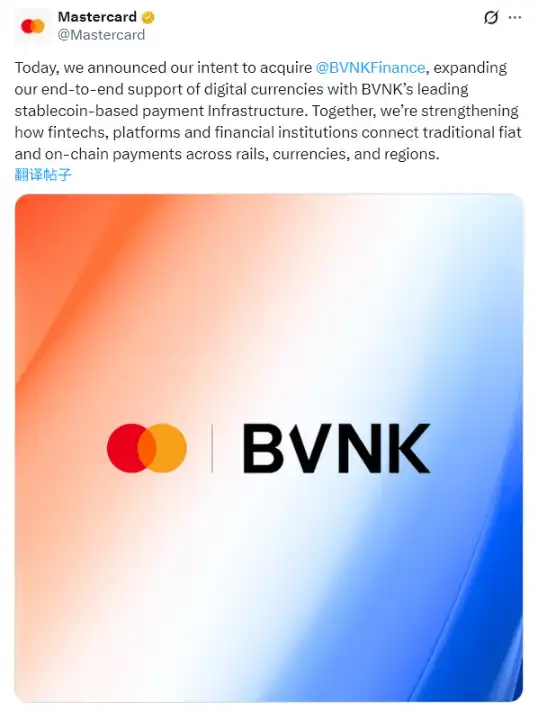
Image source: Mastercard tweet
The value of sacrificing a pawn, Coinbase's hesitation and Mastercard's decisiveness
Founded in 2021 and headquartered in London, BVNK completed a $40 million Series A funding round in May 2022, valuing the company at $340 million post-money. Two years later, in December 2024, it completed a $50 million Series B funding round, raising its valuation to approximately $750 million.
BVNK is led by three South African founders, including CEO Jesse Hemson-Struthers (a serial entrepreneur who previously founded e-commerce and gaming companies that were acquired by Naspers and Sportradar, respectively), CTO Donald Jackson (a blockchain and enterprise systems expert), and CBO Chris Harmse (a CFA holder and former partner at a macro/crypto fund, specializing in foreign exchange and cross-border payments).
This startup has quietly built a vast network for settling crypto assets.
Currently, the platform processes approximately $250-300 billion in stablecoin payment transactions annually.It provides businesses with a seamless channel connecting fiat currencies and stablecoins, supporting payment activities across major blockchain networks in more than 130 countries and regions worldwide.
But before Mastercard made its move, BVNK's real potential buyer was actually crypto giant Coinbase.
In November 2025, the acquisition negotiations between Coinbase and BVNK, which amounted to up to $2 billion, entered the deep waters of due diligence, and the two parties even signed an exclusivity agreement at one point.
Coinbase was an investor in its Series B funding round, and if the deal had gone through, it would have been a landmark event for a crypto-native company expanding into the heart of the global payments infrastructure. However, both parties ultimately announced the cancellation of the deal that month, without disclosing any substantial reason for the breakdown.
Coinbase stepped back, and Mastercard immediately filled the gap perfectly.
For a startup with annual revenue of only about $40 million, a consideration of $1.8 billion seems extremely expensive from a financial model perspective.But this astronomical sum of money was never buying the current profit margin; rather, it was buying a monopolistic ticket to the next generation of settlement networks.
Defensive counterattack, buyout of the possibility of "bypassing card organizations"
Mastercard's move was actually a strategic counterattack with strong defensive characteristics.
Stablecoins are eroding the market share of traditional cross-border settlements at a visible rate.With its 24/7 operation, low transaction costs, and extremely fast settlement speed, the blockchain-based digital dollar is beginning to show its strength in B2B payments and cross-border remittance scenarios.
In the global financial network, traditional credit card organizations are the payment channels most threatened by the disruption caused by stablecoins.If multinational corporations and businesses become accustomed to peer-to-peer on-chain settlements, Mastercard's centralized fiat currency routing network, on which it relies, will face the risk of being completely marginalized.
If you can't beat it, just buy it.
Mastercard's Chief Product Officer, Jorn Lambert, made no secret of this. In the acquisition announcement, he stated that he expects most financial institutions and fintech companies to offer digital currency services in the future.
Mastercard's plan is very clear: to directly integrate BVNK's existing stablecoin track and compliance engine into its vast global fiat currency network.Stablecoins are no longer competitors of credit card organizations; instead, they have been forcibly incorporated into a highly complementary subset of their underlying networks.
Traditional giants are building high walls with insurmountable capital barriers.
In a land grab, no new players are emerging at Wall Street's payment tables.
This is by no means an isolated action by Mastercard; the entire traditional financial sector is frantically vying for access to on-chain infrastructure.
Prior to this acquisition, BVNK had already assembled a formidable lineup of Wall Street investors. In May 2025, Visa, Mastercard's biggest rival, made a strategic investment in BVNK through its venture capital arm, Visa Ventures.
In October, Citi Ventures, the venture capital arm of Citigroup, also invested real money. Although Citigroup declined to disclose the specific investment amount and BVNK's valuation, the company stated in an interview that its valuation was higher than the $750 million in its Series B round.
Even just two months before Mastercard announced the acquisition, Visa had announced that it would integrate BVNK’s stablecoin settlement capabilities into its core Visa Direct platform to support cross-border fund transfers for global digital wallets.
This is both a rigid integration of technology and a tacit conspiracy of capital.
Looking at the entire payments industry, Stripe, a rising star in Silicon Valley, previously spent $1.1 billion to acquire stablecoin startup Bridge. Before finalizing its deal with BVNK, Mastercard was also reported to be in acquisition talks with another crypto infrastructure startup, Zerohash (founded in 2017 and headquartered in Chicago), for a potential $1.5 billion to $2 billion.
Traditional payment giants are using aggressive and intensive mergers and acquisitions to regroup the previously decentralized and fragmented stablecoin liquidity within their familiar business frameworks and regulatory channels.
At this extremely lucrative poker table, those who ultimately sit down are still the former rulers with their vast wealth.




No Comments