




















Author:Odaily 星球日报
Original | Odaily Planet Daily@OdailyChina)
Author|Azuma (@azuma_eth)

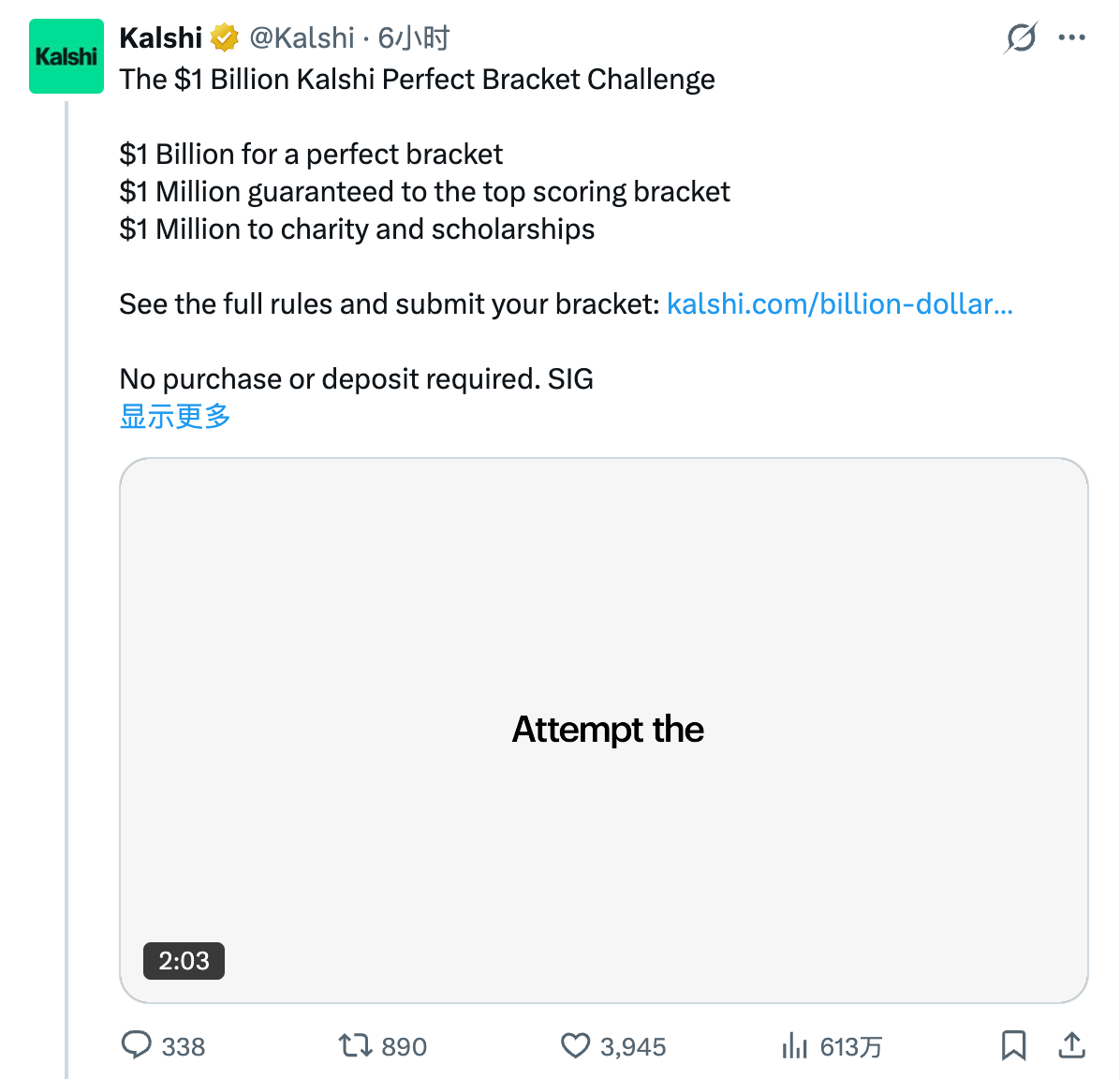
In the early hours of March 17, prediction market Kalshi announced on X that it would follow in the footsteps of Warren Buffett and launch the "Perfect Bracket Challenge" for the upcoming NCAA "March Madness" games - users who perfectly predict all the matchups will be able to take home a super prize of $1 billion.
March Madness: America's Hottest Basketball Extravaganza
The so-called "March Madness" refers to the NCAA Tournament, a national men's basketball tournament held annually in March by the NCAA. It gets its name from the fact that the tournament typically begins in March, uses a single-elimination format, and features a packed schedule and intense competition.
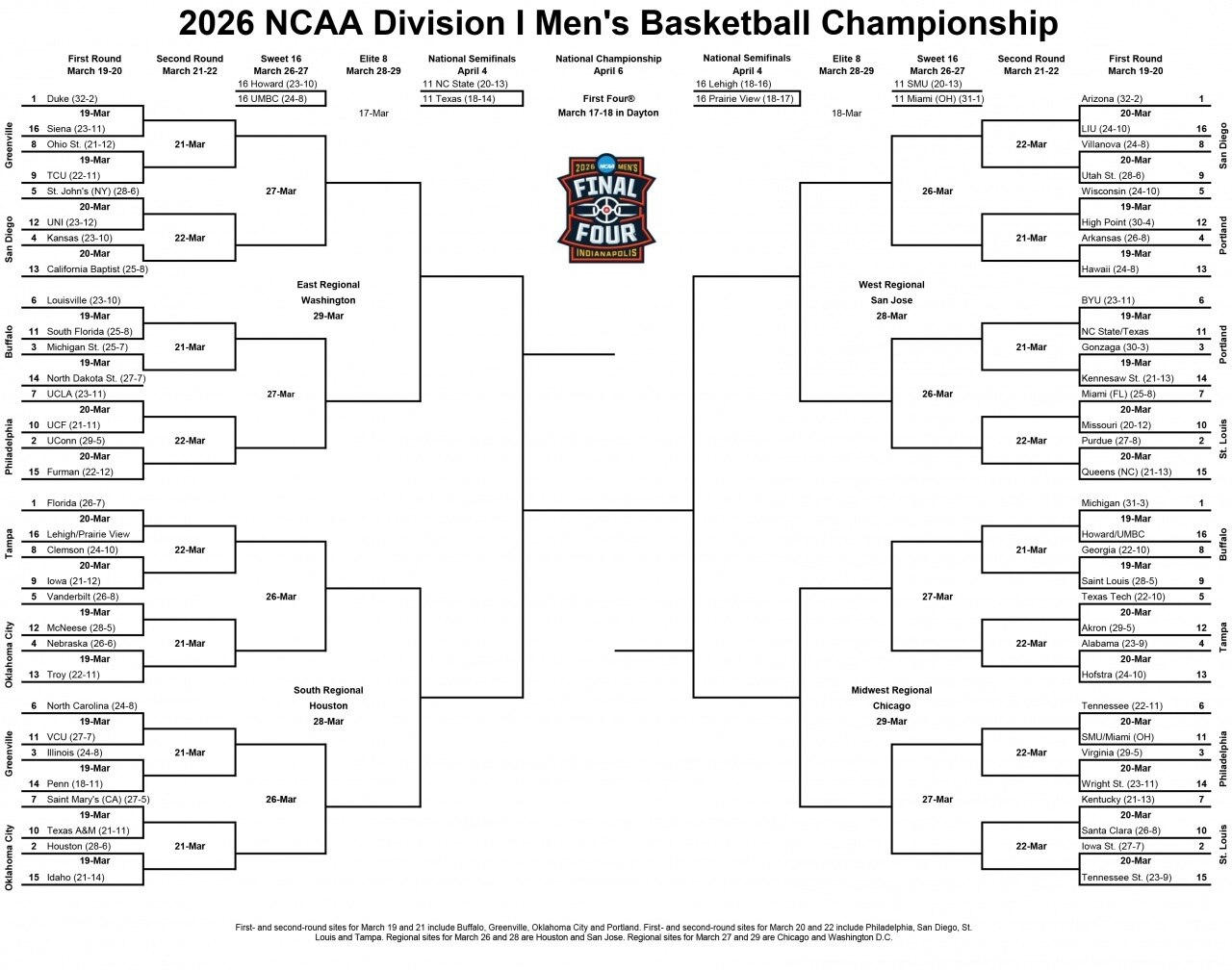
According to the schedule confirmed by yesterday's draw, the 2026 March Madness tournament will officially begin on March 18th (tomorrow) Beijing time. The 68 college teams that qualified for March Madness after months of regular season competition will compete for the championship. The first round will be the First Four, where 4 out of 8 teams will be eliminated. The remaining 64 teams will then compete in a five-round single-elimination tournament (64 teams → 32 teams → Sweet 16 teams → Elite 8 teams → Final 4 teams → Grand Final → National Champion) to determine the final winner.
As the most watched college basketball league in the United States, the NCAA, with its focus on college teams, often fosters a stronger sense of "home team identity" among the general public, compared to the NBA, which is primarily a club-based competition. During "March Madness," current students, alumni, and even local communities spontaneously cheer for their alma mater. Because of this, the level of public participation in the NCAA can, in some ways, even surpass the fervor of the NBA Finals.
From a competitive perspective, while college players are still far from matching professional players in terms of overall ability, the unique aspect of "March Madness" is that most participants have an extremely limited window of opportunity—usually only 1 to 4 years—and the most talented players often enter the NBA after their freshman season. This fleeting opportunity makes every round of the game more urgent—once they step onto the court, almost everyone will compete with everything they have.
Meanwhile, 2026 is widely considered a strong draft year for the NBA, further amplifying the attention this year's event has garnered. Darlin Peterson of the University of Kansas, AJ Dibanza of Brigham Young University, and Cameron Boozer of Duke University (son of Yao Ming's arch-rival Carlos Boozer) are all seen as exceptionally talented players, with the potential to compete for next year's NBA number one draft pick. This direct competition between these "future stars" adds a layer of forward-looking significance to this year's "March Madness," beyond its entertainment value, regarding the future landscape of the NBA.
With such massive traffic, how could we miss out on market predictions?
During "March Madness," predicting game results through sports betting services by filling out "brackets" has long been a common practice in the United States. How could the specialized prediction market miss this opportunity?
Currently, prediction markets such as Polymarket and Kalshi have launched prediction events related to the "March Madness" events. Polymarket has even included it in the first batch of pilot paid sports events, seemingly preparing to make a fortune in the upcoming event boom.
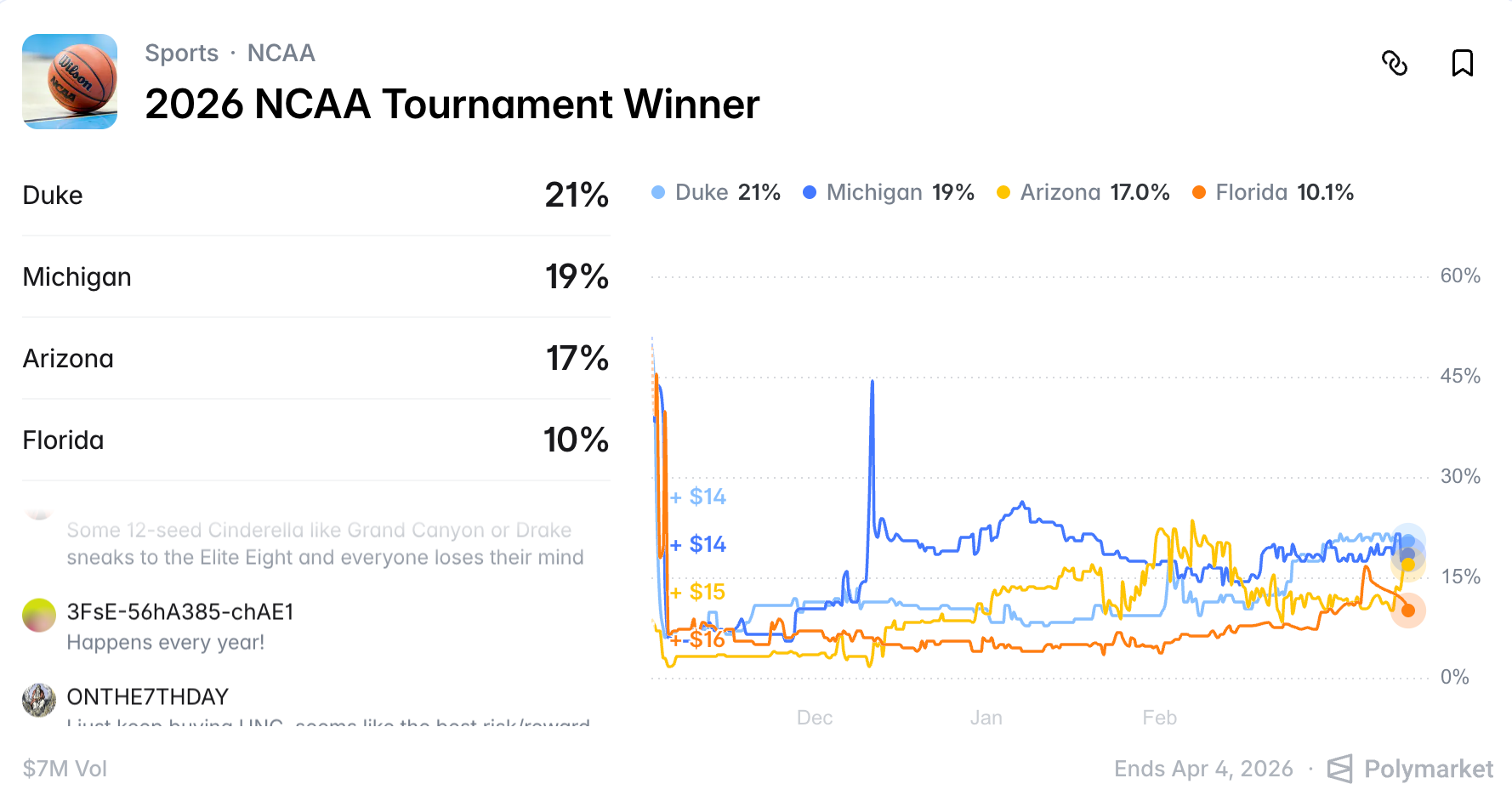
Polymarket's real-time odds show that the top four universities in the March Madness championship odds are the number one seeds from the four major regions:
Duke University, which boasts Cameron Boozer, a top prospect in next season's NBA draft, is currently ranked first with 21% of the draft.
The University of Michigan is ranked second, with a preliminary 19%;
The University of Arizona is ranked third, with a preliminary 17% ranking.
The defending champion, the University of Florida, is ranked fourth, currently at 11th.
Meanwhile, Kalshi, following Buffett's lead, launched a massive "$1 billion prize" campaign this morning. All users can submit a prediction form for free on Kalshi, and the user who perfectly predicts all match results will win $1 billion. If no one makes a correct prediction, Kalshi will also award $1 million to the user with the best prediction, and allocate an additional $1 million to support charity.
It's worth mentioning that Kalshi also enlisted NBA star Devin Booker to lend his support. In 2014, Booker's University of Kentucky achieved an undefeated record of 31 wins and 0 losses in the regular season and was once considered a strong contender for the national championship. However, they lost to the University of Wisconsin 64-71 in the semifinals. Booker entered the NBA the following year, never to fulfill that unfulfilled dream.
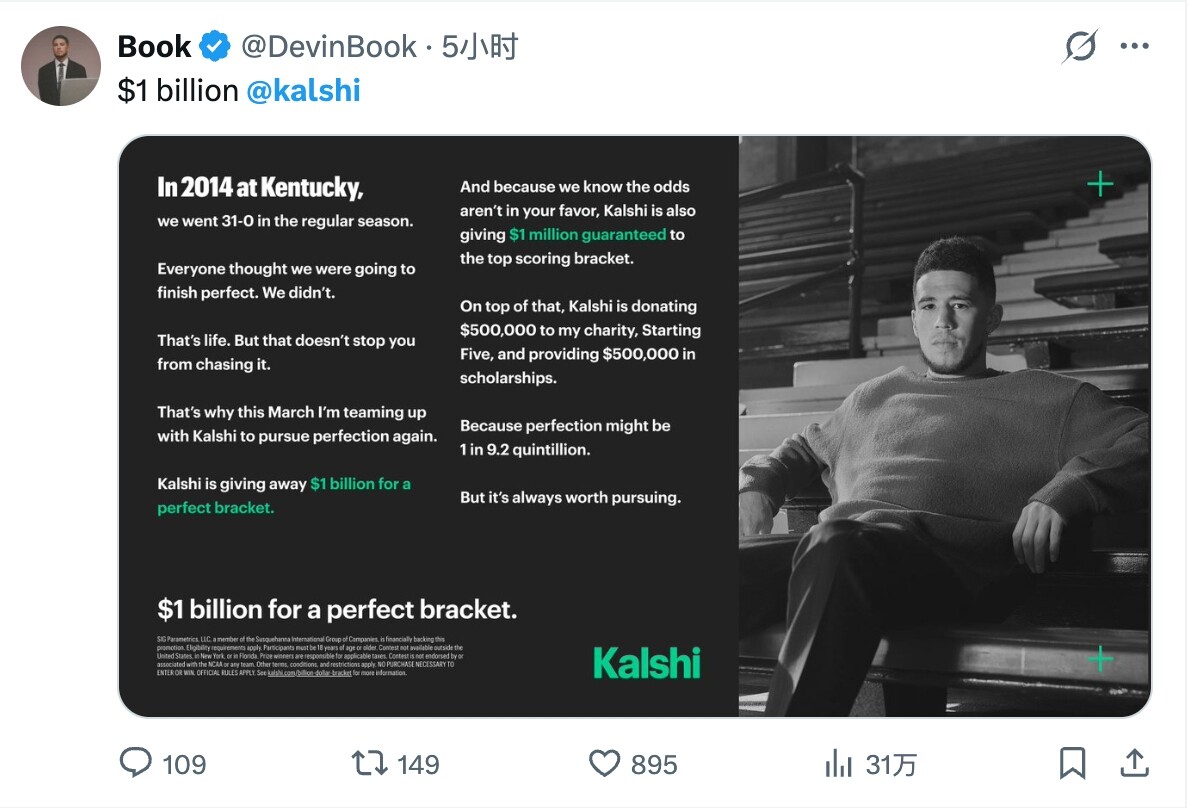
Warren Buffett has offered a reward for 12 years, but no one has claimed the grand prize.
The reason for mentioning that Kalshi's grand prize is modeled after Buffett is that Buffett established a similar grand prize as early as 2014—employees of his Berkshire Hathaway company who can guess all the results of the contest will receive a huge prize of $1 billion, which will be distributed by the company over 40 years (or they can choose to receive a lump sum of $500 million).
However, due to the extreme difficulty of making a perfect prediction, no one has ever won the prize. Warren Buffett subsequently lowered the difficulty of the contest several times (with corresponding reductions in the reward), until last year when an anonymous employee of FlightSafety International, a Berkshire Hathaway-owned aviation training company, correctly predicted 31 out of 32 games in the first round, winning the million-dollar prize after the difficulty and reward were both reduced.
How difficult is it to make a perfect prediction? One of the most classic figures circulating in the industry is "1 in 9.2 quintillions," or one in 9.2 trillion. This probability stems from the following mathematical calculation: assuming each match is 50% vs 50% (completely random), disregarding seed strength, odds, and historical patterns, and with a total of 63 matches in "March Madness" (excluding the first-round playoffs), there are 2^63 possible combinations, which translates to 9223372036854775808... If all these possibilities were written down on paper, the paper would weigh 180 trillion tons, equivalent to the weight of 500 million Empire State Buildings...
Feeling like there's no chance? Don't worry, I'll help you significantly increase your odds!
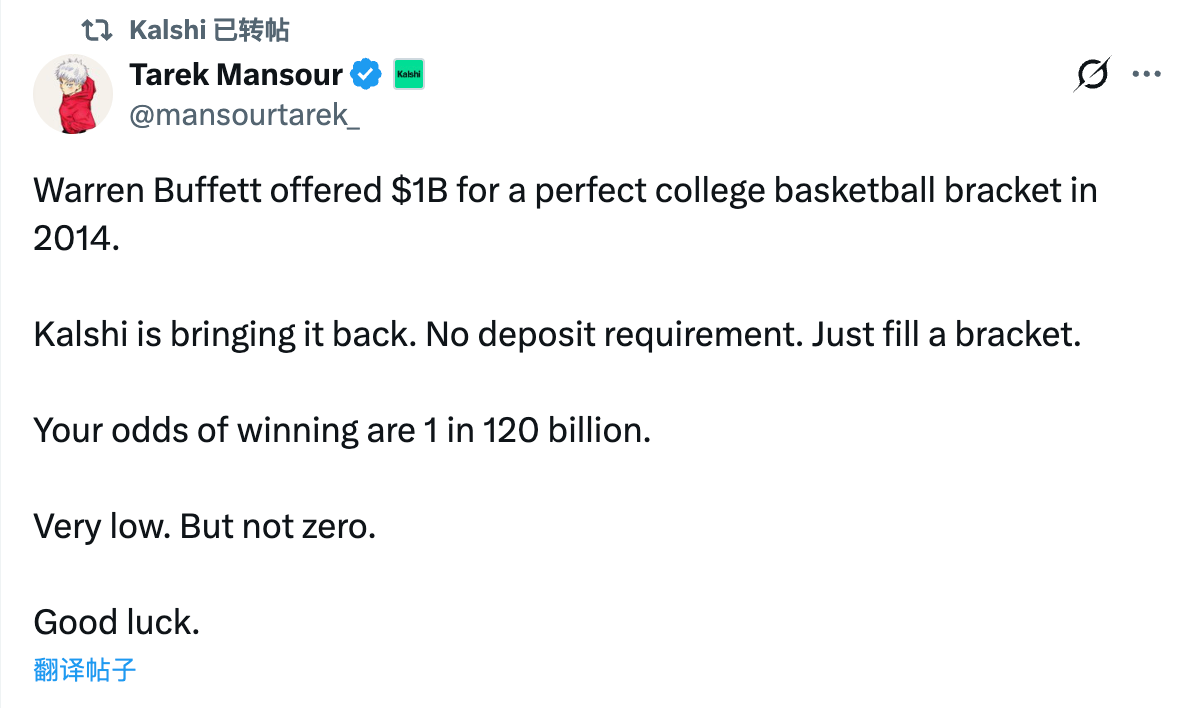
Kalshi CEO TareK Mansour, speaking about the event this morning, stated that the probability of a perfect prediction is approximately "1 in 120 billion," or "one in 120 billion." The reason for such a large difference in probability is that the calculation is based on a more realistic model—sports matches are not 50/50; stronger teams are often more likely to win. After weighting historical win rates and related odds, academia and statistics typically estimate the probability of a perfect prediction for "March Madness" to be between "1/10¹¹" and "1/10¹³," with "1 in 120 billion" falling within this range.
Even "1 in 120 billion" implies a near-zero probability. Clearly, Kalshi is playing the same probability game as Buffett, believing no one can take the $1 billion.
The community is gearing up, and AI may be the key to breaking the deadlock.
After Kalshi's grand prize event was officially announced, it immediately sparked widespread discussion on social media - after all, predictions are free, what if you win?
This time, many users are pinning their hopes on the groundbreaking revolution of AI to break the deadlock. Overseas KOL Chase Passive Income, through X, declared that he will spend $50 million on data processing, having countless AI agents create accounts and fill in all possible groups, which he believes will be "the easiest $1 billion to earn."
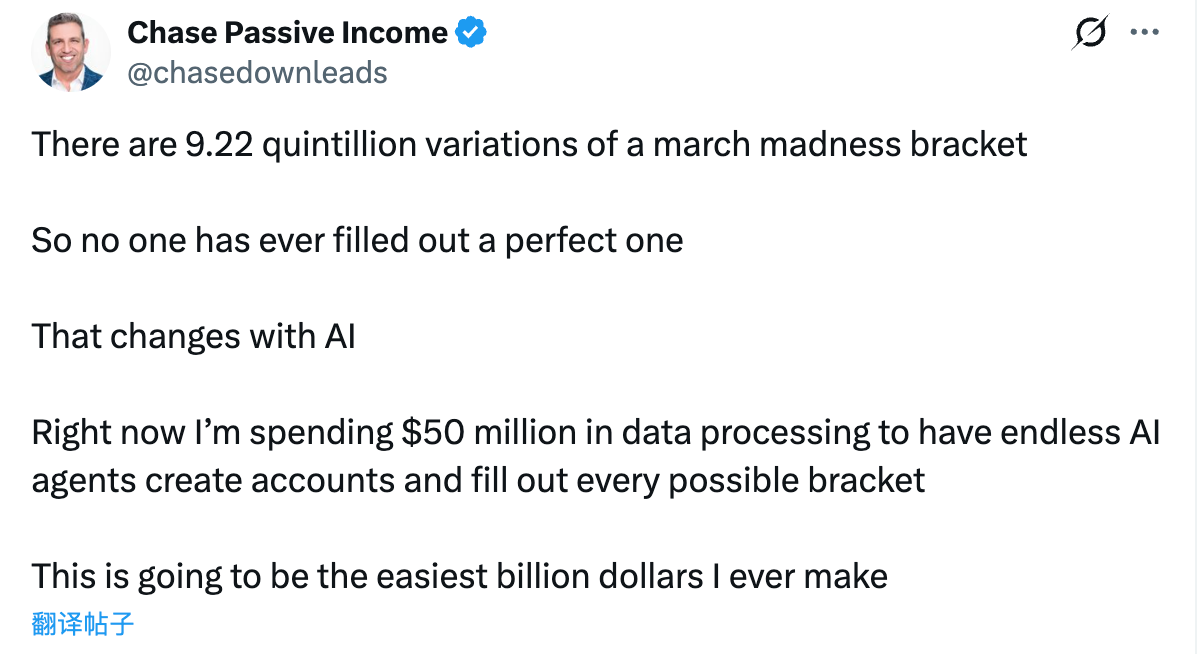
Will the unsolvable probability puzzle continue? Can AI create miracles? No one knows the answer until the national champion of "March Madness" is revealed and the competition concludes.
As spectators, besides waiting to watch the game and enjoy the drama, don't forget to go to...KalshiFill out a list of dreams.

No Comments