





















Author:Wall Street CN
Since the outbreak of the war in Iran, global markets have been under pressure and oil prices have soared. However, the capital market of the world's largest crude oil importer has stabilized against the trend—China is quietly becoming the most unexpected safe haven in this energy crisis.
Since the conflict broke out at the end of February, the CSI 300 Index has fallen by only 0.3%, while oil prices once soared by nearly 65%, approaching $120 per barrel.Meanwhile, the yuan remained largely stable against the dollar, outperforming almost all Asian currencies, with the yuan index (CFETS RMB Index) hitting a one-year high last week; the yield on China's 10-year government bonds rose by only about 1 basis point, while US and French bonds rose by more than 20 basis points.
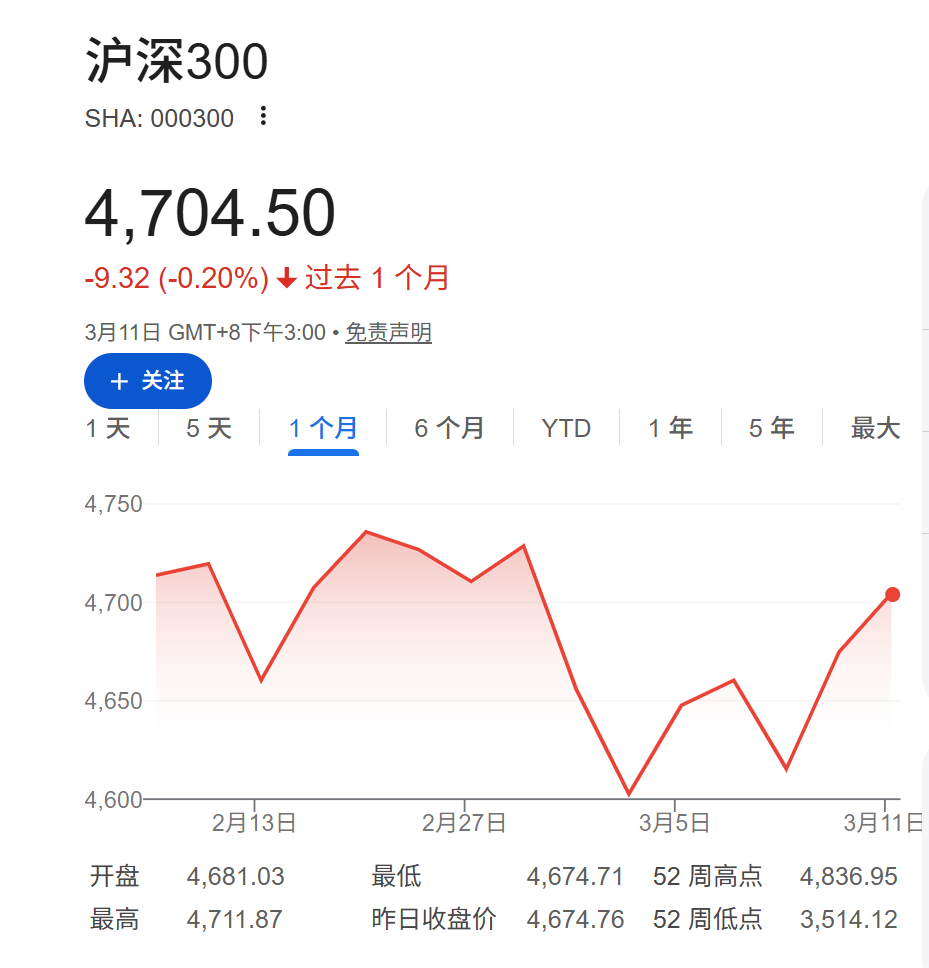
This phenomenon reflects China's systematic energy strategy over the years.Large-scale investments in renewable energy, the promotion of electric vehicles, and the establishment of massive strategic reserves have reduced China's economic dependence on imported fossil fuels. "Chinese assets have been overlooked by global investors as a safe-haven asset.""Cary Yeung, Head of Fixed Income, Greater China at Pictet Asset Management, said."
Analysts believe that China's domestic economic fundamentals and policy implementation capabilities remain the fundamental factors determining the market's medium- to long-term trend.
Global markets are turbulent, but China remains stable.
Since the outbreak of the conflict in Iran at the end of February, global markets have experienced severe volatility. Crude oil prices once approached $120 per barrel, triggering concerns about a resurgence of inflation and hindering the pace of central bank interest rate cuts. Prices subsequently retreated after Washington signaled a possible ceasefire.
Asian markets, heavily reliant on imported energy, have been hit hardest. According to Bloomberg data, Japanese, South Korean, and Indian stock markets have fallen by approximately 6%, 9%, and 4% respectively since the end of February; European markets have fallen by about 5%, and US stocks by 1.4%.
In contrast, the CSI 300 Index fell by only 0.3%. This means that if investors choose to keep their funds in the Chinese stock market rather than withdrawing from Asia to invest in the United States, their capital preservation is better than in most major markets.The exchange rate and bond market present a similar picture—the renminbi has outperformed similar Asian currencies, and the yield on China's 10-year government bonds has risen much less than that of US and French bonds.
Energy transition builds a buffer, strategic reserves create a safety net
Analysts believe that China's energy strategy provides structural support for the relative resilience of the Chinese market.
Following 2021 and 2022, the government prioritized ensuring a stable energy supply. Coal mining reached record highs, solar and wind power capacity expanded significantly, and energy storage infrastructure rapidly improved, leading to a surge in renewable electricity production. China also continued to steadily increase domestic oil and gas production.
Regarding reducing reliance on fossil fuels, sales of electric and hybrid vehicles in China have now surpassed those of traditional gasoline-powered vehicles, and gasoline demand—which accounts for more than one-fifth of China's total oil consumption—has entered a long-term downward trend. In terms of strategic reserves, according to data provider Kpler, China's strategic petroleum reserves are sufficient to cover approximately six months of lost Middle Eastern imports in a worst-case scenario.
Larry Hu, head of China economic research at Macquarie Group, said, "The short-term impact is limited and can be buffered." He estimates that even if crude oil prices rise to $100 per barrel, the increase in inflation for Chinese consumers will only be around 1%.
Tactical opportunities rather than a full-scale portfolio reshuffle; investors are cautiously optimistic.
"Chinese assets may continue to show relative strength in the near term, but we believe this is more of a tactical opportunity than a structural shift," said Clarence Li, chief portfolio analyst for multi-asset and equity strategies at T. Rowe Price. He added, "The investment logic for China leans more towards selecting thematic exposures rather than making a broad bet on stocks, bonds, or foreign exchange."
Currently, investors focusing on the Chinese market are concentrating on sectors related to energy security and domestic demand. The CSI 300 Energy Index has risen by about 8% since the end of February, making it the best-performing sub-sector index; the renewable energy sector has seen even stronger gains, with Jinko Solar's stock price rising by about 13%.
Trevor Slaven, Global Head of Asset Allocation and Multi-Assets at Barings Asset Management, believes that defensive funds shifting to Chinese assets are more likely to occur after market volatility subsides, and will flow more into stocks than government bonds.
William Bratton, Head of Cash Equities Research for Asia Pacific at BNP Paribas, noted in a research report on Monday that...If the conflict with Iran lasts longer than expected, China's relative resilience may become increasingly apparent."We believe that China is more attractive than other markets in the Asia-Pacific region because of its more domestically driven economic structure, including in terms of energy supply," he wrote.


No Comments