





















Author:BlockBeats
A prominent nonprofit think tank in Washington, D.C., pointed out in a 2024 discussion on the challenges of journalism in the AI era:
"The current environment forces journalists to prioritize speed over accuracy in breaking news scenarios."
The recent conflict in Iran is a prime example: schools were bombed, a successor leader was assassinated, and a neighboring country launched a surprise attack. Western media often use sensational headlines to attract attention and quickly shape public opinion.
However, there is one place that often demonstrates "true judgment" earlier than the media—market prediction.
Here, the probability of events such as "whether Hezbollah will attack Israel" or "whether a certain country will take military action against Iran" is not dominated by emotions or institutional narratives, but is the result of individual traders voting with real money.
To put it more intuitively, if a trader is certain that something will happen, he will bet "yes," and this act itself increases the probability of the event occurring. This mechanism of expression, constrained by capital, makes the prediction market a source of information different from traditional media.
Two events that occurred in the Middle East over the past week perfectly illustrate this point.
Drone attack on British military base in Cyprus
On the evening of March 1, local time, British Prime Minister Keir Starmer announced in a pre-recorded video statement that the UK had agreed to allow the US to use its bases to strike Iranian missile facilities. Hours later, the Royal Air Force base in Akrotiri, Cyprus, was attacked by a suspected drone.
Following the incident, several mainstream media outlets, including the BBC, The Independent, and Reuters, published reports immediately, using terms such as "Iran missiles" and "Iranian drone" in their headlines or articles to directly link the attack to Iran.
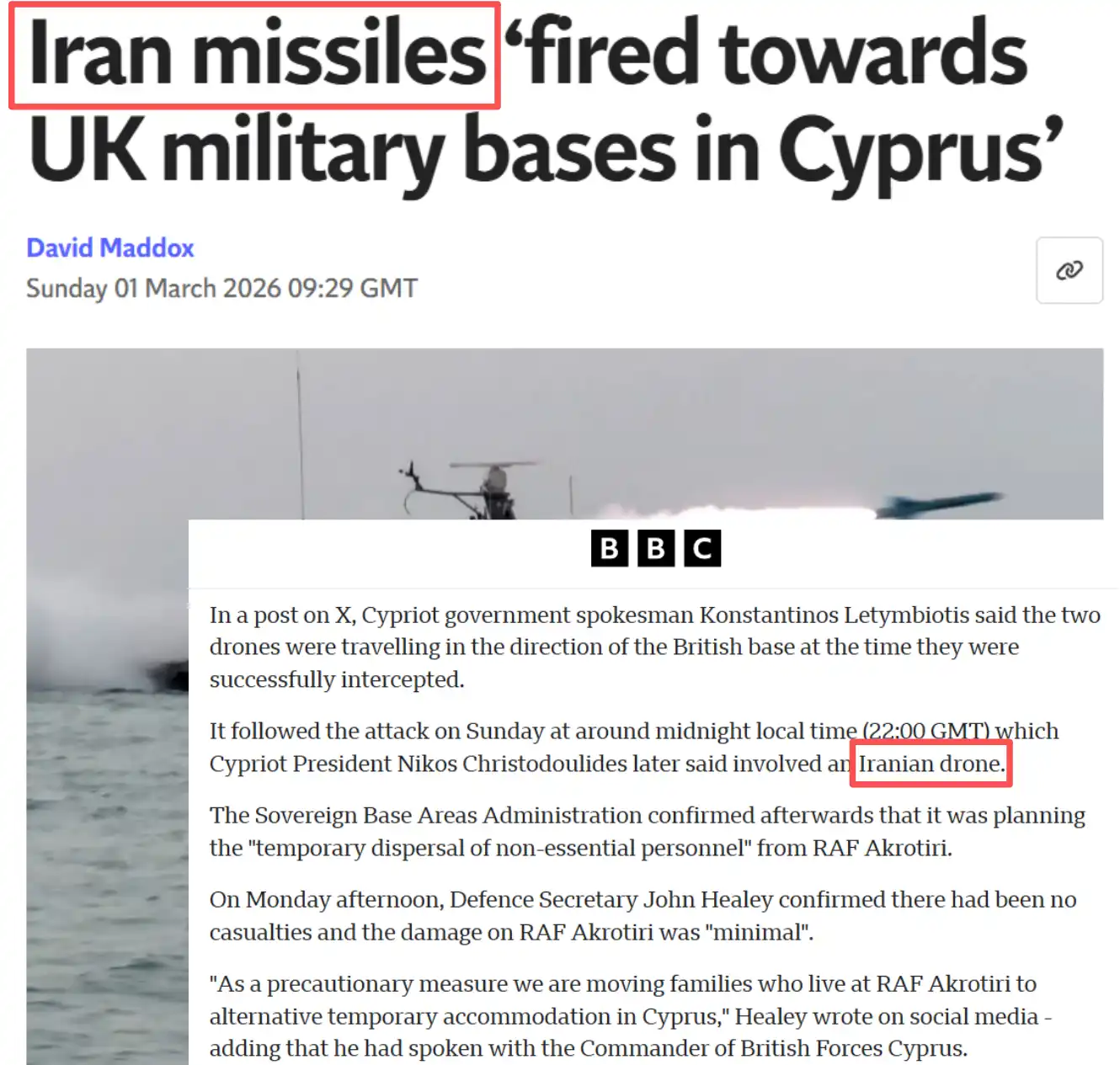
These reports quickly made it to the front page, giving readers a clear impression: Iran is directly attacking NATO allies' bases.
However, in the immediate aftermath of the incident, the prediction market on Polymarket—specifically, the prediction of whether Iran would strike Cyprus before March 31—reacted differently: Following media reports, the market did see some typical "buy the news" trading, causing a brief increase in the probability. But unlike the prevailing sentiment created by the media, the probability quickly fell back to levels similar to those before the attack within approximately 30 minutes.
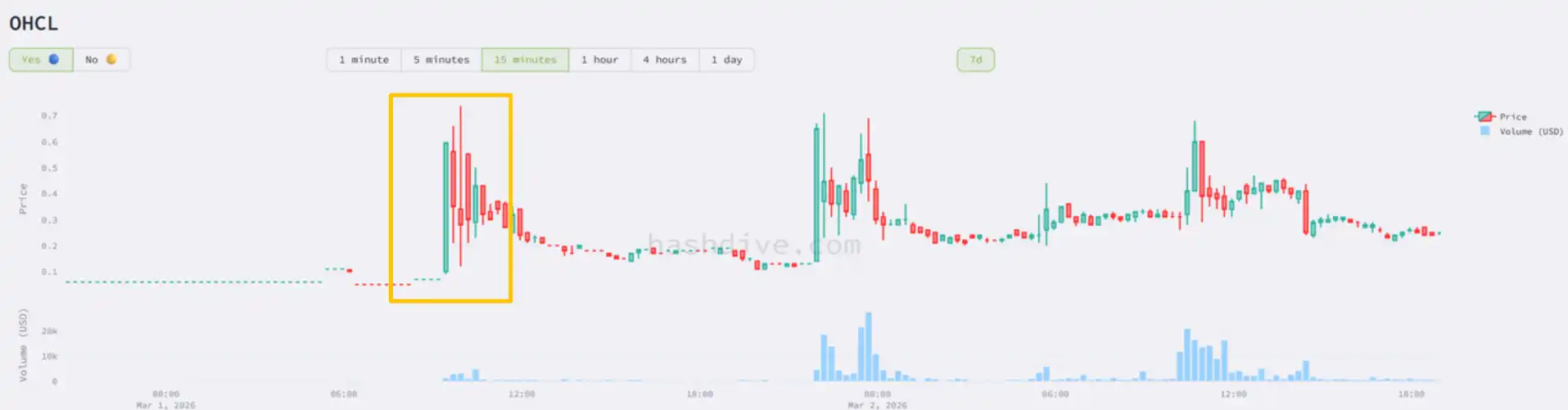
Clearly, this group of people, who are most sensitive to breaking news, do not fully trust the media narrative.
Hours later, the British Ministry of Defence issued a statement saying that "there is currently no evidence that the attack was directly carried out by Iran." Various media outlets subsequently followed up with revised reports, suggesting the attack was more likely carried out by Hezbollah, Iran's proxy armed group in Lebanon, and pointing out that the previously mentioned "Iranian drone" actually referred to "the Shahed-type drone designed by Iran," rather than the claim that "the attack was directly launched by Iran."
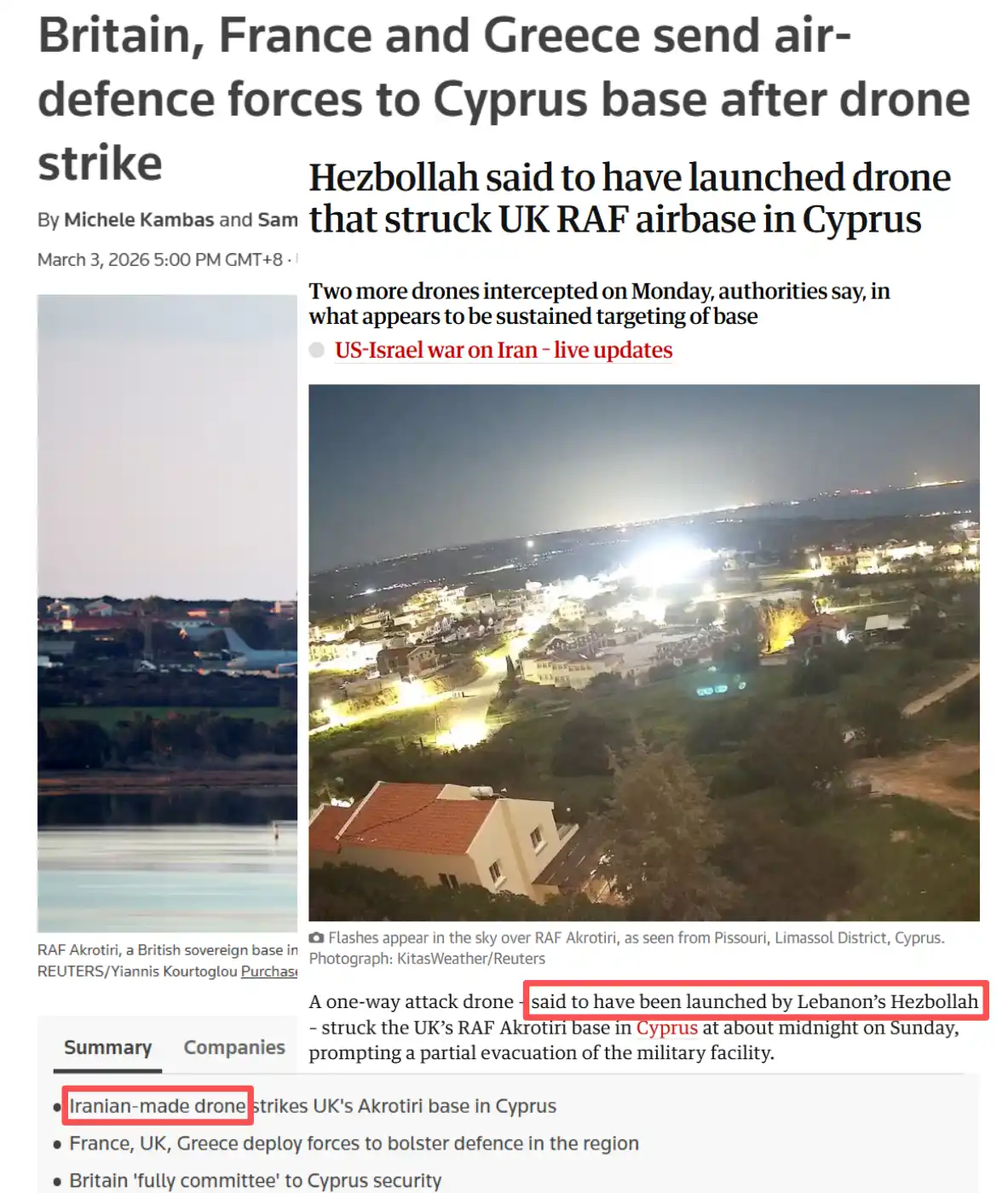
In other words, the media initially amplified Iran's direct responsibility through a narrative framework, while the forecasting market maintained a more cautious assessment from the outset.
Israeli media extensively publicized the UAE's attack on Iran.
A similar situation occurred again this week. On March 8, several Israeli media outlets reported that the UAE had launched its first strike on Iranian soil. The reports described the operation as a "symbolic retaliation" for Iran's previous attacks on Gulf states.
This narrative quickly created the impression that Gulf states were joining the military action against Iran.
Similar to the Cyprus incident, the market probability on Polymarket for "whether the UAE will strike Iran before March 31" briefly rose after the report was published, but quickly fell back within about an hour.
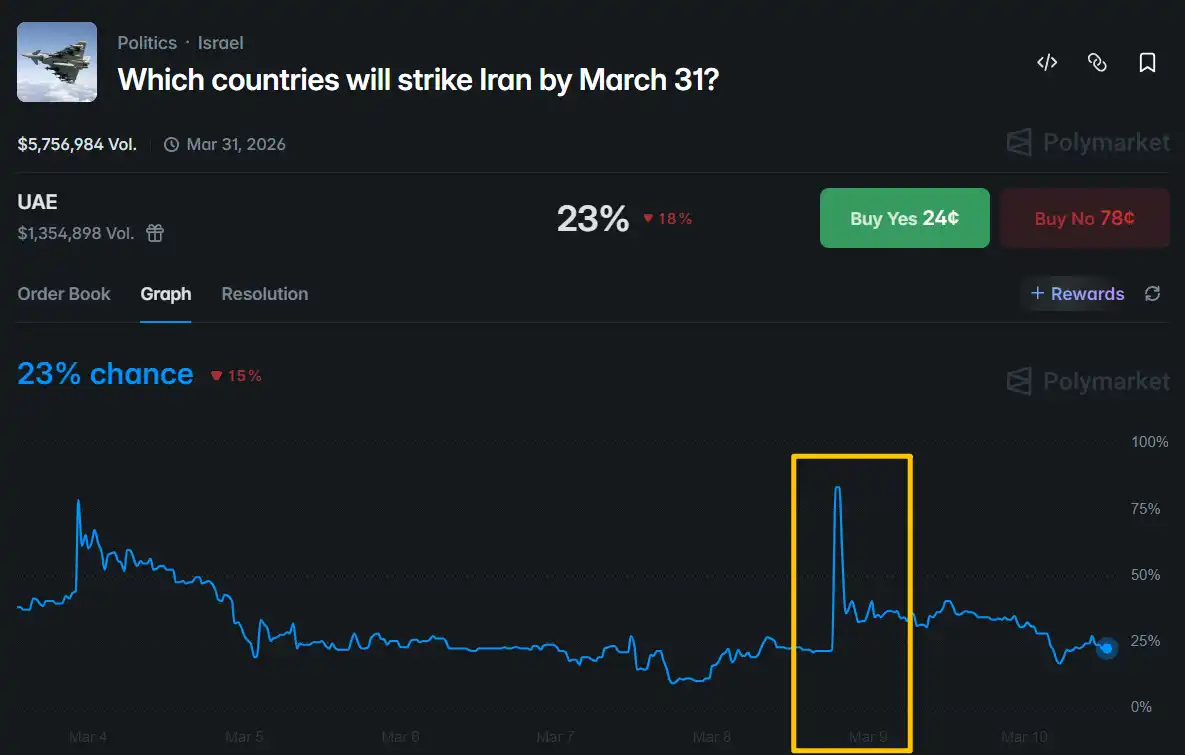
Shortly afterward, Ali Rashid Al Nuaimi, Chairman of the Committee on Defense, Interior and Foreign Affairs of the Federal National Assembly of the UAE, directly called it "fake news" on X, and frankly stated, "If we have done something, we have the courage to announce it publicly."
From an information dissemination perspective, the Israeli media's recent information campaign is likely an attempt to create a narrative of regional solidarity against Iran, thereby increasing psychological pressure on Iran and encouraging regional allies to more openly support US-Israeli actions.
However, if we filter out this media noise and look only at the predicted changes in market probability, we can realize earlier that such reports may not be reliable.
Why are market predictions more reliable?
As the global political environment gradually shifts from the post-Cold War era of openness to a more pronounced bloc-based and geopolitical competition, information dissemination is increasingly becoming a strategic tool.
In this environment, the importance of traditional media has been further amplified. The media has become not only a news channel, but also a crucial platform influencing public opinion and policy discussions.
The differences in stances between different organizations in the American media landscape are quite evident: CNN, which has long been criticized by Trump, has attracted a large audience that supports stronger gun control due to its extensive coverage of school shootings. Meanwhile, gun manufacturers are among the Republican Party's major political donors.
When news reporting becomes more than just "information" but gradually transforms into a tool for shaping public attitudes, the reliability of traditional media as a pure source of information is inevitably challenged.
In this environment, the prediction market provides a completely different information mechanism: since the probability of each event is based on the trader's decision-making about the outcome of that event, traders aiming to make a profit must invest a corresponding amount to guarantee their judgment.
In this round of the Iranian conflict, these participants may be open-source intelligence analysts, military enthusiasts, speculative traders, or even insiders involved in the fighting on the front lines or behind the lines. Regardless of their background, they express their opinions only through betting, and each bet represents a participant's genuine judgment based on their own understanding.
The accuracy of these genuine ideas has been repeatedly proven to be superior to traditional polls and expert predictions in a series of forecasts over the past few years, including elections, interest rates, and non-farm payrolls.
Seeing results in advance based on predictive market data
As mentioned earlier, when we treat predicting market probabilities as a source of information, we are essentially observing the outcome of a group of traders using their own funds to guarantee their judgments about the future.
However, relying solely on market probability still presents a problem: the skill levels of those involved in trading vary greatly, and some may simply be following the crowd. Therefore, some analytical tools further filter the data, and one commonly used indicator is the weighted market strength.
In other words, participants who have made more accurate predictions and achieved higher trading returns in the past will have a greater influence on the final probability. Compared to ordinary market probability, this indicator is closer to the so-called "smart money judgment."
To understand this with a simple analogy: if you only look at market probability, it's like having 10 anonymous people from different industries give you investment advice; but if you refer to weighted market probability, it's like you know the professional background and investment returns of these 10 people at the same time, so you will naturally pay more attention to those who have higher long-term returns.
With this in mind, let's look at a question that the world is currently focused on: whether other countries will join the US and Israel in striking Iran. According to current market probability forecasts, the probability of other countries joining the strike this month is 51%; however, if we look at the weighted market probability, the likelihood of the strike occurring is only about 25%.
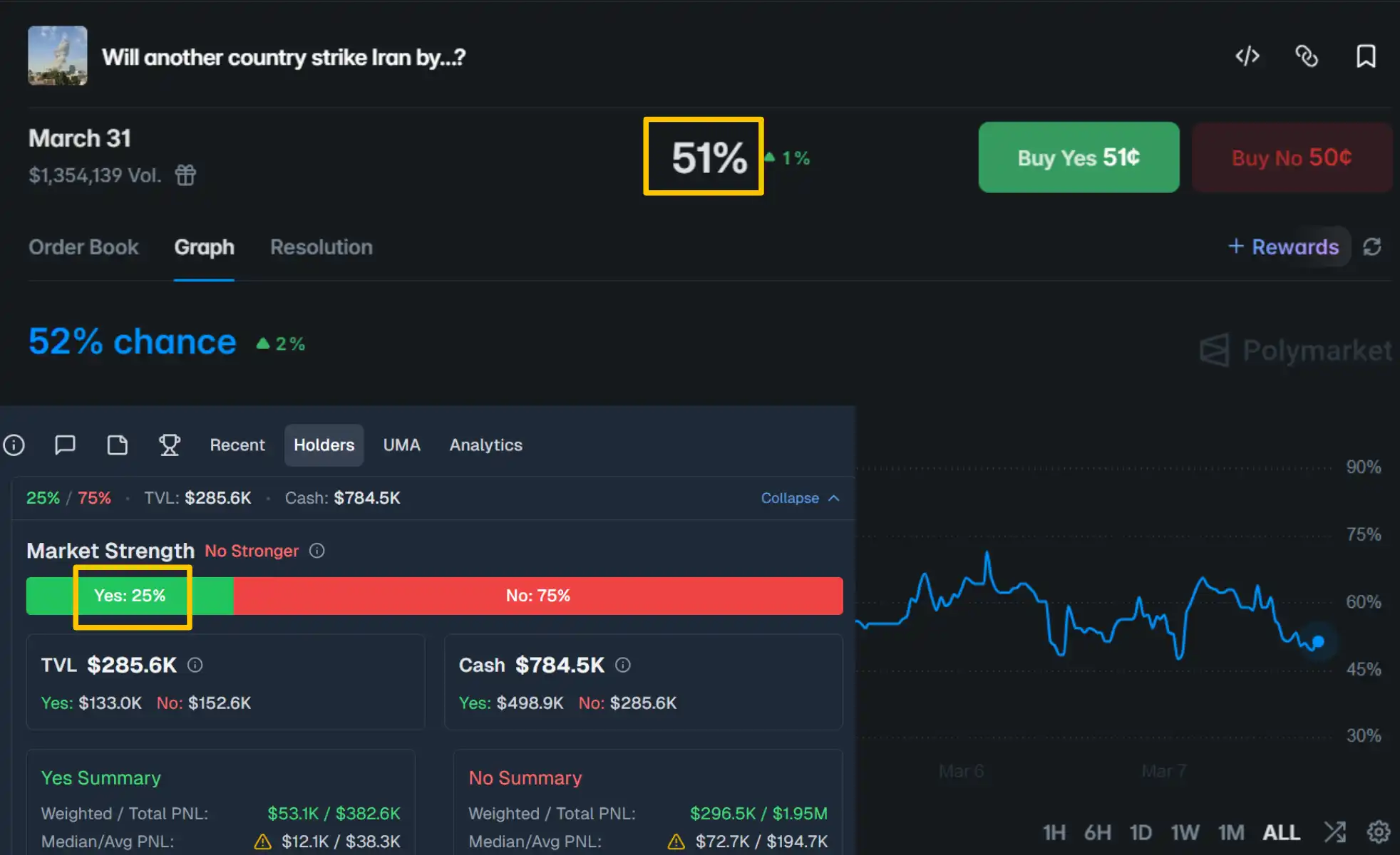
This result stands in stark contrast to recent media narratives. On the surface, news reports are filled with signals of Gulf states condemning Iran, European warships sailing into the Middle East, and the escalating regional situation, as if a larger-scale conflict is imminent. However, in the forecasting market, many long-time active traders with a good understanding of geopolitics generally believe that the likelihood of another country directly attacking Iran this month is not high.
In an era of highly fragmented information, prediction markets may not replace news, but they are becoming a new information calibration mechanism. As media narratives amplify emotions and stances, market prices provide a collective judgment constrained by capital.
For those who want to understand the real world, the difference between these two signals is itself important information.



No Comments