





















作者:Wall Street CN
The escalating situation in the Middle East is fundamentally changing the policy orientation of central banks around the world.
On Thursday, March 19, Wall Street Insights reported that major central banks around the world, while maintaining interest rates unchanged, have all issued hawkish policy signals.
Energy prices are the core source of this inflationary expectation; since the outbreak of the Middle East conflict, European natural gas prices have nearly doubled.
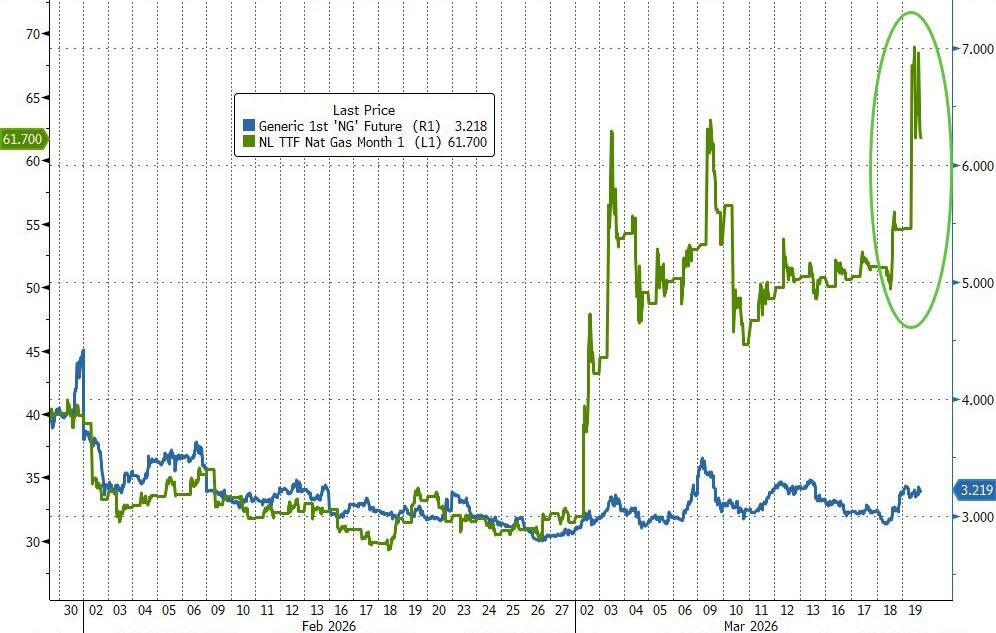 (Since the outbreak of the Middle East conflict, European natural gas prices have nearly doubled.)
It is worth noting that,Bank of England Governor Bailey has made it clear that the central bank is prepared to act if inflation continues to rise. Investors have quickly repriced their expectations for the Bank of England to three rate hikes this year, up from two rate cuts.
On Thursday, the yield on 2-year UK gilts rose by more than 30 basis points, bringing the cumulative increase to nearly 100 basis points since the start of the US-Iran conflict.
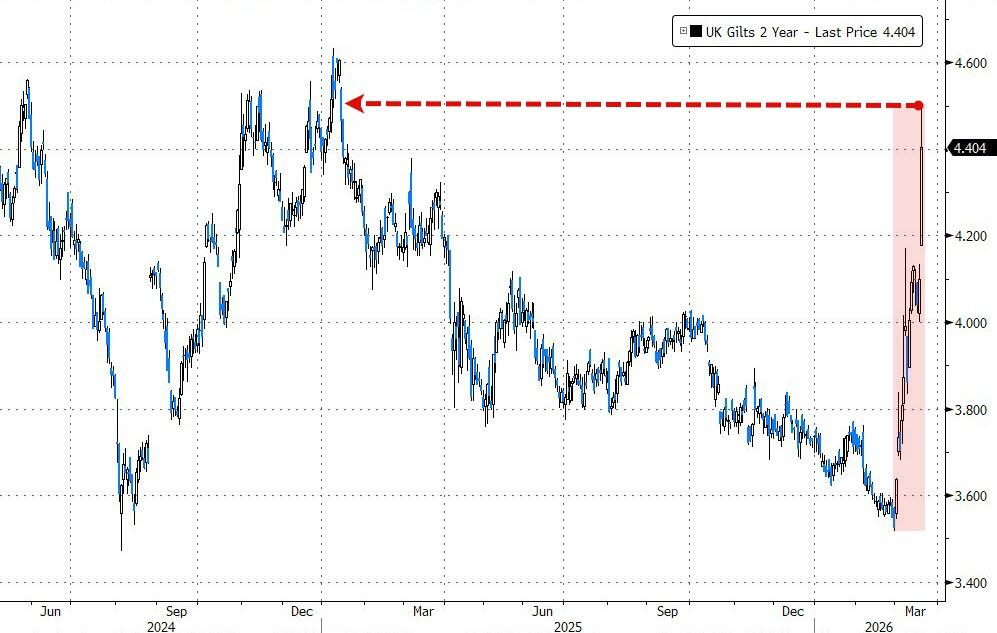 (The yield on 2-year UK gilts surged, suggesting stronger expectations of interest rate hikes.)
However, some analysts remain skeptical of the market reaction. UBS investment bank economist Anna Titareva believes the market has overreacted, stating:
This was an exceptionally turbulent day, and we do not believe there will be two or more rate hikes this year.
Central banks held rates steady, but policy signals turned significantly hawkish.
The European Central Bank, the Bank of England, the Swiss National Bank, and the Swedish central bank all kept interest rates unchanged on Thursday, following the Federal Reserve, the Bank of Canada, and the Bank of Japan's decision to hold rates steady this week.
However, beneath the surface of remaining on hold, the policy rhetoric of the two major European central banks has undergone a substantial shift.European Central Bank President Christine Lagarde said at a press conference on Thursday:
The Middle East wars have significantly increased uncertainty about the future, posing upside risks to inflation and downside risks to economic growth.
Bank of England Governor Bailey used even more direct language:
I will monitor the situation very closely, andWe are prepared to take necessary actions to ensure that inflation continues to move toward the 2% target.
Despite the threat posed by the Middle East conflict to the global economy, Europe is considered one of the most vulnerable economies due to its heavy reliance on energy imports.Since the outbreak of the conflict, European natural gas prices have nearly doubled, directly impacting the European Central Bank's assessment of the inflation path.
The European Central Bank not only raised its annual inflation forecast but also simultaneously raised its core inflation forecast for the next three years—the inflation rate excluding energy and food prices—indicating that the institution expects the energy crisis to transmit to broader price pressures.
Central bank officials acknowledged that it is too early to judge the ultimate impact of rising energy costs on the economy.However, they have begun to address the scenario where supply disruptions last longer than expected.
Lagarde also emphasized that the Eurozone's economic fundamentals were relatively sound when it entered this crisis, with a robust labor market and inflation already close to the 2% target.She said:
We are starting from a good point; we are well-prepared and have the tools to deal with this major shock.
The lessons learned from the Russia-Ukraine conflict have kept policymakers on their toes.
The European Central Bank officials' shift to a more proactive policy stance is partly due to the lessons learned from the 2022 Russia-Ukraine conflict.
From the perspective of traditional policy frameworks, the standard response to supply shocks is to "ignore them," because price shocks are often short-lived, and raising interest rates is less effective at curbing inflation than at damaging economic growth.
However, during the Russia-Ukraine conflict, the sharp rise in energy and food prices triggered a significant increase in wage demand, which drove up prices across the board in labor-intensive service industries, causing inflation to remain above the target level for a much longer period than expected.
This memory remains vivid, and policymakers worry that if energy prices rise again, workers may quickly demand higher wages, triggering a new round of price increases.Lagarde made it clear on Thursday:
Inflation expectations are closely linked to people's and businesses' memories of inflation. And now those memories are quite fresh because people have personally experienced inflation.
For the European Central Bank and the Bank of England, the question is how long the current rise in energy costs will last, and to what extent it will spill over into the prices of other goods and services. This will largely determine the direction of monetary policy in the coming months.

No Comments