





















Author:AInvest
The debate between
and gold as stores of value has intensified in 2025, with proponents of each asset framing their arguments through distinct economic and ideological lenses. Changpeng Zhao (CZ), Binance's founder, and Peter Schiff, a gold standard advocate, represent these opposing viewpoints. CZ positions Bitcoin as a decentralized, programmable financial infrastructure that transcends speculation, while Schiff dismisses it as a zero-sum game, favoring gold's tangible, historical role as money. This analysis examines how Bitcoin's institutional adoption, programmable money features, and global network effects redefine value creation in the digital age, contrasting with gold's traditional utility.Bitcoin's Institutional Adoption and Infrastructure Role
Bitcoin's institutional adoption in 2025 has been transformative, driven by regulatory clarity and infrastructure innovation. The U.S. SEC's approval of spot Bitcoin ETFs in early 2024 marked a pivotal shift, enabling institutions to access Bitcoin through familiar vehicles like the iShares Bitcoin Trust by
, which . Regulatory milestones, such as the EU's MiCA implementation and Hong Kong's virtual asset licensing regime, . In the U.S., the GENIUS Act of July 2025 provided a federal framework for stablecoins, .Institutional demand has
, with 86% of investors already exposed to or planning to allocate capital to Bitcoin by 2025. Corporate treasuries, including MicroStrategy and Tesla, have , inspiring broader corporate adoption. These developments underscore Bitcoin's role as a foundational infrastructure asset, not merely a speculative play. Its -driven by global policy shifts and ecosystem maturation-reflects its growing acceptance as a hedge against inflation and currency devaluation.The Zero-Sum Critique and Gold's Traditional Utility
Peter Schiff's critique of Bitcoin hinges on its perceived lack of intrinsic value and its volatility, which he argues make it a zero-sum game. In debates with CZ,
-a digital representation of vaulted physical gold-as a superior alternative, combining gold's historical store-of-value properties with modern convenience. He contends that Bitcoin's value is derived solely from speculative demand, without real-world utility.Gold, with a
, remains a dominant safe-haven asset. Central banks have , diversifying away from the U.S. dollar amid geopolitical tensions and de-dollarization trends. contrasts sharply with Bitcoin's 52%, making it a more stable hedge during macroeconomic shocks. prioritizing tangible assets, particularly in a year when gold surged 55% while Bitcoin faced a $2.5 trillion market cap correction in October 2025.
Programmable Money and Economic Functions
Bitcoin's programmable money features distinguish it from gold, enabling novel economic functions. Unlike gold, which relies on physical custody and centralized intermediaries, Bitcoin's blockchain allows for transparent, trustless transactions.
leverage Bitcoin's infrastructure to facilitate fast, low-cost cross-border payments, bridging traditional and digital finance. Decentralized finance (DeFi) platforms automate lending, risk management, and recurring payments, in financial systems.For example,
have pioneered on-chain subscriptions and micropayments, showcasing Bitcoin's potential to disrupt legacy payment models. and Layer 2 networks like Base further abstract complexity, making Bitcoin-based infrastructure accessible to mainstream users. These innovations highlight Bitcoin's role as a programmable, borderless medium of exchange, particularly in emerging markets with underdeveloped financial systems.Network Effects and Market Dynamics
Bitcoin's network effects are reshaping global financial infrastructure. With a
between January and July 2025 compared to 2024, its market capitalization reached $1.65 trillion-nearly 65% of the global crypto market. This growth is driven by institutional participation, which is as a cornerstone of digital assets. In contrast, gold's dominance in central bank reserves and industrial applications remains unchallenged, though -exemplified by a $2.5 trillion two-day crash in October 2025-raises questions about its reliability.CZ's rebuttal to Schiff's tokenized gold model centers on custodial risks. He argues that tokenized gold relies on intermediaries, whereas Bitcoin offers direct, verifiable ownership.
: decentralized digital money versus asset-backed alternatives. While gold's historical legitimacy is undeniable, position it as a complementary asset in a diversified portfolio.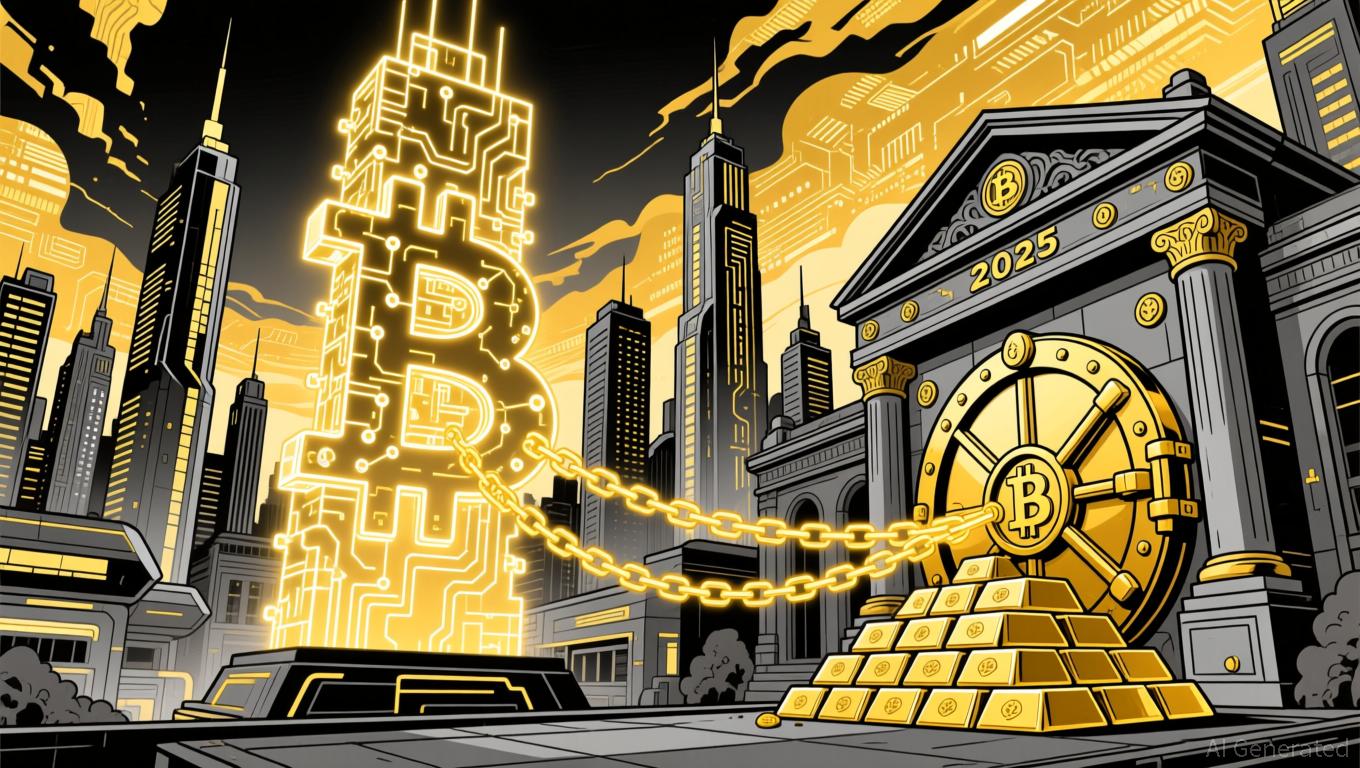
Conclusion: The Future of Value Creation
Bitcoin's evolution from speculative asset to foundational infrastructure reflects its unique capacity to redefine value creation in the digital age. Institutional adoption, regulatory clarity, and programmable money features have positioned Bitcoin as a legitimate component of modern financial systems, particularly in cross-border payments and DeFi. While gold retains its role as a safe-haven asset, its volatility and reliance on centralized custodians highlight the limitations of traditional models.
As CZ and Schiff's debate illustrates, the choice between Bitcoin and gold hinges on one's vision for the future of money. For those prioritizing innovation and global accessibility, Bitcoin's infrastructure-driven utility offers a compelling case. For others, gold's historical resilience remains irreplaceable. However, in a world increasingly defined by digital transformation, Bitcoin's ability to combine scarcity with programmability ensures its place as a wealth-creating asset beyond speculation.



No Comments