





















作者:Xbit wallet
Author: Onkar Singh, CoinTelegraph; Translated by: Baishui, Golden Finance
1. Understanding the 10-Year Treasury Yield: Definition and Importance
The 10-year Treasury yield is the interest rate the U.S. government needs to pay to borrow money for 10 years.
When a government needs cash, it issues bonds called Treasury bonds, and the 10-year Treasury bond is one of the most closely watched bonds. The "yield" is the annual return you'll get if you buy that bond and hold it until maturity. It's expressed as a percentage, such as 4% or 5%.
Imagine the government said, "Lend me $1,000 and I'll pay you back in 10 years with interest." That rate and yield will go up and down based on demand for bonds, inflation expectations, and overall economic conditions. Because U.S. Treasury bonds are considered safe (the government is unlikely to default), the 10-year Treasury yield is the benchmark for the "risk-free" return in the financial world.
Why is this so important for cryptocurrencies? Cryptocurrency yields and stablecoins are part of the wider financial world, and the 10-year Treasury yield affects investor behavior, which in turn ripples into the crypto market. Let’s take a deeper look.
2. The impact of 10-year U.S. Treasury yields on global financial markets
The 10-year Treasury yield is not unique to the United States — it plays a leitmotivating role in global financial markets, affecting everything from stocks to currencies to emerging economies.
Since the U.S. dollar is the world's reserve currency and U.S. Treasury bonds are a global safe haven, changes in the 10-year U.S. Treasury yield will cause shocks around the world. The details are as follows:
stock market:Rising Treasury yields could lead to a pullout of money from the stock market, especially growth stocks such as technology companies, as investors can earn higher returns from bonds. In 2021, the surge in yields came as tech-heavy indexes such as the Nasdaq were hammered as investors turned to safer assets. The shift could set the stage for how investors view riskier assets such as cryptocurrencies.
Global borrowing costs:The 10-year Treasury yield influences interest rates around the world. When yields rise, so do borrowing costs for companies and governments, which can slow economic growth. In 2022, for example, rising yields led to tighter financial conditions, affecting everything from corporate loans in Europe to mortgage rates in Asia.
Currency Market:Rising 10-year Treasury yields strengthen the dollar as investors flock to dollar-denominated assets. A stronger dollar can make cryptocurrencies, which are typically priced in dollars, more expensive for international investors, potentially dampening demand. It also puts pressure on emerging market currencies because their debts, which are often denominated in dollars, become more expensive to repay.
Emerging Markets:Countries with weaker economies rely on cheap borrowing. When U.S. Treasury yields rise, capital flows from riskier emerging markets to U.S. bonds, causing volatility in their stock and bond markets. This could spill over into the cryptocurrency market, as investors in those regions may sell crypto assets to make up for losses elsewhere.
Inflation and Monetary Policy:The 10-year Treasury yield is a barometer of inflation expectations. If yields rise as investors expect inflation to rise, central banks such as the Federal Reserve may raise interest rates, tightening global liquidity. This could reduce speculative investment in assets such as cryptocurrencies, as seen in 2022 when aggressive rate hikes cooled the market.
For cryptocurrency investors, this global impact sets the backdrop. Rising 10-year Treasury yields could portend tougher market conditions for cryptocurrency prices and yields, especially amid global market turmoil. Conversely, low yields tend to spur risk appetite, boosting speculative assets like cryptocurrencies.
3. Rising Treasury yields: Will safer returns take away the yield appeal of cryptocurrencies in 2025?
The 10-year U.S. Treasury yield, an important indicator of global financial health, showed significant volatility in 2025. As of May 9, 2025, the yield was approximately 4.37%-4.39%.

Yield swings are driven by factors including trade tensions, inflation expectations and Federal Reserve policy, and recent rate cuts have not lowered yields as expected, which goes against historical trends.
In the cryptocurrency space, yields are earned through activities such as staking, lending, and liquidity provision, often offering returns of 5%-10% or even higher. However, the rise in 10-year U.S. Treasury yields presents a challenge.
Research suggests that higher yields on safe assets could reduce demand for riskier cryptocurrency yields, as investors may prefer the stability of U.S. Treasuries. This competition for capital could lead to a decline in participation on cryptocurrency lending platforms, which could push up yields to attract users, but overall market activity could decline.
This is because many cryptocurrency platforms need to borrow money to operate, and their borrowing costs are tied to broader interest rates, which are influenced by the 10-year U.S. Treasury yield. If interest rates rise, these platforms may pass on the higher costs to users, affecting the yield you receive.
4. How does Treasury yields affect stablecoins?
Stablecoins like Tether’s USDt and USDC are closely tied to traditional finance because their value is often backed by assets like cash, bonds, or — you guessed it — U.S. Treasuries.
Here’s how the 10-year Treasury yield affects stablecoins:
Supported assets:Many stablecoins, such as USDC, hold U.S. Treasuries in their reserves to maintain their peg to $1. Rising U.S. Treasury yields (currently 4.39%) mean more income for stablecoin reserves, which could theoretically be passed on to users as yield.
Regulatory complexity:Regulatory frameworks in some countries complicate the process. In the European Union, the Crypto-Assets Market Regulation (MiCA) prohibits stablecoin issuers and crypto-asset service providers (CASPs) from offering interest to discourage their use as a store of value, but users can still earn yields through decentralized finance (DeFi) platforms.
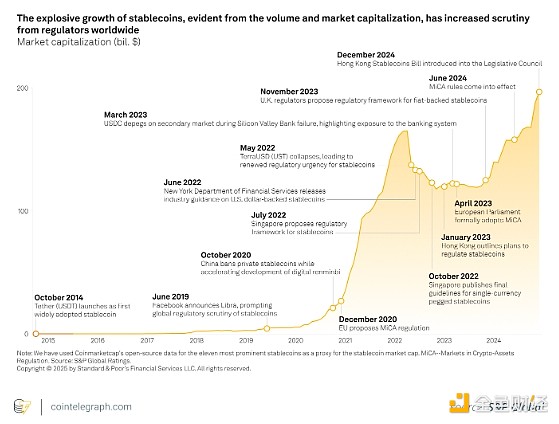
Opportunity Cost:If 10-year Treasury yields are high, holding stablecoins (which typically yield less than riskier cryptocurrencies) may not be as attractive as buying Treasuries directly. Investors may pull money out of stablecoins, reducing the amount of money available for lending and potentially reducing the yield on stablecoins.
Market Sentiment:Rising U.S. Treasury yields typically signal tighter monetary policy (e.g., Fed rate hikes), which can disrupt cryptocurrency markets. For example, in 2023, when yields reached their highest point in years, cryptocurrency prices (including stablecoin-related tokens) felt pressure as investors became more cautious. This could indirectly affect stablecoin yields as platforms adjust based on market conditions.
DeFi News:In decentralized finance (DeFi), stablecoins are the backbone of lending and trading. If U.S. Treasury yields rise and traditional finance becomes more attractive, DeFi platform activity may decrease, thereby reducing the yield of stablecoin pools. On the other hand, some DeFi protocols may increase yields to keep users engaged.
Notably, there are growing calls for regulations to allow stablecoins to share revenue with users, especially in jurisdictions where legislative work is ongoing, such as the UK and the US. This debate is critical because allowing revenue sharing could enhance stablecoin adoption and thus increase fiscal revenue, but regulatory clarity is needed to avoid legal risks.
5. USDC and US Treasuries: How should your funds be invested?
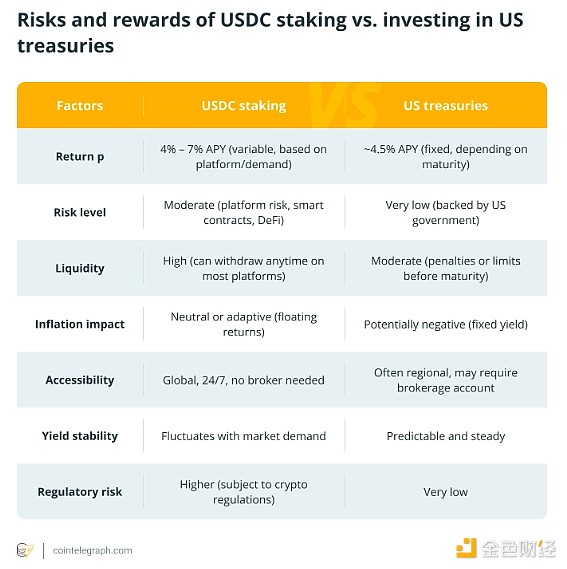
USDC staking offers higher but volatile returns with moderate risk, while U.S. Treasuries offer stable, low-risk returns and are guaranteed by the government.
When users stake USDC (by lending it out on platforms like Aave or Coinbase), they can earn a floating yield, typically between 4% and 7% annually, depending on demand and platform risk.
U.S. Treasury bonds, especially the 10-year bond, offer fixed income; yields are around 4.37%-4.39%. These securities are guaranteed by the U.S. government, making them one of the safest investments.
While USDC can offer higher yields, it comes with additional risks, such as smart contract vulnerabilities, platform failures, and regulatory changes. U.S. Treasuries, while safer, have limited upside.
6. The impact of rising bond yields on cryptocurrency investors
For cryptocurrency investors, higher Treasury yields may reduce risk appetite, but tokenized Treasuries offer a safe alternative.
If you are considering staking your Ethereum or lending USDC, understanding the trend of Treasury yields can give you an advance idea of whether yields will rise, fall, or pose additional risk.
For example:
If yields rise, it could be a sign that cryptocurrency yields could become more competitive, but it could also mean that global markets are getting nervous. You should probably stick with stablecoins or safer platforms.
If yields are low, investors may want to put their money into cryptocurrencies, which will give them higher yields, but also increase volatility. This could be an opportunity to earn more, but you need to be aware of the risks.
Additionally, if you use stablecoins to store cash or earn extra income, the 10-year Treasury yield can hint at whether those yields will remain attractive or if you’re likely to find better returns elsewhere. Because of the global reach of stablecoins, yields can signal broader economic changes that could impact your cryptocurrency strategy.
Additionally, if regulations evolve to allow for revenue sharing, especially in the U.S., stablecoin holders could benefit from higher reserve income, although EU restrictions push yield creation into DeFi. Alternatively, traditional investors could explore tokenized Treasuries to gain blockchain-based Treasuries exposure and potentially integrate them into a broader portfolio when there is more regulatory clarity.
One notable development in 2025 is the rise of tokenized Treasuries, digital representations of U.S. Treasuries on the blockchain. According to RWA.xyz analysis, as of May 4, 2025, the total value of tokenized Treasuries has reached $6.5 billion, with an average yield to maturity of 4.13%. This trend offers crypto investors a way to earn returns comparable to traditional bonds, potentially mitigating the impact of rising U.S. Treasury yields on the crypto market.
Additionally, the emergence of tokenized U.S. Treasuries marks a blurring of the line between traditional finance and decentralized ecosystems. These blockchain-based government debt instruments not only provide yield stability, but also reflect a broader trend: the integration of real-world assets (RWA) into the cryptocurrency market. This development has the potential to reshape risk management practices, attract more conservative capital, and accelerate regulatory involvement in digital assets.



No Comments