





















Author:Token Analyst
If the Rollup ecosystem of Ethereum had been based from the beginning, I believe its narrative position today would have been better.
Writing:BREAD
Compilation: Deep Tide TechFlow
If you have heard of any discussion about L2, you are likely to have heard of 'Based' rollups.
They are different from 'Optimistic' and 'Zero Knowledge (ZK)' rollups because they are considered to have a stronger synergy with the Ethereum mainnet.
Here are the reasons (with accompanying pictures).
We will start with the basics (simple terminology explanation - I guarantee it's brief), then talk about 'ordinary' blockchain, and finally introduce Based ™️ The structure.
Terminology analysis
Firstly, let's learn some terminology and key roles.
role
- Sorter: A machine operated by the L2 team responsible for collecting user transactions, determining their packaging order in the L2 block, and ultimately submitting them in bulk to L1.
- Block builders: These roles are part of the pipeline of sorters in the Ethereum mainnet. They receive user transactions (which can be public or private), maximize profits through specific sorting methods, and ultimately pass the transactions to validators to form blocks.
Key terms
- Base fee: This is the minimum fee that users need to pay to enter a certain block, and its price is determined by the level of network congestion. For example, if the gas usage rate of the 10th block exceeds 50%, the minimum fee for the 11th block will increase. This fee will be destroyed on Ethereum and some L2 platforms.
- Priority fee: This is an "additional fee" or "tip" that you are willing to pay in addition to the base fee in order to receive priority ranking in the block (i.e., your transaction is executed first in that block).
By understanding these, you can understand why Based Rollups are different from what we commonly see.
Ethereum Blocks
Firstly, let's understand how Ethereum blocks are generated and which terms are key.
Please refer to the following image:
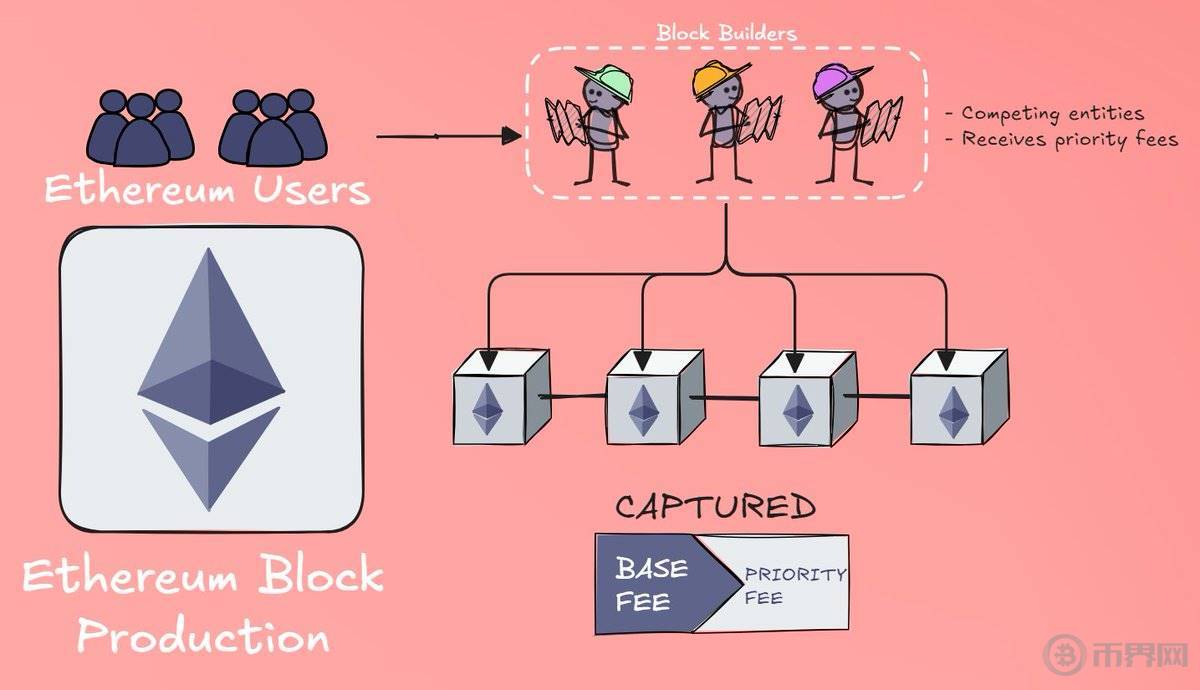
Now, let's explain the process in detail:
- Ethereum users submit their transactions to block builders.
- These transactions indicate the maximum fees that users are willing to pay, which will be used for payment; Base fee (destroyed), the remaining portion is treated as a priority fee/tip (retained by the builder).
- Then, the builders hand over these blocks to validators for inclusion in the Ethereum main chain.
Ultimately, all fees paid by the user will either be deducted or$ ETH Asset capture (through destruction) can either be obtained by participants (such as builders) in the Ethereum blockchain supply chain.
The former mechanism is seen as a neutral alternative to direct public goods funding, while the latter mechanism provides incentives for key parts of the Ethereum block construction process. Both are usually considered to have a positive impact on the value of the entire network.
Now, let's take a look at a typical L2.
Traditional Rollup Block
Taking Optimism as an example, we can maintain a structure similar to Ethereum by replacing the builder (a collection of competing entities) with a sorter (a single machine operated by the team behind Optimism).
Visualization:
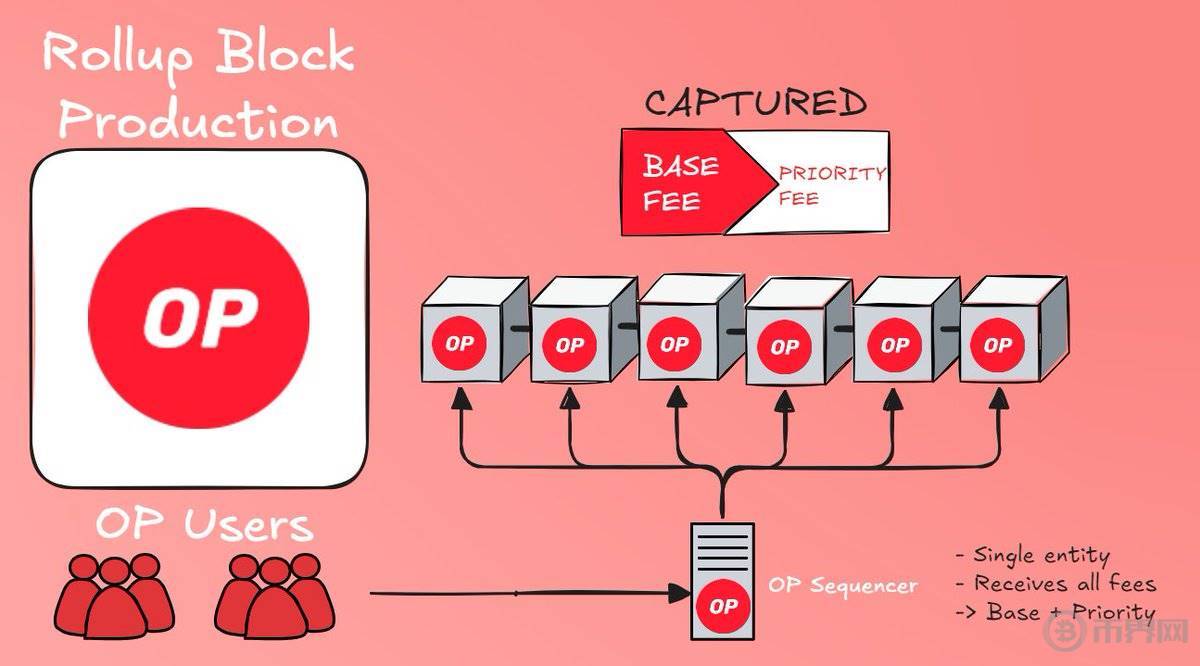
Looking at the process again, you will find that they are very similar:
- Optimism users submit transactions to; OP Sorter.
- Similar to Ethereum, these transactions indicate the maximum fees for users, covering; Base fee (OP Stack chain will destroy this part of the fee, but not all L2 will do so, such as Arbitrarum), and the remaining fee difference will be treated as a priority fee/tip (retained by the team running the sorter).
- The sorter then sorts the transactions, proposes to include the next block in the canonical chain, and updates the L2 state/world view to the main network Ethereum.
It should be noted that the relationships of end-users and the 100% fees they pay belong to the sequential entities (i.e., they remain in the L2 ecosystem). Whether this entity is Optimism, Base, Arbitrarum, or Blast, it is entirely up to them to decide how to use these fees.
- Some entities will destroy the base fee and retain the priority fee (Base).
- Some will allocate these two fees to token holders (Arbitrarum).
- Some will also return a portion of the funds to the developers on the chain (Blast).
But BREAD, if L2 captures all these fees, how will Ethereum benefit?
So, let's discuss how these two block building processes are interconnected.
Traditional Rollup+Ethereum Block
As usual, the first step is to visualize:
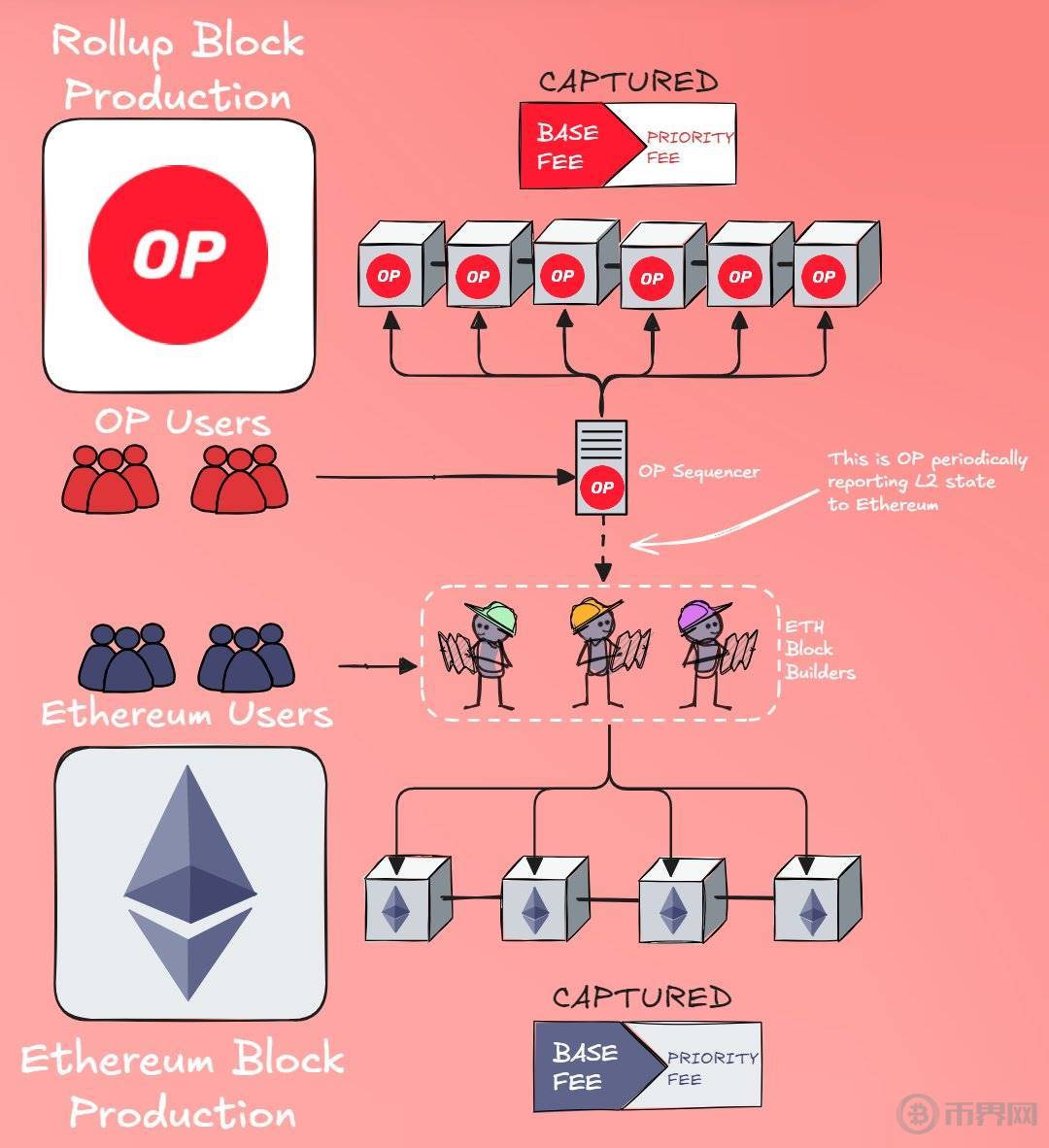
As you can see, in order to connect these two independent block building processes together, not much content was added (just a line).
This line indicates that L2 sorters regularly publish data to the Ethereum mainnet so that L2 can provide some security guarantees for users (such as mandatory inclusion).
It should be noted that Ethereum cannot control when any specific L2 releases transactions, which means that the frequency and efficiency of releases are entirely in the hands of the submitter.
Overall, this is quite advantageous for traditional L2 as they can not only capture all costs generated within the ecosystem, but also control the maximum expenditure (published to the mainnet), which is entirely voluntary.
Midnight break, let's take a look back
We have laid the foundation for the following content. Here are the most important points in traditional concepts so that we can focus on the uniqueness of Based:
- Ethereum blocks are constructed by competing, unrelated parties
- The traditional rollup block is constructed by a sorter operated by the rollup team
- Each block construction process captures 100% of the cost within its ecosystem, and Ethereum is connected to L2 through a voluntary L2 release frequency
Now, let's delve deeper into Base ™️。
Based Rollup+Ethereum Blocks
The reason why we don't need to start with graphics containing Based only content is because the construction of Bases is relatively simple (which is precisely their elegance).
They raised a question: 'Why don't we just use Ethereum as the sorter?' So, they achieved this by utilizing the builders we mentioned in the Ethereum block building section.
Use @ taikoxyz Visualize:
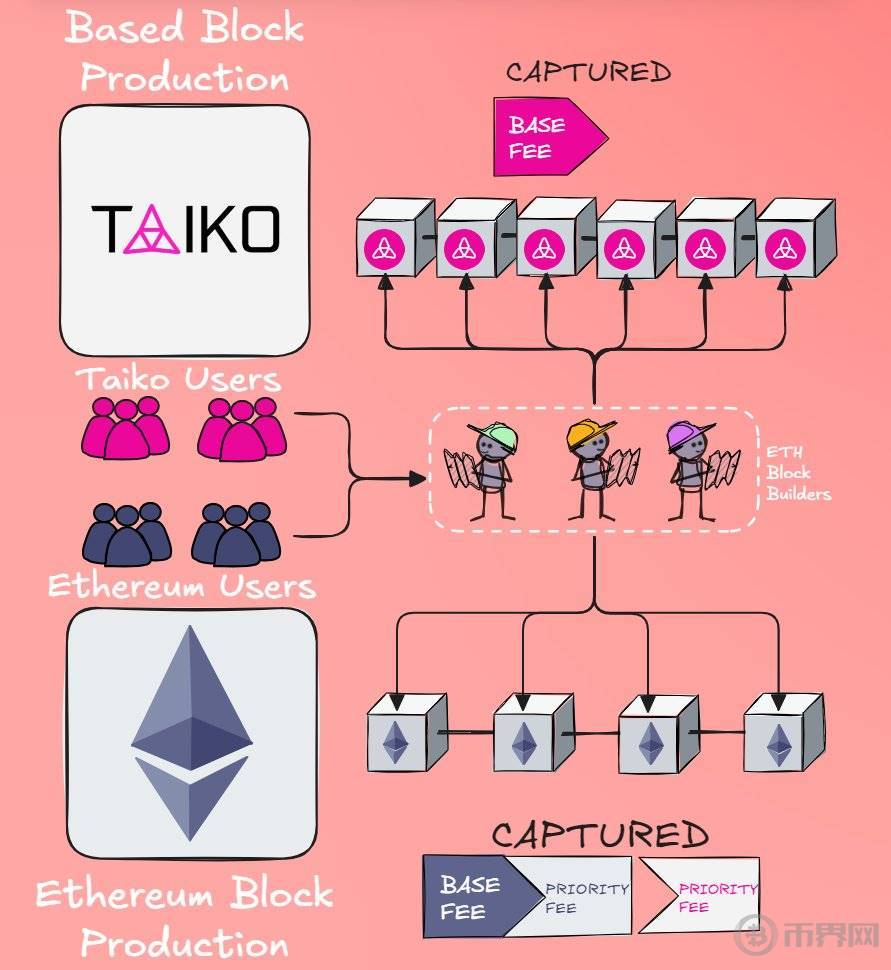
You may ask, how does this process work? In fact, the process is not much different from traditional rollup, but there are some subtle differences in user experience.
The process is as follows:
- Users send transactions to L1 builders who choose to build blocks for Ethereum and Based L2.
- Users specify the maximum fee they are willing to pay.
- L2 capture; Base Fee (determined by the congestion situation of L2), and pass on priority fees/tips to L1; The builder is responsible for sorting transactions.
In this paradigm, Ethereum not only captures 100% of the fees within its ecosystem, but also receives a portion of the L2 tip and settlement release costs.
As a reward, Based L2 inherits the following advantages:
- The activity of Ethereum (as long as Ethereum is processing blocks, Based L2 will continue to run); If a single sorter in traditional rollup fails, the chain may pause,
- The ability to atomically combine with L1 states (meaning that transactions on L2 can directly interact with L1's liquidity, such as exchanges on L2 utilizing L1's liquidity).
Of course, this close connection with Ethereum also brings some drawbacks, as the Based team needs to sacrifice some profitability (such as priority fees) and must also address challenges related to the Ethereum mechanism (such as its 12 second block time).
Although these issues can be alleviated through mechanisms such as pre confirmation, they still need to be carefully considered.
retrospect and prospect
So, can Based Rollups solve our L1<& What about the issue of L2 economic relations and becoming the future of Ethereum?
Perhaps I am skeptical about whether many teams would choose to use Based Rollups, as it directly affects their profitability. Fortunately, their advantages in L1 atomic level combinations are attracting developers, so we can at least see the development of related experiments.
In @ gwyneth_taiko And @ Spire_Labs Between them, an interesting research is underway called 'Next Generation Based Rollups'. They emphasize that L1 applications can run their own based application chain, capture priority fees, and maintain composability with L1 contracts. This is the direction I will closely monitor.
If the rollup ecosystem of Ethereum had been based from the beginning, I believe its narrative position today would have been better, but that is the arrangement of life.

No Comments