



















作者:Coin Gabbar
How the CLARITY Act and GENIUS Act Shape US Crypto in 2026
Did Washington just settle the CLARITY Act fight, or did social media move faster than the bill text? An X post framed the CLARITY Act as finished after banks and crypto companies allegedly reached a deal. But the public record points to a slower story: compromise language is still under review, Senate action is still pending, and bitcoin was hovering near $68,912 on April 7 as traders waited for proof, not celebration.
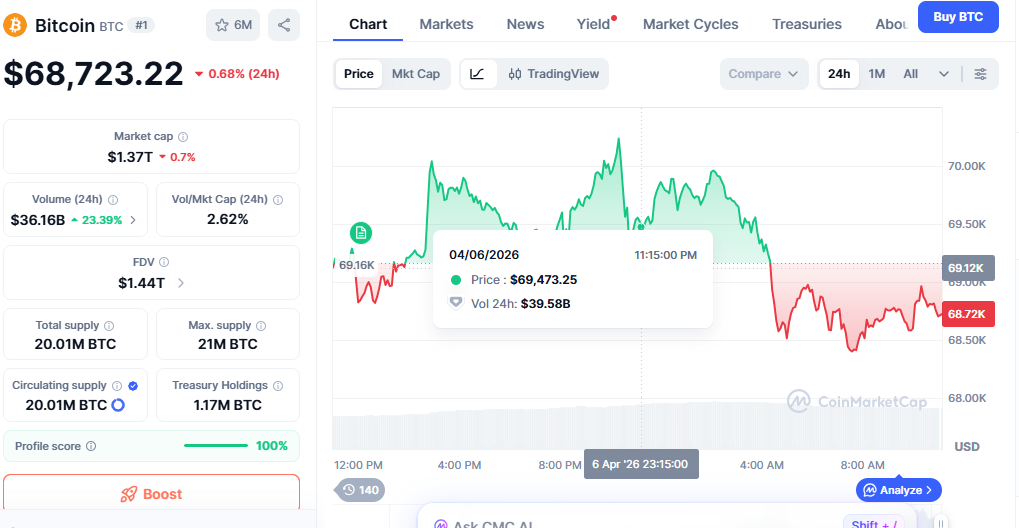 Source: CoinMarketCap BTC Price
CLARITY Act Deal Claim Hits a Verification Wall
The post drew attention because it promised a historic breakthrough and pointed readers to more details in late April. Yet the strongest public reporting so far does not show a finished Senate package. Talks had hit a new impasse after banks rejected a White House compromise on stablecoin rewards, and White House meeting between banks and crypto firms ended without an agreement. In early April, additional industry reporting said Coinbase chief legal officer Paul Grewal described the talks as very close, even while the revised text remained unpublished and expected release timing slipped further into April.
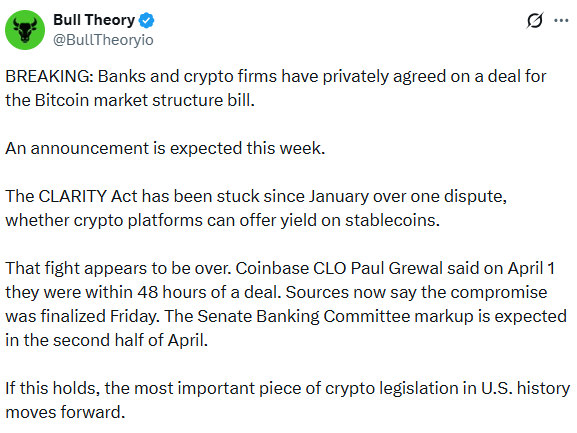 Source: X(formerly Twitter)
That distinction matters. On the available public record, the CLARITY Act is not yet a done deal. The House already passed its version in July 2025 by a 294-134 vote, and Senate Banking Committee Chair Tim Scott had announced a markup for January 15, 2026. Even so, the bill still depends on agreed language, committee timing, and floor space before it can become law. For readers trying to separate signal from noise, the verified takeaway is that the CLARITY Act is active, important, and closer to resolution than before, but not publicly complete.
CLARITY Act Standoff Keeps Banks and Crypto Split
The core fight is still the same one that stalled the bill earlier this year. Banks want tighter limits on yield-like rewards tied to stablecoins because they fear those products could pull money out of traditional deposits. White House compromise would allow rewards in some cases, such as peer-to-peer payments, but not on idle balances. Standard Chartered estimated stablecoins could pull about $500 billion in deposits from US banks by the end of 2028.
The wider policy backdrop shows why this fight is so important. Treasury said on April 1 that stablecoin issuers with no more than $10 billion in outstanding issuance may use state oversight only when that regime is substantially similar to the federal framework, and Treasury opened a 60-day comment period on that proposal. Federal Reserve Governor Michael Barr said on March 31 that the United States has a long and painful history of private money created without enough safeguards, adding that stablecoin success will depend heavily on how regulators implement the law. The FDIC then scheduled an April 7 board meeting to consider its own GENIUS Act's proposal. In plain terms, Washington is still writing the rules that would sit beside the CLARITY Act, not after it.
CLARITY Act Outlook Now Depends on Late April Text
This is why the late-April reference matters more than the headline itself. If lawmakers and stakeholders release compromise language, the market will finally be able to judge whether it truly settles the stablecoin rewards dispute or merely parks it for another round. That outcome also matters for firms already positioning for a more regulated US market. Coinbase said it received conditional OCC approval for a national trust charter, and full approval could strengthen its federally regulated custody business for institutions. Coinbase also stressed that it is not becoming a commercial bank and will not take retail deposits.
CLARITY Act Expert Analysis Before Late April Text
The X post captured the mood of an industry that badly wants certainty, but the verified story is more grounded. The CLARITY Act appears closer to a decision than it was a month ago, yet it is still not beyond dispute. In Washington, published text, committee action, and enforceable rules matter more than a victory post for markets right now.
Your Money Your Life Disclaimer: This article is for informational and journalistic purposes only. It is not financial, investment, legal, or tax advice. Readers should verify primary sources and assess their own risk before making financial decisions.





No Comments