













作者:货币探险家
The US will release its February CPI inflation data at 8:30 PM Beijing time on Wednesday. The market generally believes that February's inflation may be relatively mild, but this may not be significant for financial markets and the Federal Reserve.
According to a survey of economists, the CPI is expected to rise 2.4% year-on-year in February, unchanged from January. Excluding volatile food and energy prices, core CPI is likely to rise 2.5%, also unchanged from January. Month-on-month CPI and core CPI are expected to record 0.3% and 0.2%, respectively.
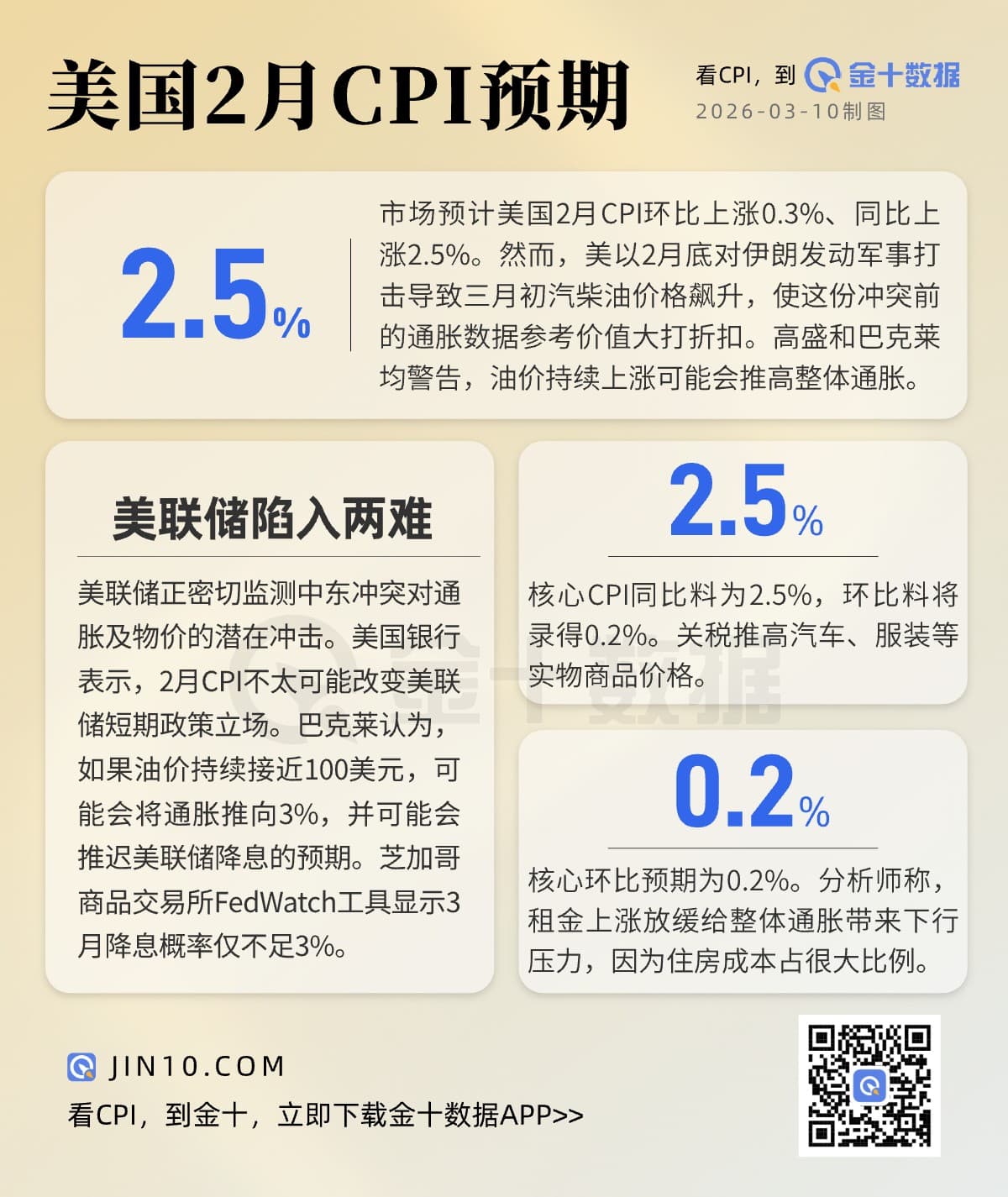
Under normal circumstances, an inflation report that meets expectations might reassure investors and Federal Reserve policymakers, indicating that inflation has not worsened, even if it has not yet cooled to the Fed's 2% annual target. However,The data will be less relevant in revealing inflation trends because the US-Israeli military strikes against Iran caused gasoline and diesel prices to surge in early March.
Nevertheless, this CPI report will still provide an overview of the inflationary landscape prior to the outbreak of conflict. Although inflation remains stubbornly above the Federal Reserve's 2% annual target, this steady inflation will suggest that, at least prior to the current Middle East conflict, inflation did not pose a significant threat to the economy.
Bank of America stated in its report thatThe US February CPI report is unlikely to change the Federal Reserve's short-term policy stance.The bank said the February CPI report should continue to show moderate growth in consumer prices, with overall CPI and core CPI expected to rise by 0.3% month-on-month.
"Given the surge in energy prices, the importance of Wednesday's U.S. February CPI report has diminished," wrote Sal Guatieri, senior economist at BMO Capital Markets.
Antonio Gabriel, a global economist at Bank of America Securities, said that compared to this week's CPI data,
"Perhaps more important is the evolving landscape of inflation risks, as the conflict in Iran has created upside risks to the inflation outlook through rising oil prices."
Middle East conflict brings the risk of stagflation
U.S. Democratic Senator Edward Markey has written to the acting director of the Bureau of Labor Statistics, requesting the agency to analyze and release a comprehensive report on the impact of the Middle East conflict on inflation over a period of six to twelve months.
Markey pointed out that after the US and Israel launched strikes against Iran at the end of February and Tehran retaliated, American households have faced rising prices for gasoline, supermarket goods, and utility bills, as oil prices once broke through $100 a barrel, with retail gasoline prices jumping nearly 17% to $3.48 a gallon.
The oil price shock exhibits typical characteristics of "stagflation": it both inhibits economic activity and increases the risk of recession, while also exacerbating inflation.The International Monetary Fund (IMF) estimates that a 10% rise in energy prices would reduce global growth from 3.2% to 3%.For the United States, if oil prices reach $125, GDP may contract by 0.8%, while inflation may exceed 4%.
Both Goldman Sachs and Barclays have warned thatContinued oil price increases could push up overall inflation.
Goldman Sachs estimates that a sustained 10% rise in oil prices could increase the CPI by approximately 0.28 percentage points. If oil prices rise by about $10 and remain high for three months, the US inflation rate could rise from 2.4% to about 3%.
Barclays believes that oil prices near $100 a barrel will push up overall inflation, primarily through gasoline prices. According to its baseline outlook, it projects overall U.S. inflation to be around 2.7% year-on-year, with core inflation at around 2.8%, assuming oil prices do not remain high for an extended period. If oil prices continue to approach $100 a barrel, it could push inflation towards 3% and potentially delay expectations of a Federal Reserve interest rate cut.
David Bassanese, chief economist at Beta Shared Fund, points out that the current situation is similar to the oil price shock triggered by the Middle East conflicts of the 1970s. If oil prices remain above $100, a "stagflation moment" may occur in the first half of the year.Growth is weak, but the central bank is helpless due to high inflation.
Is the Middle East conflict masking the real crisis? The Federal Reserve faces a dilemma.
Economists say two major forces are pushing consumer prices in opposite directions.
On the one hand, tariffs have driven up the prices of many physical goods, including cars and clothing. On the other hand, rent increases have been slowing for years and are likely to continue, which will put downward pressure on overall inflation, as housing costs account for a large proportion of inflation indicators such as the CPI.
Bill Adams, chief economist at Commailika Bank, wrote:"The February CPI report is likely to be modest, as stable housing costs offset the impact of tariffs. Grocery price inflation is likely to be modest in that month."
Federal Reserve officials have been closely monitoring inflation data to decide whether to continue cutting interest rates later this year. Lower interest rates would reduce borrowing costs and could help the job market, but many Fed policymakers are currently inclined to keep rates unchanged to prevent fueling inflation.
The Federal Reserve will hold its interest rate meeting on March 17-18 local time. The market widely expects interest rates to remain unchanged at 3.5%-3.75%, while the CME FedWatch tool shows the probability of a rate cut in March is less than 3%.
Currently, Federal Reserve policymakers are also closely monitoring the potential impact of the conflict with Iran on inflation and consumer prices.
New York Federal Reserve President John Williams stated that the impact of the conflict on the economy and inflation remains uncertain, but...Historical experience shows that oil price fluctuations have not fundamentally changed the economic trend, and further observation is needed.
He acknowledged that the conflict could, in the short term, contradictorily impact the Federal Reserve's dual mandate—boosting inflation and slowing global growth—but that the transmission effects through financial markets would be relatively mild. He said,If inflation falls as expected, interest rate cuts will eventually be reasonable.
Minneapolis Federal Reserve President Neel Kashkari stated that...Geopolitical events have dampened confidence in predictions of an interest rate cut this year.More data is needed to assess the duration of the impact.
Boston Federal Reserve President Susan Collins stated that there is no rush to adjust policy and that a patient and prudent approach will be adopted. She believes the inflation outlook remains uncertain and carries upside risks, and given the relatively stable labor market, policy rates should remain at their current slightly restrained level. She noted that...Hostilities in the Middle East have exacerbated economic uncertainty.