






















Author:Token Analyst
Recently, there have been many controversial voices in the industry regarding the development and current situation of Ethereum, with the focus of questioning mainly on the following aspects:
Doubt 1:The Ethereum Foundation's account frequently transfers ETH, and its financial planning is opaque, making it difficult to maintain its assets for future operational development.
Related events:
On August 24, 2024, the Ethereum Foundation deposited 35000 ETH into Kraken, and ETH's market value dropped by 13% in the following 6 days.
On September 5, 2024 at 16:10, according to the monitoring of @ ai_9684xtpa, the Ethereum Foundation transferred 100 ETH again. This address has accumulated 2616 ETH transferred on the chain in the past 8 months.
On September 6, 2024 at 14:07, according to Lookonchain's monitoring, the Ethereum Foundation transferred 1000 ETH to a multi signature address starting with 0xbC9a 15 minutes ago. Based on previous trading patterns, this multi signature wallet account may transfer ETH to a wallet address starting with 0xd779 and convert it into asset DAI.
Response and Discussion:
The Ethereum Foundation's Justin Drake event on the Raddit platform on September 5, 2024Personal opinion expressed at the 12th Open Q&A Event (hereinafter referred to as AMA)The financial report of the Ethereum Foundation will be released soon, estimating that the Ethereum Foundation will hold a total of about 10 years of capital reserves, which will experience significant changes due to fluctuations in Ethereum prices.
Based on the current market value of assets, the Ethereum Foundation spends approximately $100 million annually. The Ethereum wallet primarily used by the Ethereum Foundation currently holds assets worth approximately $650 million. At the same time, the Ethereum Foundation also has currency reserves that can cover operational needs for the next few years.
Ethereum founder Vitalik Buterin stated at the 12th AMA:Currently, the budget strategy of the Ethereum Foundation is to spend 15% of the remaining funds each year, which means that the Ethereum Foundation can continue to operate, but its influence in the ecosystem will decrease over time.
According to media reports,Aya Miyaguchi, Executive Director of the Ethereum Foundation, once posted on social media stating:The Ethereum Foundation has an annual budget of approximately $100 million, mainly consisting of grants and salaries, with some beneficiaries only able to receive payments in legal tender. Since 2024, due to complex regulatory reasons, the Ethereum Foundation has been advised not to engage in any financial activities and is currently unable to share plans in advance. The Ethereum Foundation's ETH transfer transactions are not sales.
Doubt 2:The Ethereum roadmap focuses too much on Layer 2 solutions (mainly referring to Rollups) and neglects the focus on the development and improvement of Layer 1 on the Ethereum mainnet,road mapNeed to be modified.
Response and Discussion:
Ethereum researcher Dankrad Feist expressed his personal opinion at the 12th AMA, stating:Many people believe that a roadmap centered around Rollups will weaken Ethereum's fee revenue and MEV, and ultimately Rollups may become a parasite. I don't think this is correct.
The highest value transactions will still occur on the Ethereum mainnet Layer 1, and Rollups will expand the entire ecosystem by providing users with a large amount of trading space.This relationship is symbiotic:Ethereum provides low-cost data availability for Rollups, while Rollups makes Ethereum Layer1 a natural hub for high-value transactions.
In the process of advancing the Ethereum roadmap centered around Rollup, I believe that expanding the execution capability of Layer 1 should also be a goal,It does not necessarily conflict with the roadmapThis is reflected in:
Data availability is almost infinitely scalable - the ultimate limitation of non scalability essentially comes from users' interest in participating in Ethereum, that is, how many people are willing to run the entire node seriously and record all data.
Execution capability is inevitably subject to objective limitations, but the ultimate bottleneck is single thread limitation. Currently, state access is a direct limitation for expanding the execution capability of Ethereum Layer1.
Through zkEVM and parallelization technology, the scalability of Ethereum Layer 1 can be increased by 10 to 1000 times. Rollups will provide the remaining scalability to meet Ethereum's demand for world-class scale.
The Ethereum Foundation's long-term sustainable plan is to utilize SNARK to expand the EVM execution capability of Layer 1 on the Ethereum mainnet. In addition to significantly improving the vertical scaling advantage brought by Layer 1 EVM Gas limitation, there is also an opportunity to use EVM in EVM precompilation for arbitrary horizontal scaling to validate EVM execution within the EVM at low cost.
This precompilation will allow developers to programmatically launch new Layer1 EVM instances, unlocking a boosted version of executing shards where the number of shards is infinite and a single shard is a programmable Rollup, also known as a 'native Rollup'.
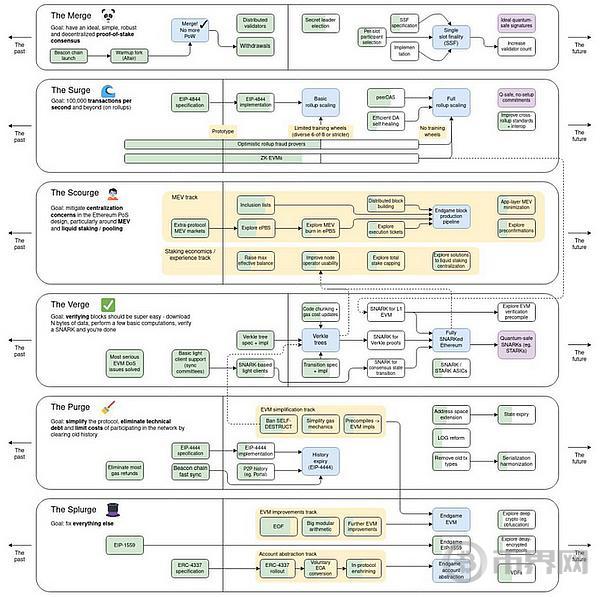
The Ethereum 2024 roadmap consists of the following six parts:
The Merge, The Surge, The Scourge, The Verge, The Purge, and The Splurger
Doubt Three:The ecosystem is developing well, but the market value of ETH has not increased significantly.
Response and Discussion:
Anders Elowsson of the Ethereum Foundation expressed his personal opinion at the 12th AMA, stating:In the long run, Ethereum's promotion of sustainable economic activity is directly linked to the appreciation of ETH's market value. If we design a sustainable economic activity system, we need to design the price growth of ETH. Conversely, when designing ETH appreciation, it is necessary to ensure that Ethereum promotes sustainable economic activity.
If we only focus on 'price growth' in the short term without considering its source, it may lead to a long-term decrease in value. I personally believe that the current roadmap is actually a 'price growth roadmap'. If Ethereum succeeds but ETH does not experience price growth, I would be surprised or even disappointed, but this could actually be an opportunity to buy ETH because the market will eventually realize the theory of price growth.
Justin Drake from the Ethereum Foundation stated at the 12th AMAI personally believe that the price growth of ETH can be attributed to liquidity and premium. The key indicator for liquidity is the total cost, not the cost per transaction. The key indicator for premium is the proportion of ETH used as collateral assets. In the future, Ethereum's success goal is to achieve 10 million transactions per second, even if the transaction fee is less than 1 cent, it can still generate billions of dollars in daily revenue.
Doubt 4:The cost of Optimal Rollups is actually cheaper than ZK Rollups, and theoretically ZK is a superior technology.
Response and Discussion:
George Kadianakis stated at the 12th AMA:The Ethereum Foundation is currently researching different zero knowledge (ZK) projects at multiple stages.
Justin Drake from the Ethereum Foundation stated at the 12th AMA:I am very excited about introducing SNARK into Layer1 EVM. In the past few months, we have made tremendous progress. According to the latest data from Uma (from Succinct), it has been proven that the cost of all Layer1 EVM blocks is approximately $1 million per year, and future optimizations will further reduce this cost.
It is expected that by 2025, the proof cost for all Layer1 EVM blocks may only be $100000 per year, thanks to the optimization of SNARK ASIC and various layers of the stack. The Ethereum Foundation is also accelerating the formal verification of zkEVM, a project led by Alex Hicks with a budget of $20 million.
For beacon chains, our recent benchmark tests have accelerated the timeline for hash based signatures and SNARKs aggregation. This is the key to achieving quantum security after the beacon chain.
Max Resnick, a researcher at the Ethereum Special Mechanism Group (SMG), stated in an interview with Bankless podcast:ZK is the only technology that can truly break through bandwidth limitations, which Optimal Rollups cannot achieve
What should we do next? I think we should start optimizing the features required for ZK Rollups.
If you want to continue on the route of Rollups, you need to immediately turn around and make the cost of verifying ZK proofs on the chain lower, rather than continuing to lower data costs, because data on the chain is almost free now.
Additionally, I believe that the fees on Ethereum Layer1 have reached a balanced level, but if you want to launch an application, the key considerations are:What will the cost become when the application achieves explosive growth?
If I were an application developer and developed a killer app that could achieve 100 times growth and bring in a large number of users, I wouldn't choose to publish it on Ethereum at this stage - because in the best case scenario, if I succeed, it would cause chain congestion and costs to become unusable. So, based on this consideration, the truly important development facing Ethereum now is not to maintain the current balance, but to think about how strong its scalability can be,Strong enough to attract top application developers who want to bring 100x user growth into the Ethereum ecosystem.

How should we view the challenges and doubts of Ethereum?
Tracing back to the original intention, firmly believing in the value development of Ethereum
Compared to the doubts about Ethereum in the market, Ethereum founder Vitalik Buterin remains firmly optimistic about the future of Ethereum and believes it is full of hope. At the ETHTAIPEI event in 2024, Ethereum founder Vitalik Buterin stated in a media group interview that:
I thinkThe next five years will be crucial for the development of Ethereum.Because prior to this,Many applications that are still in the theoretical stage or on a smaller scale will be preparing to enter the real world from now on. Many ideas generated in the field of blockchain have permeated into the wider world through many yet to be fully understood ways.
Non financial applications are expected to have a greater impact as well. The special benefit that decentralization brings to these projects is that almost everyone can write new clients, and when you have a new client, you can access and write the same content without having to build your network effects from scratch.
Meanwhile, IIt is expected that the identity space based on Ethereum will grow rapidlyTechnology is rapidly improving, and I really hope it can soon witness the introduction and use of more mainstream use cases. Many people are concerned about the issue of account identity, but currently when people want to solve it, the top priority is to have a centralized solution. I hope that the Ethereum space can create a truly decentralized identity alternative and make them easy to access and use.
In addition, Stable Coins may have a significant impact on the future, andEthereum can help Stable Coins become more open, decentralized, and not reliant on third parties with weak trust foundations. You can already see the efforts being made on projects like Base in Layer2
Looking ahead to the future, the market still needs to give Ethereum some time
1. Outlook for Pectra Upgrade
After the Dencun upgrade, Ethereum will undergo another major technological update in the first quarter of 2025- the Pectra upgrade. This upgrade will further simplify and improve the process of creating and maintaining on chain smart contracts, which means developers can develop more powerful applications more efficiently. For users, they can also experience faster transaction speeds, lower transaction costs, and more secure on chain use cases.
The Pectra upgrade has direct benefits for modular blockchain, abstract accounts, abstract account wallets, and other projects and users. In addition, there are technical improvement proposals in the Pectra upgrade that are beneficial for the ZK Prover network, which is also an effort to enhance ZK technology.
2. Outlook on PoS mechanism, ecological innovation, and strong community power
The question of whether the PoS consensus mechanism will lead to centralization risks is a concern for many blockchain users.
Ethereum founder Vitalik Buterin also stated in a media interview that the risk of centralization in the PoS consensus mechanism is currently the most significant challenge. The situations with high attention that may bring centralization risks include the growth of MEV review risks and pledge activities.
Compared to other influential industry figures in the blockchain world, Vitalik Buterin, the founder of Ethereum, and the core team of Ethereum have always been highly vigilant about various centralization situations on Ethereum, and have insisted on actively speaking out for the concept of decentralization. This is also the core strength of Ethereum that deserves a firm outlook.
In addition, although the innovation and growth of Ethereum's use cases seem to have entered a bottleneck period of development, in the world of blockchain, thanks to the continuous upgrading and technological improvement of Ethereum's infrastructure, the ecological power of Ethereum is still strong, and its most unique value lies in the strong community power - this is the necessary foundation for possible disruptive innovation and the firm support for Ethereum's future development to achieve steady progress.
4. Outlook on ZK Technology
In the field of enhancing the scalability of Ethereum in the Layer2 ecosystem, there is currently a certain consensus on the development and applicability of Optimal Rollups and ZK Rollups: in the short term, the development of Optimal Rollups with better compatibility will be faster than the development of the ecosystem based on ZK technology. But in the long run, ZK Rollups, which can ensure real-time transaction validity and provide privacy protection, will inevitably receive more positive development.
Privacy is the key point driving a new chapter in the future narrative of Ethereum. Ethereum founder Vitalik Buterin once stated in a blog post discussing the three technological transformations needed for Ethereum:If there is no technological shift towards excessive privacy, Ethereum may lose most of its users and may fail.
The privacy protection scenarios provided by ZK technology are its main application scenarios in the field of blockchain. As Vitalik Buterin emphasized at the annual Ethereum community conference, "ZK-SNARK will be as important as blockchain in the next 10 years.
With the maturity of technology, the narrative related to ZK technology will become more diverse and attractive in the next development of Ethereum.
5. Outlook for ETH
In his Q2 partner letter posted on social platform X on August 24, 2024, Confirmation founder Nick Tomaino expressed his strong optimism about the development trend of digital assetsThe market value of ETH may surpass BTC in the next 5 years.At present, the market value of BTC is about four times higher than that of Ethereum, and both will continue to grow, but ETH will eventually surpass BTC.
The value accumulation of ETH is crucial to the success of Ethereum, and this is still a relatively common consensus at present. As stated by members of the Ethereum Foundation at the 12th AMA, the value accumulation of ETH will be achieved through total fees and asset premiums, and the value growth of ETH will support the security and economic activities of the Ethereum ecosystem, thereby promoting Ethereum as a global financial platform.


No Comments